The Jakarta Post
Please Update your browser
Your browser is out of date, and may not be compatible with our website. A list of the most popular web browsers can be found below.
Just click on the icons to get to the download page.


Popular Reads
Top Results
No results found. Please check your search term and try again
Can't find what you're looking for?
View all search results
Popular Reads
Top Results
No results found. Please check your search term and try again
Can't find what you're looking for?
View all search resultsG20 must remain central to global economic governance
From the crisis-driven boardrooms of the Global North to a historic shift in Global South leadership, discover how the G20 is being fundamentally rewritten to steer a fractured world through a relentless modern polycrisis.
Change text size
Gift Premium Articles
to Anyone
Share the best of The Jakarta Post with friends, family, or colleagues. As a subscriber, you can gift 3 to 5 articles each month that anyone can read—no subscription needed!
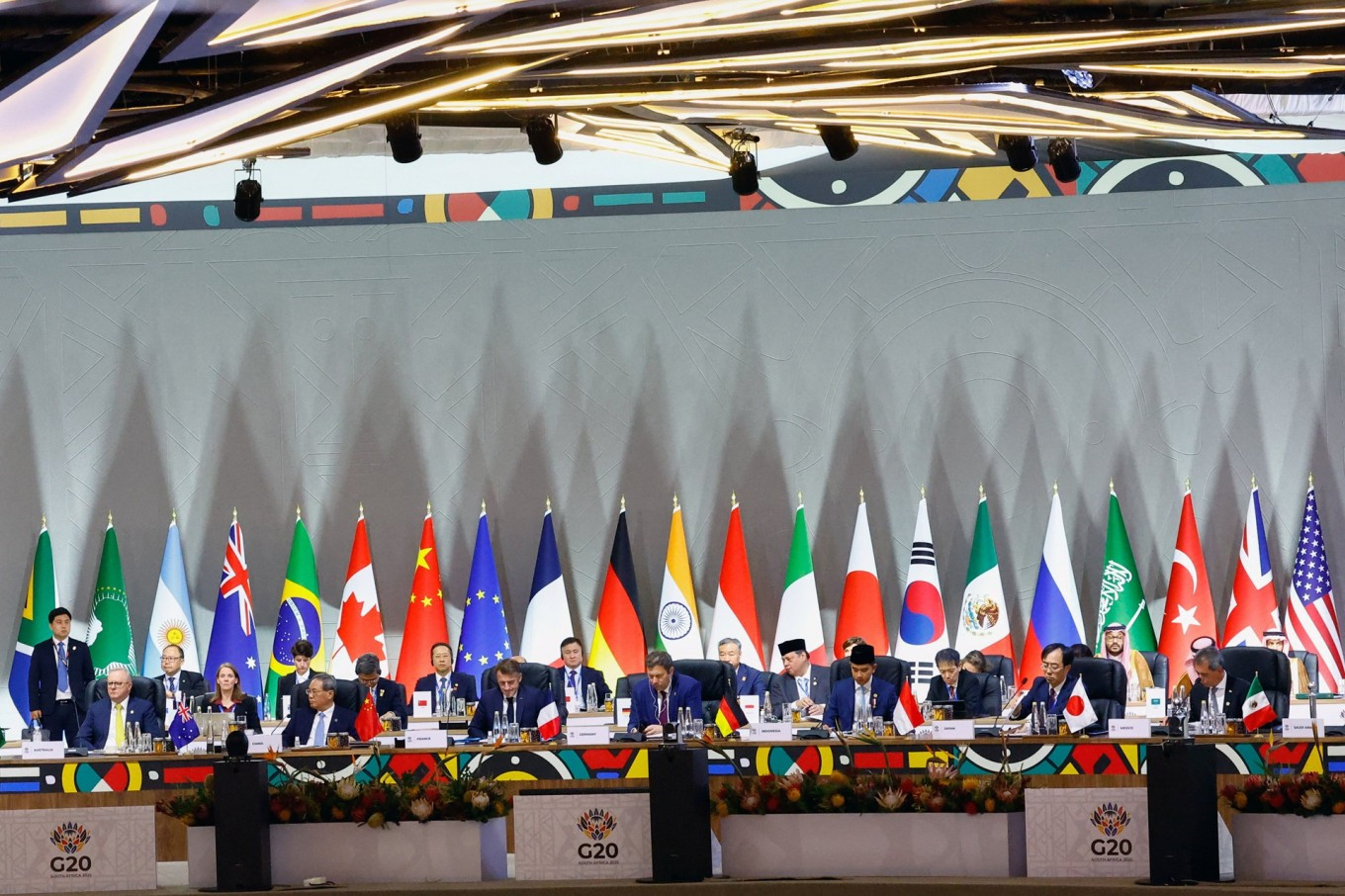 Leaders attend a plenary session on the opening day of the G20 leaders' summit on Nov. 22 at the Nasrec Expo Centre in Johannesburg, South Africa. (Reuters/Pool/Thomas Mukoya)
The global economic landscape has undergone a profound transformation since the 2008 global financial crisis exposed the limitations of the post-World War II economic architecture. Today’s interconnected challenges, ranging from climate-induced financial risks and debt distress to digital fragmentation and geopolitical tensions, require more adaptive and inclusive forms of global governance.
In this context, the Group of 20 (G20) has emerged as the premier forum for managing an increasingly complex "polycrisis".
Critics often point to the G20’s lack of a permanent secretariat and legally binding enforcement powers. Yet, the consecutive presidencies of Indonesia (2022), India (2023), Brazil (2024) and South Africa (2025) have fundamentally reshaped the forum’s strategic direction. By placing the priorities of the Global South at the center of the agenda, this sequence of emerging economy leadership has demonstrated that the G20 is not merely a crisis-management platform, but an essential steering mechanism for a more inclusive, resilient and multipolar global order.
For much of its history, from the 2008 financial crisis through the COVID-19 pandemic, the G20 was often perceived as a forum where advanced economies largely shaped the agenda while developing economies merely reacted to it. However, the recent sequence of presidencies has altered this dynamic by using the G20 as a platform to bridge the priorities of developed and developing nations.
Amid the lingering effects of the COVID-19 pandemic and the geopolitical disruptions arising from the war in Ukraine, Indonesia successfully steered the G20 toward practical cooperation through initiatives such as the Pandemic Fund and the Just Energy Transition Partnership (JETP). Indonesia demonstrated that the G20 could remain functional despite intensifying geopolitical fragmentation while simultaneously advancing cooperation on global health architecture, energy transition and digital transformation.
India’s presidency marked a milestone in global representation. By securing permanent membership for the African Union (AU), India addressed a longstanding imbalance in global governance and ensured that African voices gained formal representation at the world’s premier economic forum. India also promoted Digital Public Infrastructure (DPI) as a scalable framework for financial inclusion, public service delivery and digital governance across developing economies.

Building on this momentum, Brazil shifted attention toward global governance reform and the fight against hunger and inequality. Through initiatives such as the Global Alliance against Hunger and Poverty, Brazil highlighted the link between social inclusion and macroeconomic stability, arguing that sustainable growth cannot be achieved without addressing structural inequalities.