TheJakartaPost
Please Update your browser
Your browser is out of date, and may not be compatible with our website. A list of the most popular web browsers can be found below.
Just click on the icons to get to the download page.


Popular Reads
Top Results
No results found. Please check your search term and try again
Can't find what you're looking for?
View all search results
Popular Reads
Top Results
No results found. Please check your search term and try again
Can't find what you're looking for?
View all search results2026: Perfect start for routine eye health screening among Indonesia's children
Globally, two out of three people who need glasses do not have them, especially in low-income countries.
Change text size
Gift Premium Articles
to Anyone
Share the best of The Jakarta Post with friends, family, or colleagues. As a subscriber, you can gift 3 to 5 articles each month that anyone can read—no subscription needed!
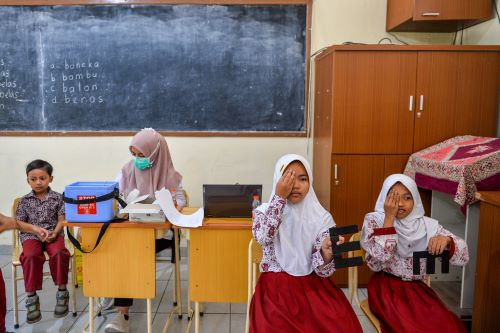 Pupils of Pardomuan state elementary school in Bandung, West Java, take an eye test on Aug. 14, 2024 during the government-sponsored School Immunization Month. (Antara/Raisan Al Farisi)
S
ight problems are a major health burden on Indonesian children, but early detection of children’s visual impairment remains suboptimal. Poor habits, especially the rampant use of gadgets from an early age, have been cited as key factors responsible for the increase in eye disorders among children.
In numerous instances, eye damage has already occurred by the time children enter elementary school.
The 2025 Free Health Checkup for Schools (CKG Sekolah) report released in January shows that 1.1 million (6.35 percent of the 17.51 million children aged 7-17 screened) had vision problems. Many of them likely had undiagnosed vision issues for years due to the absence of routine screenings, which eventually delayed early intervention that could have been as simple as a pair of glasses or timely treatment. Untreated eye problems generally deteriorate over time.
Globally, two out of three people who need glasses do not have them, especially in low-income countries, the World Health Organization (WHO) reports.
In Indonesia, about 10 percent of schoolchildren aged 5–19 years struggle with vision problems, which can often be corrected with a pair of glasses. About 3.6 million children in the country still have uncorrected refractive disorders, a condition the Health Ministry says can potentially hamper children’s development and quality of life.
Currently, only one in four children with refractive disorders can access eyeglasses, says the Indonesian Ophthalmologist Association (Perdami).

Indonesia’s decision to join WHO SPECS 2030, a global initiative to eliminate vision problems that can be either prevented or corrected, is the country’s latest push to strengthen eye health services for children.