TheJakartaPost
Please Update your browser
Your browser is out of date, and may not be compatible with our website. A list of the most popular web browsers can be found below.
Just click on the icons to get to the download page.


Popular Reads
Top Results
No results found. Please check your search term and try again
Can't find what you're looking for?
View all search results
Popular Reads
Top Results
No results found. Please check your search term and try again
Can't find what you're looking for?
View all search resultsAnalysis: The slow collapse of Indonesia’s steel industry
Change text size
Gift Premium Articles
to Anyone
Share the best of The Jakarta Post with friends, family, or colleagues. As a subscriber, you can gift 3 to 5 articles each month that anyone can read—no subscription needed!
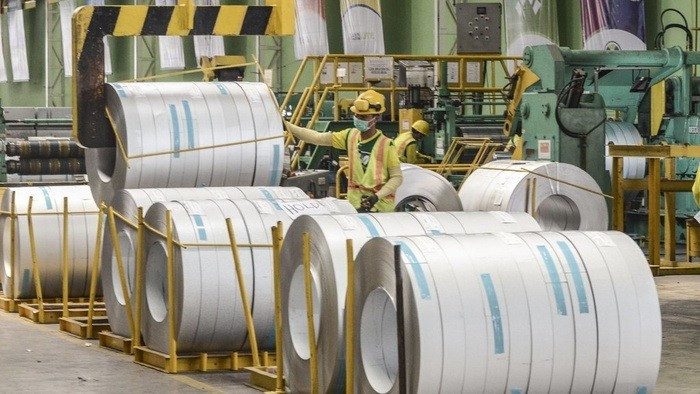 Quality control: A worker at a steel factory in the Cikarang industrial estate in Bekasi, West Java, inspects the quality of product on Oct. 4, 2019. (Antara/Fakhri Hermansyah)
I
ndonesia’s steel industry is facing a deepening crisis as major producers buckle under a wave of cheap imports, particularly from China, amid oversupply and weakening domestic demand. The collapse of Metal Steel Group in 2025 and the planned closure of PT Krakatau Osaka Steel in 2026 have sharpened concerns over the sector’s survival, prompting the government to mandate the Indonesian National Standard (SNI) for steel products starting May 20, 2026.
While producers see the move as a long-awaited lifeline, importers warn it could disrupt supply chains and add fresh uncertainty to the market. Industry players have also warned that the new regulation risks triggering production stoppages, layoffs and opportunities for corruption.
The regulation came in the form of Industry Ministerial Regulations Nos. 23/ and 24/2026, which mandate that all steel products, both domestically produced and imported, comply with SNI standards for zinc-coated steel sheet (Bj LS) and aluminum-zinc-coated steel (Bj LAS). The policy is not entirely new, as SNI certification for these product categories has technically been required since 2008 and 2009, respectively. What has changed is enforcement.
The Industry Ministry has framed the regulations as a quality and safety measure, as well as an effort to level a playing field that domestic producers have long argued is tilted against them. Officials noted that businesses had been given ample notice, with the regulatory framework published as far back as November 2024, and that a one-year grace period had already been extended to ease the transition.
The deadline, however, has arrived amid significant unease on the other side of the debate. Importers and downstream industries warn that the policy rollout is technically unready, with certification bodies and testing laboratories still lacking the capacity to process the required volume of applications.
The Association of Indonesian Steel Light Industry (Persibri) formally requested a postponement, warning that importers had already begun holding back purchases in anticipation of the new rules, causing domestic steel coil prices to spike by roughly 20 percent and stocks to run dangerously thin. The National Importers Association (GINSI) raised a sharper concern: With thousands of brands and companies required to obtain SNI certification simultaneously, and the process reportedly costing tens of thousands of dollars per certificate, the regulation risks triggering production stoppages, layoffs and opportunities for corruption.

Despite the government’s SNI intervention, the challenges facing Indonesia’s steel industry run far deeper than import competition and regulatory uncertainty alone. Even before the surge of cheap imports intensified, domestic steel producers had already been struggling with rising production costs fueled by global energy price volatility. Escalating geopolitical tensions in the Middle East have pushed oil prices higher, driving up transportation and logistics costs throughout the supply chain and placing additional pressure on manufacturers.