The Jakarta Post
Please Update your browser
Your browser is out of date, and may not be compatible with our website. A list of the most popular web browsers can be found below.
Just click on the icons to get to the download page.


Popular Reads
Top Results
No results found. Please check your search term and try again
Can't find what you're looking for?
View all search results
Popular Reads
Top Results
No results found. Please check your search term and try again
Can't find what you're looking for?
View all search resultsCan the climate crisis unite Europe?
Dismissing environmental priorities as outdated misunderstands both the crisis they represent and their significance for Europe’s political union.
Change text size
Gift Premium Articles
to Anyone
Share the best of The Jakarta Post with friends, family, or colleagues. As a subscriber, you can gift 3 to 5 articles each month that anyone can read—no subscription needed!
 Set as preferred source
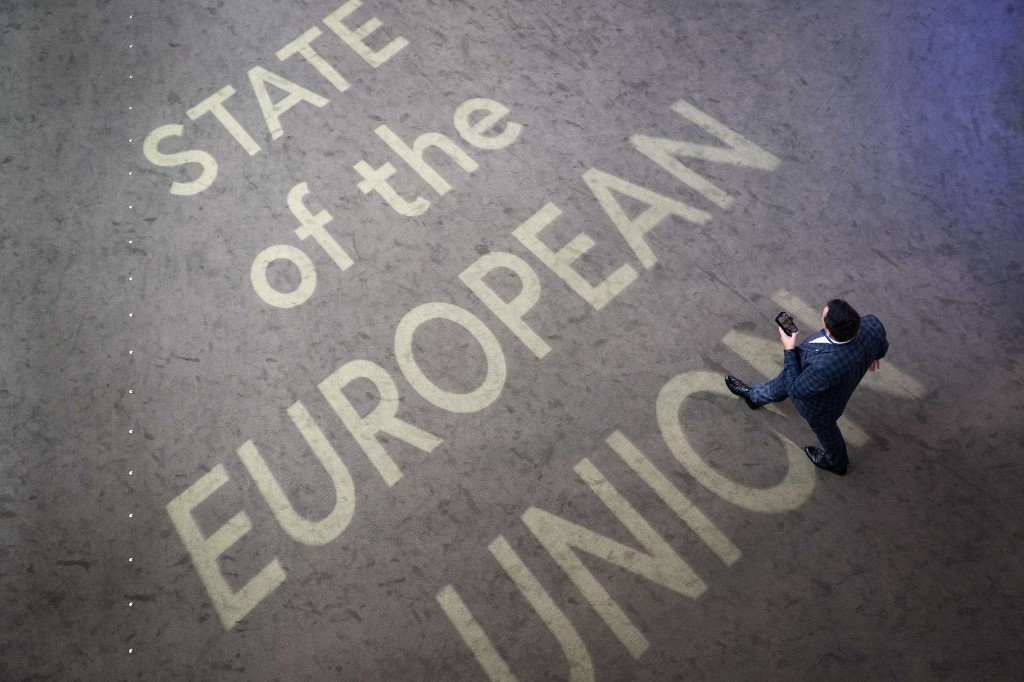 A man passes on a light sign reading “State of the European union“ of the day of the EU Commission President 's annual State of the Union address during a plenary session at the European Parliament in Strasbourg, eastern France, on Sept. 10, 2025. (AFP/Sebastien Bozon)
E
urope today faces an increasingly hostile geopolitical landscape, yet the European Union is struggling to unite its member states around a shared political project. Security, competitiveness, migration and democratic values have all been invoked as grounds for deeper integration. None has proved sufficient.
Meanwhile, the environment, once at the heart of Europe’s political project, has fallen by the wayside, a casualty of the rupture between the certainties of the past and an increasingly uncertain future. But dismissing environmental priorities like climate action as outdated misunderstands both the crisis they represent and their significance for Europe’s political union.
Consider the historical roots of European unification. Speaking at the Peace Congress of 1849, Victor Hugo gave voice to the aspirations of generations of European intellectuals who envisioned a federal republic that would bring peace and stability to the continent. “[A] day will come,” he declared, “when we shall see those two immense groups, the United States of America and the United States of Europe, stretching out their hands across the sea, exchanging their products, their arts, their works of genius, clearing up the globe, making deserts fruitful, ameliorating creation under the eyes of the Creator, and joining together to reap the well-being of all.”
But translating republican ideals into a continental political framework posed an immense territorial challenge. For centuries, republics were largely confined to city-states because broad participation across vast territories seemed impractical. The American Revolution changed that, proving that representative governments could draw dispersed communities into a single constitutional order to govern both people and the physical environment they inhabited.
In the early 20th century, thinkers like the Italian economist Luigi Einaudi saw federal republicanism as the only alternative to imperial domination and the fragility of the League of Nations. Support for federalism grew steadily during the interwar period, with Richard von Coudenhove-Kalergi’s 1923 book Pan-Europa and Philip Kerr’s 1935 essay “Pacifism Is Not Enough” both arguing that only a federalist system could deliver lasting peace.
A European federation nearly emerged in 1940, when Winston Churchill’s government proposed a full political union between the United Kingdom and France to contain Nazi Germany’s advance. The project collapsed after the French armistice, but its principal architect, Jean Monnet, would later become a prominent advocate of postwar integration, laying the groundwork for the Treaties of Rome, Maastricht and Lisbon.

Today, as conflicts strain the foundations of Europe’s postwar prosperity, reigniting a federalist spark, the escalating climate crisis may prove to be the key to deeper European integration.