The Jakarta Post
Please Update your browser
Your browser is out of date, and may not be compatible with our website. A list of the most popular web browsers can be found below.
Just click on the icons to get to the download page.


Popular Reads
Top Results
No results found. Please check your search term and try again
Can't find what you're looking for?
View all search results
Popular Reads
Top Results
No results found. Please check your search term and try again
Can't find what you're looking for?
View all search resultsAnalysis: Bank Indonesia faces a growing policy paradox
Change text size
Gift Premium Articles
to Anyone
Share the best of The Jakarta Post with friends, family, or colleagues. As a subscriber, you can gift 3 to 5 articles each month that anyone can read—no subscription needed!
 Set as preferred source
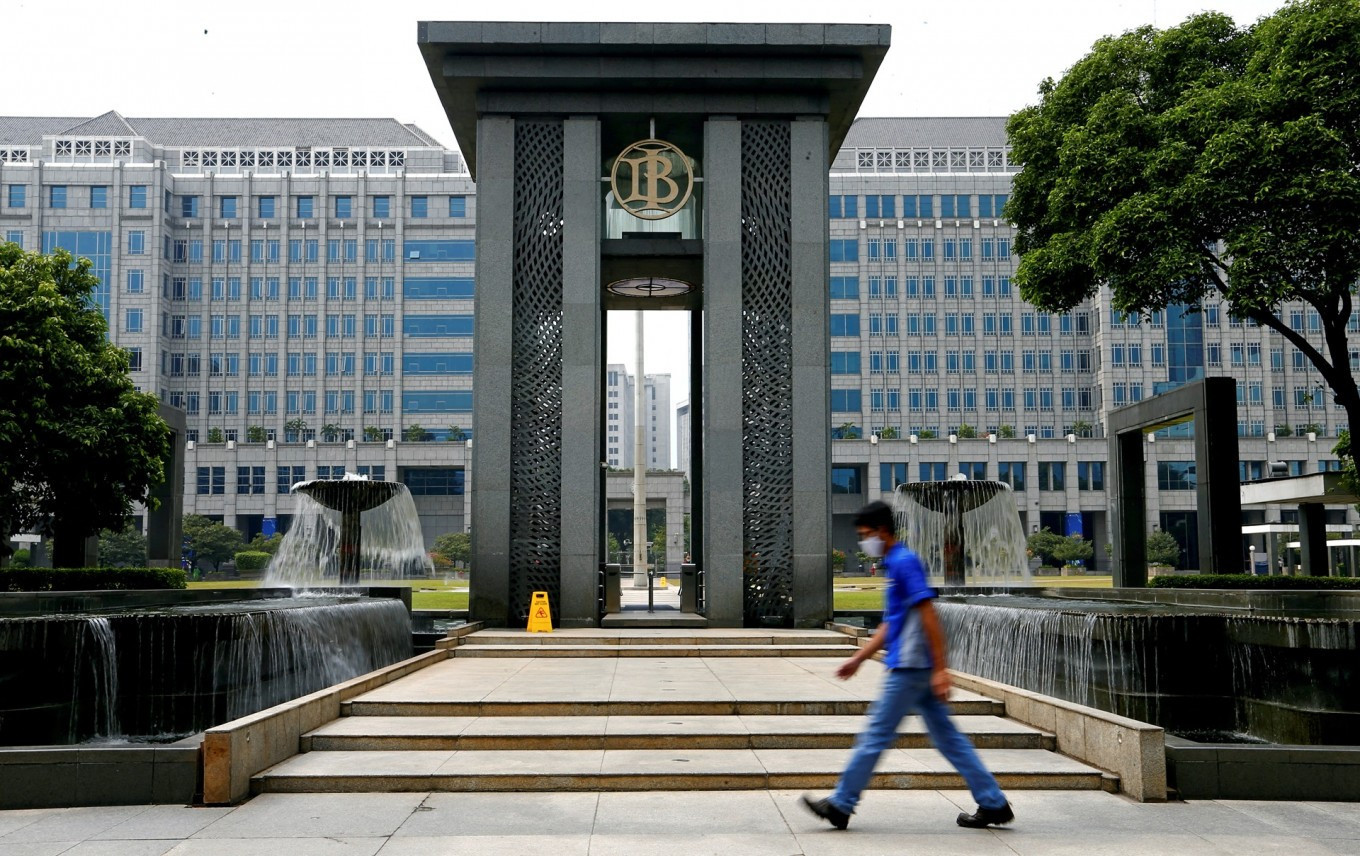 A man walks past the Bank Indonesia (BI) headquarters in Jakarta on Sept. 2, 2024. (Reuters/Ajeng Dinar Ulfiana)
B
ank Indonesia’s decision to raise its benchmark BI Rate by 50 basis points to 5.25 percent marks a clear shift from supporting growth to defending macroeconomic stability as the rupiah comes under pressure. But the move also exposes a deeper dilemma: The central bank must stabilize the currency while sustaining growth, even as expansive fiscal intervention weakens monetary policy effectiveness and raises questions over its independence.
Since September 2025, BI had maintained its benchmark rate at 4.75 percent to support economic expansion. At the time, the accommodative stance remained manageable because global capital flows were relatively stable. That situation has now changed dramatically. Rising geopolitical tensions in the Middle East have widened the United States’ fiscal deficit and pushed US Treasury yields higher, encouraging investors to move capital away from emerging markets toward safe-haven assets.
Indonesia has become increasingly vulnerable to this shift. Although the economy appears stable on the surface, growth has become heavily dependent on government spending rather than strong private-sector activity. This raises concerns over fiscal sustainability, especially as large-scale flagship programs continue to absorb state resources.
The pressure intensified after MSCI warned Indonesia over governance and liquidity concerns in its equity market. Since the beginning of the year, foreign investors have recorded equity outflows exceeding Rp 27.64 trillion. The resulting capital flight pushed the rupiah to around Rp 17,719 per US dollar on May 19, its weakest level since the 1998 Asian Financial Crisis.
Facing mounting pressure from the capital outflow, BI increased yields on its rupiah securities, known as SRBI, by 100 basis points to attract foreign inflows. These measures helped generate approximately Rp 105.16 trillion in capital inflows between January and May, partially offsetting outflows from the equity market and weaker demand for government bonds.
However, the cost of stabilization is becoming increasingly visible. Indonesia’s foreign exchange reserves declined by around US$10 billion between December 2025 and April 2026, falling to $146.2 billion. Although reserves remain above international adequacy standards, continued intervention could erode this buffer if pressure on the rupiah persists.

At the same time, BI continues to maintain base money growth above 10 percent, an approach that appears inconsistent with its stabilization efforts. In practice, the central bank is being pressured to support the government’s flagship programs and broader growth agenda through accommodative liquidity policies. The government’s aggressive spending, however, creates inflationary pressure even as BI attempts to stabilize prices and defend the rupiah.