TheJakartaPost
Please Update your browser
Your browser is out of date, and may not be compatible with our website. A list of the most popular web browsers can be found below.
Just click on the icons to get to the download page.


Popular Reads
Top Results
No results found. Please check your search term and try again
Can't find what you're looking for?
View all search results
Popular Reads
Top Results
No results found. Please check your search term and try again
Can't find what you're looking for?
View all search resultsAnalysis: RI introduces fuel surcharge framework as airfare pressures intensify
Change text size
Gift Premium Articles
to Anyone
Share the best of The Jakarta Post with friends, family, or colleagues. As a subscriber, you can gift 3 to 5 articles each month that anyone can read—no subscription needed!
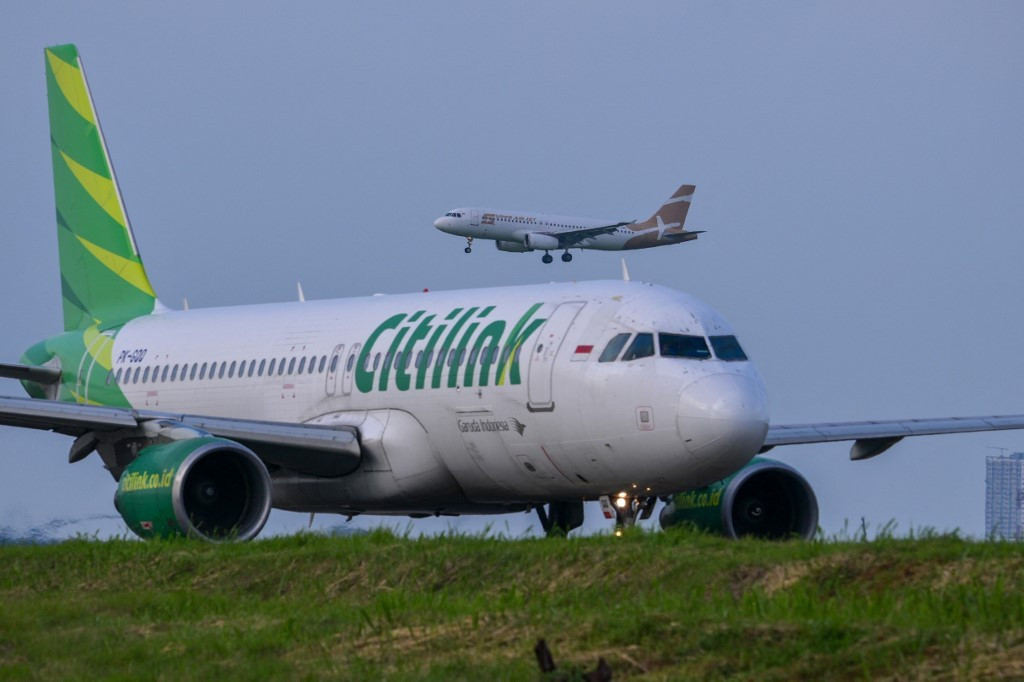 An Indonesian airline Citilink plane taxis as a Super Air Jet plane lands on Jan. 10, 2025, at Soekarno-Hatta international airport in Tangerang, Banten. (AFP/Bay Ismoyo)
T
he Indonesian government is introducing a new fuel surcharge mechanism that could significantly raise domestic commercial flight ticket prices, with surcharges allowed to reach as high as 100 percent of the applicable fare ceiling under certain fuel price conditions. The policy was introduced as global aviation turbine fuel (avtur) prices surged amid the Iran conflict, adding further pressure to domestic airfares that are already considered expensive due to longstanding structural problems in Indonesia’s aviation sector.
Through Transportation Ministerial Decree No. 1041/2026, the government introduced a new fuel surcharge framework intended to create a more flexible mechanism for adjusting airline ticket prices in response to fluctuations in avtur costs. The surcharge is calculated separately from the base airfare and adjusted according to government-designated avtur price brackets, with surcharge ceilings now ranging from 10 percent to as high as 100 percent of the applicable tariff ceiling, compared with a maximum of only 10 percent under the previous regulation, depending on prevailing fuel prices.
The amount of the fuel surcharge is determined based on the average avtur price set by aviation fuel providers, which reached Rp 29,116 (US$1.8) per liter during the latest evaluation period as of May 1. Based on that calculation, airlines have been permitted since May 13 to impose fuel surcharges on domestic economy-class tickets of up to 50 percent of the applicable fare ceiling. At the same time, the government is also considering raising the airfare ceiling itself.
The introduction of the mechanism comes at a time of heightened public sensitivity over airfare prices in Indonesia. Domestic flight tickets have experienced persistent inflation since the COVID-19 pandemic, but concerns intensified this year after prices surged during the March–April Idul Fitri travel season and failed to normalize afterward, remaining elevated through June.
One example can be seen on the Jakarta–Denpasar route, one of Indonesia’s busiest domestic flight corridors. At the end of March, a roundtrip economy-class ticket on Lion Air cost around Rp 1.88 million. After the regulation took place, prices for the same itinerary had climbed to between Rp 2.6 million and Rp 2.89 million, although this was still slightly below the roughly Rp 3 million peak recorded in April.
Even before the introduction of the new fuel surcharge mechanism, Indonesian airlines had increasingly developed a reputation for having some of the highest airfares in Asia. Garuda Indonesia in particular is frequently cited for maintaining some of the region’s highest ticket prices on a per-kilometer basis despite facing long-running financial difficulties. The airline has also remained closely tied to repeated government-backed rescue efforts, including debt restructuring programs, state capital injections, and various financing initiatives introduced to stabilize operations following years of mounting losses and the severe disruption caused by the COVID-19 pandemic.

Much of Indonesia’s airfare problem is rooted in deeper structural challenges within the aviation industry, particularly the difficulty of balancing competition, airline sustainability and affordable connectivity across an archipelagic country. Indonesia’s geography naturally creates exceptionally strong demand for air travel, making aviation an essential component of national mobility and economic integration rather than simply an alternative mode of transportation.