The Jakarta Post
Please Update your browser
Your browser is out of date, and may not be compatible with our website. A list of the most popular web browsers can be found below.
Just click on the icons to get to the download page.


Popular Reads
Top Results
No results found. Please check your search term and try again
Can't find what you're looking for?
View all search results
Popular Reads
Top Results
No results found. Please check your search term and try again
Can't find what you're looking for?
View all search resultsRemilitarization and its threat to labor welfare
Labor welfare has declined as remilitarization has increased.
Change text size
Gift Premium Articles
to Anyone
Share the best of The Jakarta Post with friends, family, or colleagues. As a subscriber, you can gift 3 to 5 articles each month that anyone can read—no subscription needed!
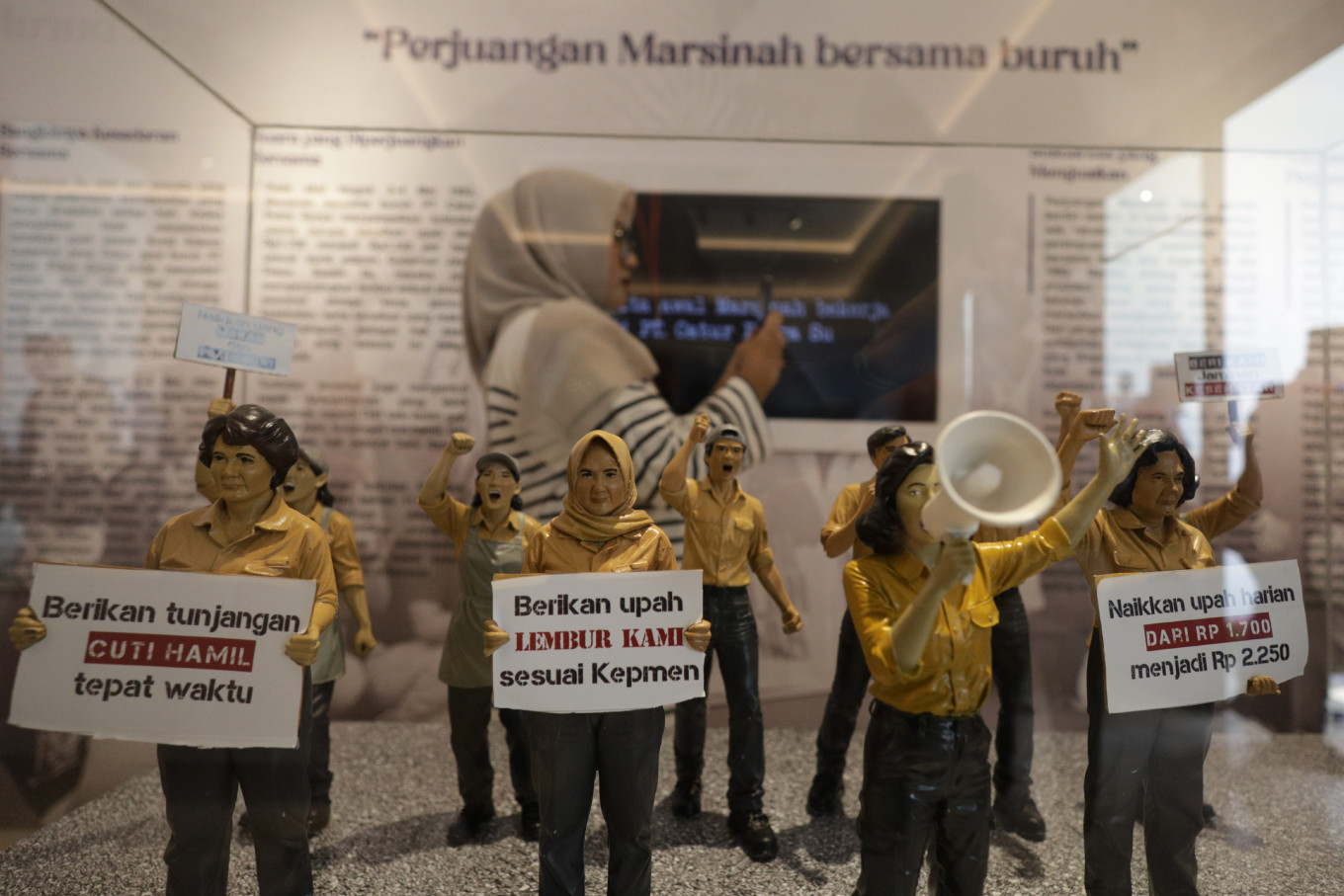 A visitor photographs a diorama with a mobile phone on May 16 at the Marsinah Museum in Nglundo village, Nganjuk, East Java. (Antara/Prasetia Fauzani)
T
he Indonesian labor movement has historically been repressed and shaped by militarism. Throughout the Old Order and New Order eras, economic expansion and national stability were the main reasons behind the repression of the labor movement and the depoliticization of civil society.
One of the first attempts to keep a tight rein on labor movements in Indonesia was the establishment of the Labor-Military Cooperation Board (BKS-BUMIL) in 1957. Military personnel began to dominate managerial positions in nationalized companies through BKS-BUMIL, which compelled the anti-strike regulation.
To keep the protests at bay, president Sukarno issued Presidential Decree No. 7/1963
that prohibited strikes and lockouts in vital companies, government departments and agencies
followed by Presidential Decree No. 123/1963. It took the government 27 years to revoke these haphazard regulations through Presidential Decree No. 27/1990.
The repression of the labor movement reached its peak in the New Order Era. The Central Bureau of the All-Indonesian Labor Union (SOBSI), the labor wing of the now-defunct Indonesian Communist Party (PKI), along with 62 other labor unions, were disbanded by the ruling regime via Decree No. 85/KOGAM/1966 signed by then-lieutenant general Soeharto.

Furthermore, the New Order regime forced all labor unions to join the sole umbrella organization All-Indonesian Workers’ Federation (FBSI), which later changed to All-Indonesian Workers Union (SPSI). In this era, the Labor Ministry also changed its name to the Manpower Ministry.