TheJakartaPost
Please Update your browser
Your browser is out of date, and may not be compatible with our website. A list of the most popular web browsers can be found below.
Just click on the icons to get to the download page.


Popular Reads
Top Results
No results found. Please check your search term and try again
Can't find what you're looking for?
View all search results
Popular Reads
Top Results
No results found. Please check your search term and try again
Can't find what you're looking for?
View all search resultsProper sanitation still out of reach for many
Two out of 10 Indonesian people live without safely managed sanitation, Statistics Indonesia (BPS) data shows.
Change text size
Gift Premium Articles
to Anyone
Share the best of The Jakarta Post with friends, family, or colleagues. As a subscriber, you can gift 3 to 5 articles each month that anyone can read—no subscription needed!
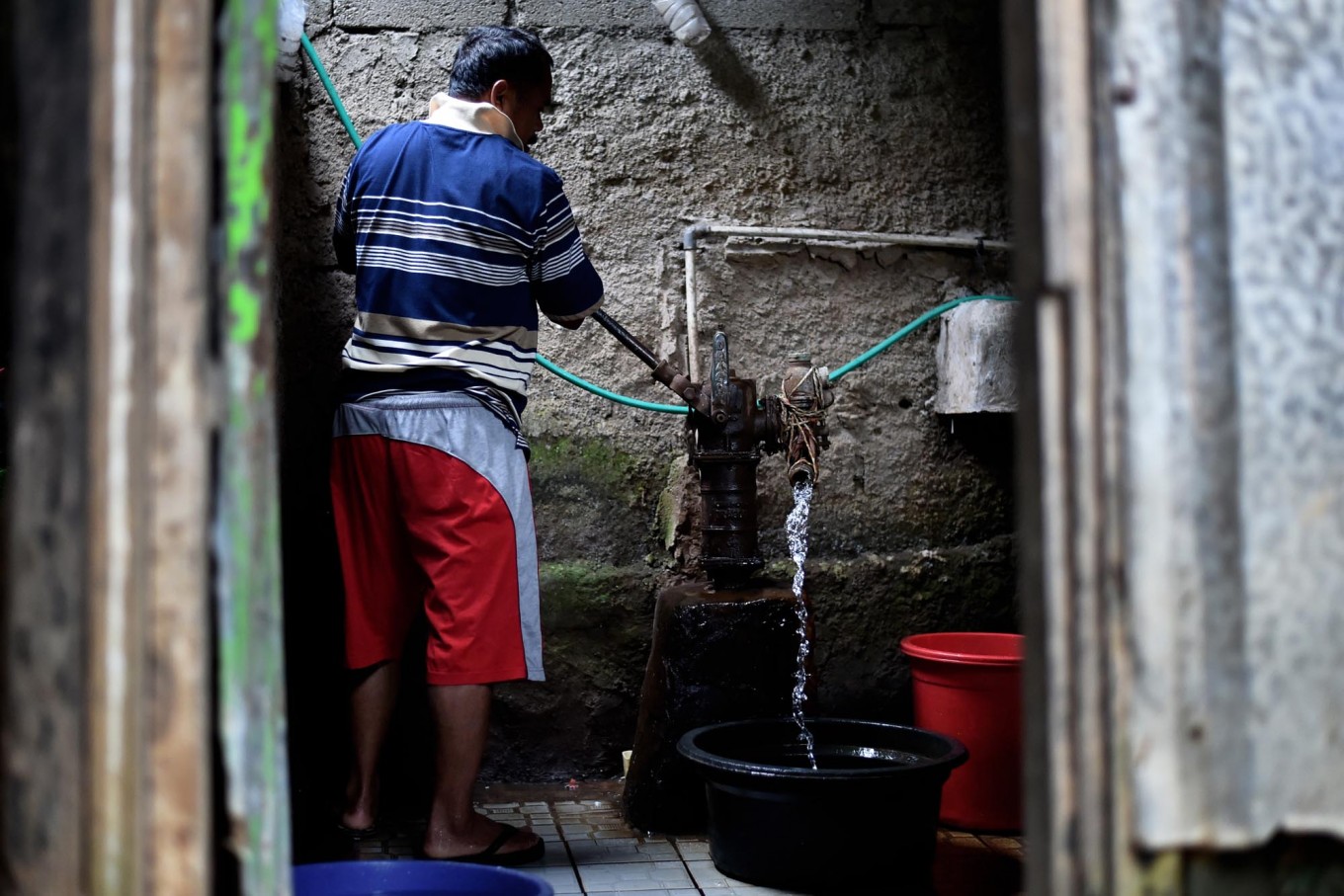
Most people may think that those living in urban areas can easily access toilets with running water. But data suggests otherwise.
Data from Statistics Indonesia (BPS) shows a lack of sanitation facilities in both urban and rural regions, with two out of 10 Indonesians nationwide living without access to safely managed sanitation or proper toilets.
On average, only 77.39 percent of the population has access to safely managed sanitation services in 2019, with 82.27 percent and 71.17 percent living in urban and rural areas, respectively.
The United Nations defines safely managed sanitation as the use of an improved sanitation facility that is not shared with other households and that excretion is safely disposed of on-site and transported and treated off-site.
But according to Health Ministry records, about 7.97 million households nationwide still practice open defecation and another 5.73 million share toilets.
Even in big cities like Jakarta, home to 11 million people, 134,257 households still defecate in the open, and about 179,497 families either depend on communal toilets or use their neighbors’.
In addition to a lack of basic sanitation facilities among Jakarta households, public toilets are scarce in the country's center of business and economy, where people often spend time on the street for work. Hence, the stench of urine may often greet Jakartans as people practice public urination.
The Jakarta Water Resources Agency is considering plans to build more public toilets (MCK) next year.
“We were focusing more on communal wastewater treatment plants last year, but we will probably start building MCKs again as they are considered highly necessary,” the agency’s raw water, drinking water and wastewater unit head, Nelson Simanjuntak, told The Jakarta Post on Tuesday.
Aside from building toilet infrastructure, Nelson emphasized that connecting the toilets to either on-site or off-site wastewater treatment plants would be another point of concern as Jakarta’s watersheds had been found to contain Eschericia coli (E. coli) bacteria. E. coli is one of the parameters of human waste, strongly indicating wastewater contamination from households.
“It is important to think about how we discharge the wastewater so it does not pollute our water sources,” he said.
Most residents in the capital also rely on basic sewage facilities such as septic tanks that are often poorly constructed and pollute groundwater, and only 17 percent of Jakarta households are served by proper sewer pipes, according to Nelson.
For the past two years, the agency has been focusing on developing communal wastewater treatment facilities that serve households in densely populated areas. The facility can treat wastewater discharged by up to 6,000 people on average per day, he said.
Last year, the city administration developed nine communal wastewater treatment plants. Jakarta aimed to develop more this year but the COVID-19 pandemic forced budget cuts and hampered the plan.
Nationwide, Indonesia looks to achieve 100 percent access to water supply and sanitation by 2030 as part of its Sustainable Development Goals (SDGs).
But the central government has been struggling to provide basic sanitation facilities even before the pandemic hit the country.
The long-awaited Jakarta Sewerage System (JSS), for example, was derailed by financial constraints. The national strategic project, worth at least Rp 70 trillion (US$5 billion), should have kicked off in 2017 but is currently still in the tender process for its first phase. In total, the project will cover the development of sewerage systems throughout the capital that is divided into 14 zones.
Public Works and Public Housing Ministry human settlements director general Danis Sumadilaga conceded that access to clean water and sanitation remained a problem nationwide.
“Actually, this sector has been our priority, especially as [adequate access to water supply and sanitation] is greatly required during the pandemic. In our directorate general, budget allocation for water supply and sanitation is the highest among other sectors,” he said but did not provide any supporting data.
The WHO says each dollar spent on water and sanitation investment will yield fourfold that value, a $4.3 return, due to reduced healthcare costs and better productivity. Therefore, it is important to accelerate universal access to water and sanitation, said water specialist Firdaus Ali from the University of Indonesia.
He suggested that the government allocate more funds and research to tapping into new funding sources and provide incentives to encourage the wider participation of families, nongovernmental organizations and the private sectors in their cause.
He cited tax reduction for institutions willing to fund water and sanitation projects as an example.
“[Accelerating the water supply and sanitation system] should be a collective action. Raising awareness on sanitation and hygiene for families who are still practicing [open defecation] is needed, too,” he said.