TheJakartaPost
Please Update your browser
Your browser is out of date, and may not be compatible with our website. A list of the most popular web browsers can be found below.
Just click on the icons to get to the download page.


Popular Reads
Top Results
No results found. Please check your search term and try again
Can't find what you're looking for?
View all search results
Popular Reads
Top Results
No results found. Please check your search term and try again
Can't find what you're looking for?
View all search resultsRI supports global push to combat illegal fishing
The global fisheries sector has become one of many to be affected by the COVID-19 pandemic, in addition to ongoing illegal, unregulated and unreported (IUU) fishing.
Change text size
Gift Premium Articles
to Anyone
Share the best of The Jakarta Post with friends, family, or colleagues. As a subscriber, you can gift 3 to 5 articles each month that anyone can read—no subscription needed!
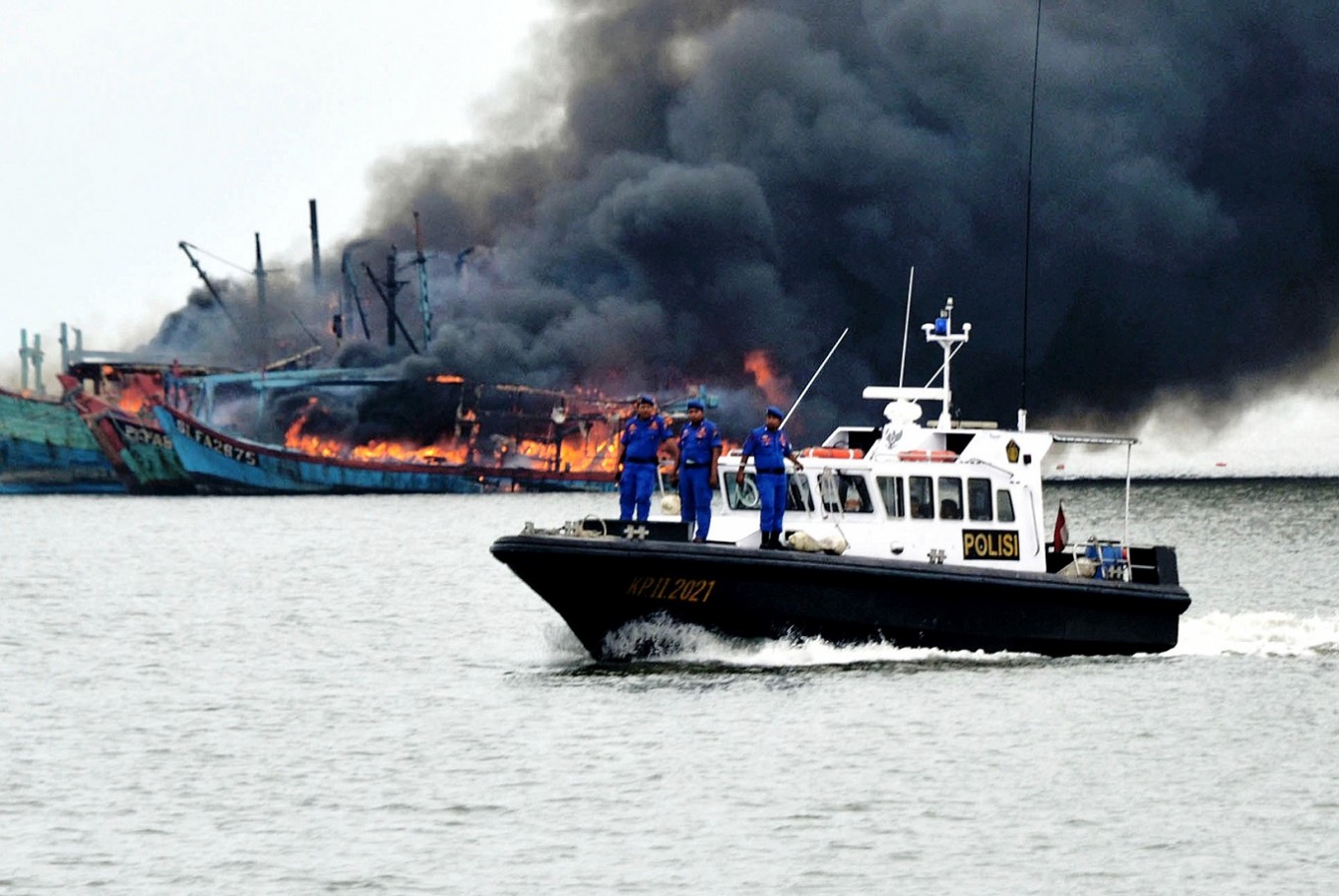
The global fisheries sector has become one of many to be affected by the COVID-19 pandemic, in addition to ongoing illegal, unregulated and unreported (IUU) fishing.
Officials and experts have called for a truly global effort to combat such transnational organized crimes.
IUU fishing practices account for 20 percent of the world’s commercial catches and even up to 50 percent in some areas, which in turn threatens the sustainability of global fisheries in national coastal waters and on the high seas.
As the largest archipelagic country in the world, Indonesia has placed the eradication of illegal fishing and related crimes high on the government’s list of priorities, but it requires the support and collaboration of all countries, said Febrian Ruddyard, the Foreign Ministry’s director general for multilateral cooperation, during a webinar last week.
According to the Food and Agriculture Organization (FAO), fish and fish products are among the most traded food products in the world, with 38 percent of fish/seafood entering international trade. At the same time, fishing and fish farming are important at the local level for the livelihoods of many fish-dependent communities, low-income countries and small island developing states.
Then-maritime affairs and fisheries minister Edhy Prabowo said in April that, based on an analysis by the ministry’s Control Center (Pusdal), there was a trend among operators of fishing boats from neighboring countries to take advantage of the looser surveillance during the pandemic by poaching in Indonesian waters.
Between October 2019 and Dec. 7 this year, the ministry has detained 99 ‘illegal’ fishing vessels, including 63 with foreign flags, according to recent ministry data.
“Fishing has become less profitable during the pandemic due to the restrictions on fishing, and many coastal countries have also reduced monitoring control and surveillance effort due to budget cuts,” Febrian said.
In recent years, various strategies have been devised and implemented to prevent and combat IUU fishing, including recommendations formulated in the Blue Papers under the framework of the High-Level Panel for the Sustainable Ocean Economy, the ministry official said on Tuesday.
Peter Thomson, the United Nations Secretary General’s Special Envoy for the Ocean, said that one way to go about achieving good and sustainable ocean governance was to follow through on various Sustainable Development Goals (SDGs), including Goal 14.6, which calls for an end to harmful fishery subsidies by the end of 2020.
“We're now in the last month of 2020. So, what are our chances? The answer lies in the hands of negotiators at the WTO [World Trade Organization] in Geneva, who have been diligently working to complete the task. We must now watch this space in the days ahead and whatever results emerge this month,” the UN envoy said at the webinar.
Thomson said the goals set out in the relevant SDGs were already considered low-hanging fruit and noted that “the absurd unsustainability of subsidizing industrial fleets to build further overcapacity even as fish stocks decline [was] something even a primary school student [could] comprehend.”
Another of the SDGs related to fish stocks is Goal 14.B, which calls for improved access of small-scale artisanal fishers to marine resources and markets; as well as the ambitious Goal 14.4, which called by 2020 to effectively regulate harvesting and end IUU fishing and destructive fishing practices as well as implement science-based management plans to restore fish stocks in the shortest time possible.
However, Thomson acknowledged that Goal 14.4 was always going to be ambitious given the call to end IUU fishing by the end of this year. He cited the latest FAO report showing that the world was overfishing at a rate of 34.2 percent of the total global commercial fishing stocks.
“As I've said before, it's a bit like saying we will end crime. Until some utopian future has arrived, that crime will be with us, but we can get it under control. We can reduce its negative effects,” he said.
Thomson said countries should promote the signing of the Agreement on Port State Measures (PSMA), which prevents IUU fishing vessels from using ports and landing their catches, essentially blocking their products from reaching national and international markets.
The PSM currently has 67 signatories, including the European Union, which, with its 27 members, brings the total count to 95 signatory countries.
“This is good progress, but we should keep the pressure on those islands and coastal countries that have yet to sign up,” he said.