TheJakartaPost
Please Update your browser
Your browser is out of date, and may not be compatible with our website. A list of the most popular web browsers can be found below.
Just click on the icons to get to the download page.


Popular Reads
Top Results
No results found. Please check your search term and try again
Can't find what you're looking for?
View all search results
Popular Reads
Top Results
No results found. Please check your search term and try again
Can't find what you're looking for?
View all search resultsExperts warn of New Order's shadow as Listyo made top cop
Change text size
Gift Premium Articles
to Anyone
Share the best of The Jakarta Post with friends, family, or colleagues. As a subscriber, you can gift 3 to 5 articles each month that anyone can read—no subscription needed!
P
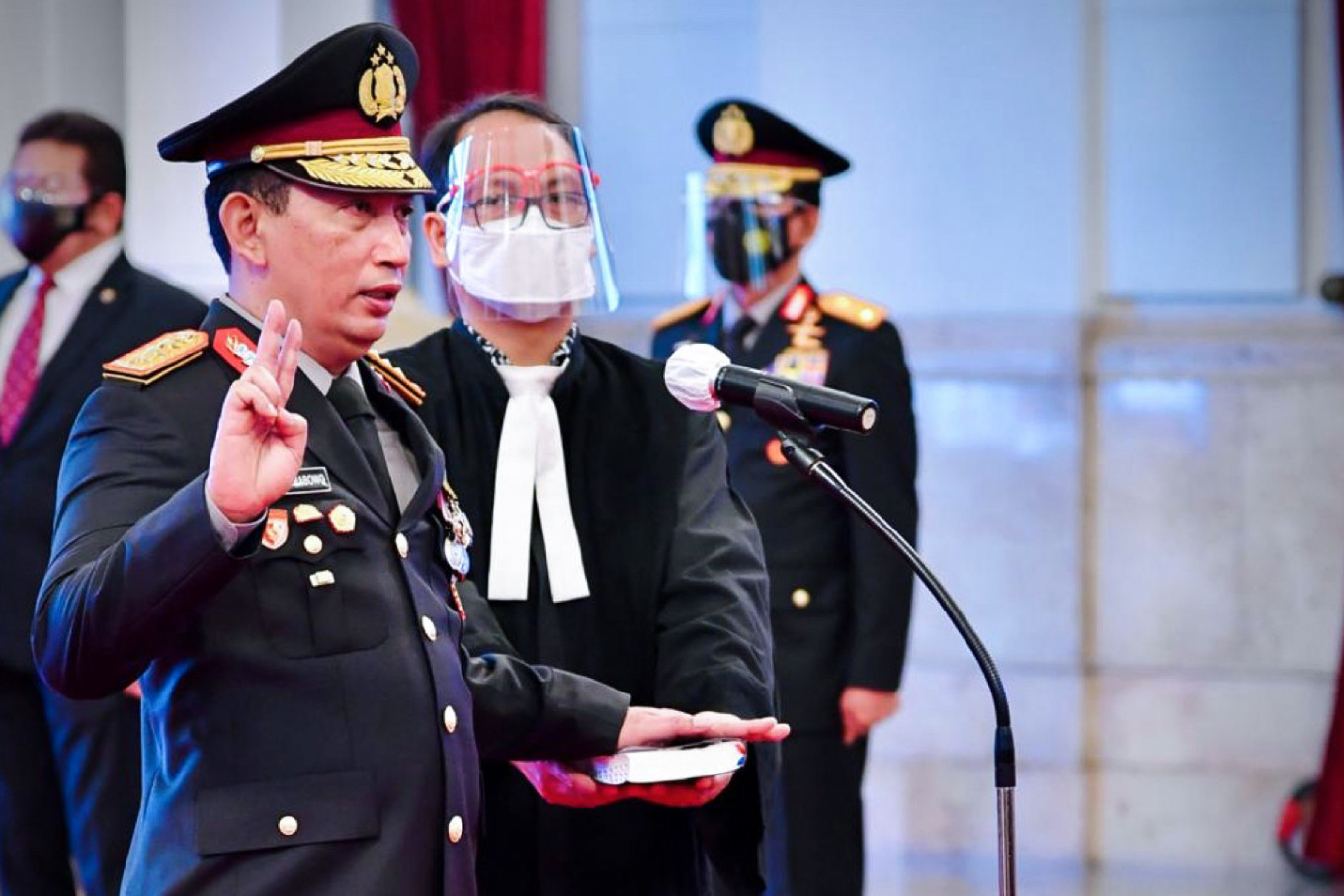
resident Joko “Jokowi” Widodo on Wednesday inaugurated National Police chief Gen. Listyo Sigit Prabowo, building on the two public figures’ relationship that dates back a decade to Jokowi’s term as Surakarta mayor.
The inauguration ceremony follows a unanimous vote at last week’s plenary session of the House of Representatives to approve Jokowi’s pick for the nation’s top police post. Listyo replaces outgoing Gen. Idham Azis, who is retiring.
Listyo has vowed to improve the public image of the National Police by taking a more “humane” approach to law enforcement.
“We are [focusing on] how to demonstrate the police’s firm but humane [approach] to the public, how to deliver good and transparent public service, as well as how we will enforce the laws justly,” said Listyo, speaking after his inauguration at the State Palace on Wednesday. “This will be our task in the future.”
He added that ensuring compliance with the COVID-19 health protocols in public spaces was among his immediate short-term priorities.
Listyo is the second police chief to come from a religious minority background after the late Widodo Budidarmo, who led the Indonesian police force from 1974 to 1978.
He served as the Surakarta Police chief for three years from 2011 under Jokowi, who was the city’s mayor. After winning the 2014 presidential election, Jokowi picked Listyo as his personal adjutant, a position he held until 2016, when he was assigned to helm the Banten Police.
Prior to his latest appointment as the country’s police chief, Listyo led the force’s Criminal Investigation Department (Bareskrim). The key role he played in the arrest of longtime corruption fugitive Djoko Tjandra was among the reasons he was tipped to become Idham’s successor.
Under his leadership, Bareskrim also arrested two primary suspects in the April 2017 acid attack on Corruption Eradication Commission (KPK) senior investigator Novel Baswedan to end a 2.5-year investigation. Activists criticized the circumstances surrounding the arrest, however, citing irregularities and pointing out the suddenness of the arrests amid increasing public pressures for the police to solve the case.
At his confirmation hearing on Jan. 21 with House Commission III overseeing legal affairs, Listyo revealed his visions for the police force, including controversial programs such as intensifying nationwide public surveillance and creating a new cyber police unit.
He also planned to revive the Pam Swakarsa civilian security force and authorize it to repurpose satpam (private security guards) and members of Satkamling community watch groups to undertake certain policing functions at the National Police’s discretion.
The plan has unearthed memories of a paramilitary group of the same name that broke up widespread student demonstrations at the end of the New Order regime.
Given the precedent, deputy chairman Bonar Tigor Naipospos of human rights watchdog Setara Institute called the plan “concerning”, pointing out that the police could mobilize such groups against protesters or in an agrarian conflict.
“There are concerns about the return of practices seen during the New Order era, when groups such as [Pam Swakarsa] were used as instruments to pressure the public that eventually led to [social conflict],” Bonar said.
A 2020 National Police regulation provides a legal basis for establishing the Pam Swakarsa. Under the regulation, members of the public can initiate a Satkamling program and register with the local police precinct, which can then authorize the community watch group to maintain public order, including through nonjudicial measures.
Bambang Rukminto of the Institute for Security and Strategic Studies (ISESS) said reviving the Pam Swakarsa would create future problems for the police, as it would be difficult for the police to monitor a civilian force and hold it accountable.
“What if the [civilian security] recruited by the police turn out to be the party that actually causes civil disorder? Not to mention, the public’s trust in the police is still low,” he said.
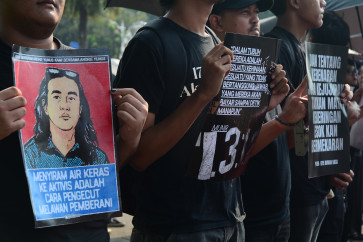
The police have been in the spotlight over alleged use of excessive force during last year’s nationwide protests against the Job Creation law. Data compiled by Amnesty International Indonesia reveal that at least 411 people in 15 provinces had been victims of police brutality during the series of protests, and 6,658 people in 21 provinces had been detained during and after the protests.
The police are also facing scrutiny following a report from the National Commission on Human Rights (Komnas HAM) on the fatal shooting last December that involved officers and members of the now-banned Islamic Defenders Front (FPI) in Karawang, West Java. In its report, the commission concludes that four out of six casualties in the incident, all FPI members, were unlawfully killed by police officers who could be held responsible for their deaths.
Bonar of Setara Institute has called on Listyo to improve internal oversight by both the National Police Commission (Kompolnas) and the internal affairs divisions (Propam) of individual police stations to avoid the occurrence of another ethics or administrative breach.
“Oversight by Kompolnas and Propam needs to be improved. Propam needs to be truly independent [in investigating police conduct] and not bowing to the police’s [higher-ups],” he said.