TheJakartaPost
Please Update your browser
Your browser is out of date, and may not be compatible with our website. A list of the most popular web browsers can be found below.
Just click on the icons to get to the download page.


Popular Reads
Top Results
No results found. Please check your search term and try again
Can't find what you're looking for?
View all search results
Popular Reads
Top Results
No results found. Please check your search term and try again
Can't find what you're looking for?
View all search resultsIndonesia nets more than 50,000 hectares of new mangrove forests
Change text size
Gift Premium Articles
to Anyone
Share the best of The Jakarta Post with friends, family, or colleagues. As a subscriber, you can gift 3 to 5 articles each month that anyone can read—no subscription needed!
I
ndonesia, home to about a fifth of the world’s mangrove forests, has gained more than 50,000 hectares of mangroves, according to the latest edition of its national mangrove map, as the government counts on the forestry sector, including mangroves, to contribute to its carbon-emission reduction goals.
The mangrove forests, which usually grow in intertidal areas in tropical and subtropical countries, play a vital role in providing a natural buffer against coastal erosion caused by the sea or winds.
The government utilized satellite imaging and on-the-ground verification in several sample sites to update the map, which revealed that the country’s mangrove forest area has grown from 3.31 million ha in 2019 to 3.36 million ha in 2021, netting an additional 52,873 ha.
The condition of the mangrove forests varies, however. About 3.1 million ha of mangroves are in good condition, which is defined as dense areas with over 70 percent of tree coverage, while 242,000 ha of mangrove zones have less than 70 percent tree coverage.
The Environment and Forestry Ministry's watershed control and protected forest management acting director general, Helmi Basalamah, said during the launch of the updated national map on Oct. 13 that the data indicated “positive progress” in the country’s conservation efforts.
Speaking in the same event, Coordinating Maritime Affairs and Investment Minister Luhut Pandjaitan said the updated map would be used as a reference for nationwide “rehabilitation, conservation and monitoring of mangroves”.
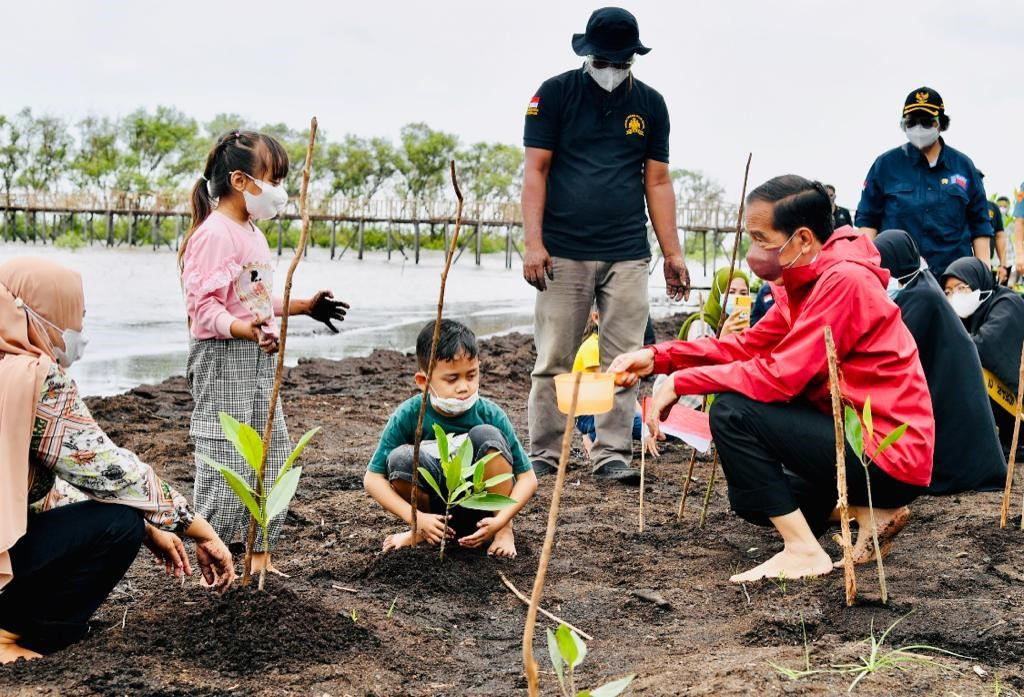
He also underlined the government’s “serious” commitment to restoring mangrove forests across the country as it aims to rehabilitate a total of 600,000 ha of mangrove forests by 2024.
“We are going to deliver our [target] in the next three years,” said Luhut.
He added that he was set to talk about Indonesia’s mangrove-restoration program in his upcoming meetings with United States presidential envoy on climate John Kerry as well as former US president Barrack Obama to emphasize that Indonesia had “walked the talk” in the effort to reduce carbon emissions under the Paris Agreement commitments.
To achieve its mangrove-restoration target, the government expanded in December 2020 the authority of the Peatland and Mangrove Restoration Agency (BRGM), which previously exclusively handled peatland-restoration efforts in the country, and extended the agency’s mandate to 2024.
Read also: Jokowi extends, broadens authority of peat restoration agency
BRGM head Hartono Prawiraatmadja told The Jakarta Post on Friday that natural growth of the mangrove forests had contributed to the net gain in the updated national mangrove map, adding that the additional mangrove areas were mainly found in areas near river mouths – the most suitable habitat for the plants.
Deputy Environment and Forestry Minister Alue Dohong previously said that the mangrove areas were expected to be one of the contributors toward Indonesia’s reduction of its carbon emissions as mangroves absorb more carbon from the atmosphere than they release, a feature known as a carbon sink.
“Mangroves are part of an important ecosystem in the carbon sink because good mangroves can sequester carbon dioxide in the trees themselves and in the land below them,” said Alue on Oct. 11. "It is our hope that mangroves can support us in reaching our nationally determined contributions [NDCs]."
Indonesia aims to reduce carbon emissions by 29 percent independently and 41 percent with international assistance in its NDCs submitted to the United Nations Framework Convention on Climate Change (UNFCCC) secretariat in 2016.
Read also: Indonesia aims to transform forest into carbon sink
In addition to the identification of Indonesia’s mangrove areas, the new mangrove map also provides an estimation of 756,000 ha of potential area, the majority of which is former fish or shrimp aquaculture sites, which could be converted into mangrove forests.
Hartono said the agency would conduct further studies to verify the potential sites as some of them are located near residential areas, plantations and seaports.
The global mangrove area was estimated at around 13.5 million ha in 2016, about 4 percent less than the 14.1 million ha in 1996, according to the Global Mangrove Alliance report titled “The State of the World’s Mangrove 2021”.
Technical officer of Wetlands International Indonesia Apri Susanto lauded the government’s initiative to provide an updated national mangrove map, which he said could be used to analyze future trends in mangrove cultivation.
Nonetheless, he called on the government not to solely focus on rehabilitating mangrove forests, but also to take into account local biodiversity in the areas to ensure the success of the rehabilitation program.
“A good rehabilitation strategy is not only aimed at recovering mangrove forest areas, but also being mindful of their biodiversity, ecological function and support,” Apri said. (mrc)