TheJakartaPost
Please Update your browser
Your browser is out of date, and may not be compatible with our website. A list of the most popular web browsers can be found below.
Just click on the icons to get to the download page.


Popular Reads
Top Results
No results found. Please check your search term and try again
Can't find what you're looking for?
View all search results
Popular Reads
Top Results
No results found. Please check your search term and try again
Can't find what you're looking for?
View all search resultsContinuity and discontinuity in Indonesian constitutionalism
Free and regular elections are a concrete means of enforcing constitutional power, people’s constitutional rights and policy correction mechanisms.
Change text size
Gift Premium Articles
to Anyone
Share the best of The Jakarta Post with friends, family, or colleagues. As a subscriber, you can gift 3 to 5 articles each month that anyone can read—no subscription needed!
S
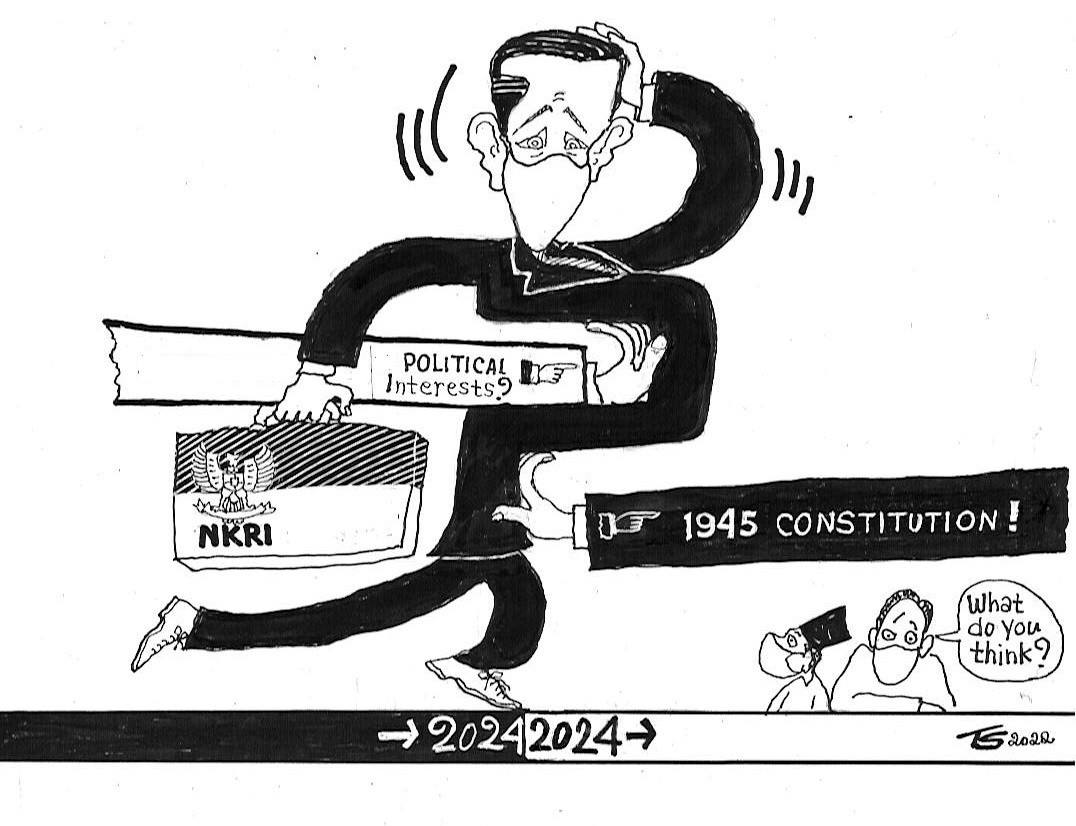
tories published by The Jakarta Post recently have highlighted the debate surrounding the proposed postponement of the 2024 elections and a potential fifth amendment to extend the presidential term limit.
The article “Nasdem, Dems align against election postponement” published on Thursday highlights the Nasdem Party's move to join forces with the Democratic Party in rejecting the election delay and any constitutional amendment to extend the presidential term.
Another Post article titled “Push for Jokowi’s term extension intensifies” published on Friday further outlines how President Joko “Jokowi” Widodo’s term extension proposal has developed at the grassroots level, as many regions are now seeing a proliferation of banners of support set up by volunteer groups.
The two articles have two main takeaways. Firstly, the opposition to the election delay will potentially expand because almost all political parties, both within and outside the ruling coalition, are now increasingly concerned about the developing constitutional issues. Secondly, the rapid development of the discourse surrounding the Jokowi term extension suggests that the issue is well orchestrated, targeting both elite and grassroots groups to ultimately form a public narrative.
In response, three counternarratives should be conveyed.
The first is in regard to the 1945 Constitution’s raison d'être. Conceptually, a constitution is a mechanism to frame and direct political behavior so that it aligns with basic structures put in place by the constitution’s makers. This basic structure is formed by popular sovereignty, the principle of the rule of law, constitutionalism, the protection of human rights and political rights, as well as a republican form of government.
Theories from French philosophers Montesquieu (1689-1755) and Benjamin Constant (1767-1830) specifically highlight the justification for the existence of a constitution. For Montesquieu, a constitution is a political framework to produce a legitimate authority to regulate society, regulate public institutions and control power itself. Meanwhile, for Constant, a constitution is more than just an instrument to protect society from the abuse of state power; it also forms a mechanism for community learning and governmental self-correction (Martin Loughlin, 2017).
Thus, the existence of a constitution is very much needed and is the foundation for a constitutional democracy, especially in the context of Indonesia, where the 1945 Constitution directs power and protects the political rights of citizens.
Secondly, the main spirit in the 1945 Constitution, as a result of the fourth amendment, is to reaffirm the fundamental structure of the state, namely constitutionalism and the civil and political rights of citizens. In other words, the current 1945 Constitution is a form of commitment to democracy and the continuity of constitutionalism. More importantly, it was formed in response to political practices during the Sukarno and Soeharto administrations, where those two fundamental structures experienced discontinuity.
The discontinuity of the constitutionalism that characterized the first two administrations took shape in domination by executive power over other branches of power and citizens. Compared with the French constitutional tradition, the situation reflected the Caesarean tradition in the era of Napoleon Bonaparte, where strong leadership and executive authorities were affected by certain political needs and extensive popular support (Sophie Boyron, 2013).
Historically, the strongest periods of Indonesia’s constitutional tradition can be found from 1945 to 1949 and from 1949 to 1959.
The period from 1945 to 1949 marked the introduction of the legislative tradition, where political parties and legislative systems became the core of sociopolitical dynamics. The system aimed to ensure the constitutional democratic corridor of life, in response to the original manuscript of the 1945 Constitution, which was not able to support constitutional democracy.
Furthermore, in the period from 1949 to 1959, the legislative tradition and citizens’ constitutional rights were strengthened, especially during period of the 1949 Federal Constitution of the United States of Indonesia (UUD RIS) and the Provisional Constitution of 1950 (UUDS RI). In this case, the regulation of human rights provisions and the political rights of citizens were part of the efforts to uphold strict power limitations.
The lesson of those examples is that constitutionalism can only survive if the people’s constitutional rights are protected and the principle of constitutionalism is enforced. Free and regular elections are a concrete means of enforcing this constitutional power, people’s constitutional rights and policy correction mechanisms.
Constitutionalism was renewed when the 1945 Constitution was amended four times from 1999 to 2002. In such dynamic conditions, those amendments strengthened and added basic structures to the constitution to achieve a balance of power and relations between the state and the people. Also, at certain levels, legislative traditions are combined with the Caesarean tradition, so there are checks and balances.
Finally, an attempt to amend the Constitution without substance or sustainable political and legal needs will only damage the balance and bring back the discontinuity of constitutionalism. The impact of such situation may result in several potential scenarios.
First, at the earliest, constitutional instability could potentially occur, marked by the emergence of strong resistance from civil society as well as political polarization and maneuvers. Second is a constitutional crisis, characterized by civil insubordination, a legitimacy crisis and a depreciation of civic space.
Third, at the final level, is a situation of constitutional failure. This could begin with the collapse of the basic structure: constitutional order and the Constitution as the nation’s basic law and political and legal reference. The aftermath of such scenario could be a legal system that steers away from freedom, equality and solidarity. Such a failure could even enforce political violence and result in military supremacy.
To prevent any form of amendment that only aims for consolidation of power, all citizens must use their political rights to fill public discourse with narratives that focus on the improvement of the constitutional system. The recent constitutional issues should, therefore, be a wake-up call for everyone to unite in the fight for constitutionalism.
***
The writer is a researcher in the politics and social change department of the Centre for Strategic and International Studies (CSIS) Jakarta.