TheJakartaPost
Please Update your browser
Your browser is out of date, and may not be compatible with our website. A list of the most popular web browsers can be found below.
Just click on the icons to get to the download page.


Popular Reads
Top Results
No results found. Please check your search term and try again
Can't find what you're looking for?
View all search results
Popular Reads
Top Results
No results found. Please check your search term and try again
Can't find what you're looking for?
View all search resultsLong-sought police reform stalled at the institutional gate
When a state's police force expands its institutional power faster than the civilian mechanisms designed to oversee it, what grows stronger is not the rule of law, it is simply the apparatus itself.
Change text size
Gift Premium Articles
to Anyone
Share the best of The Jakarta Post with friends, family, or colleagues. As a subscriber, you can gift 3 to 5 articles each month that anyone can read—no subscription needed!
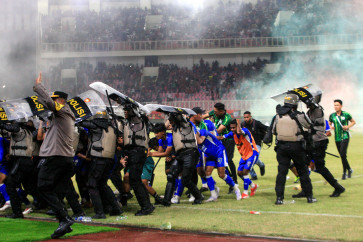
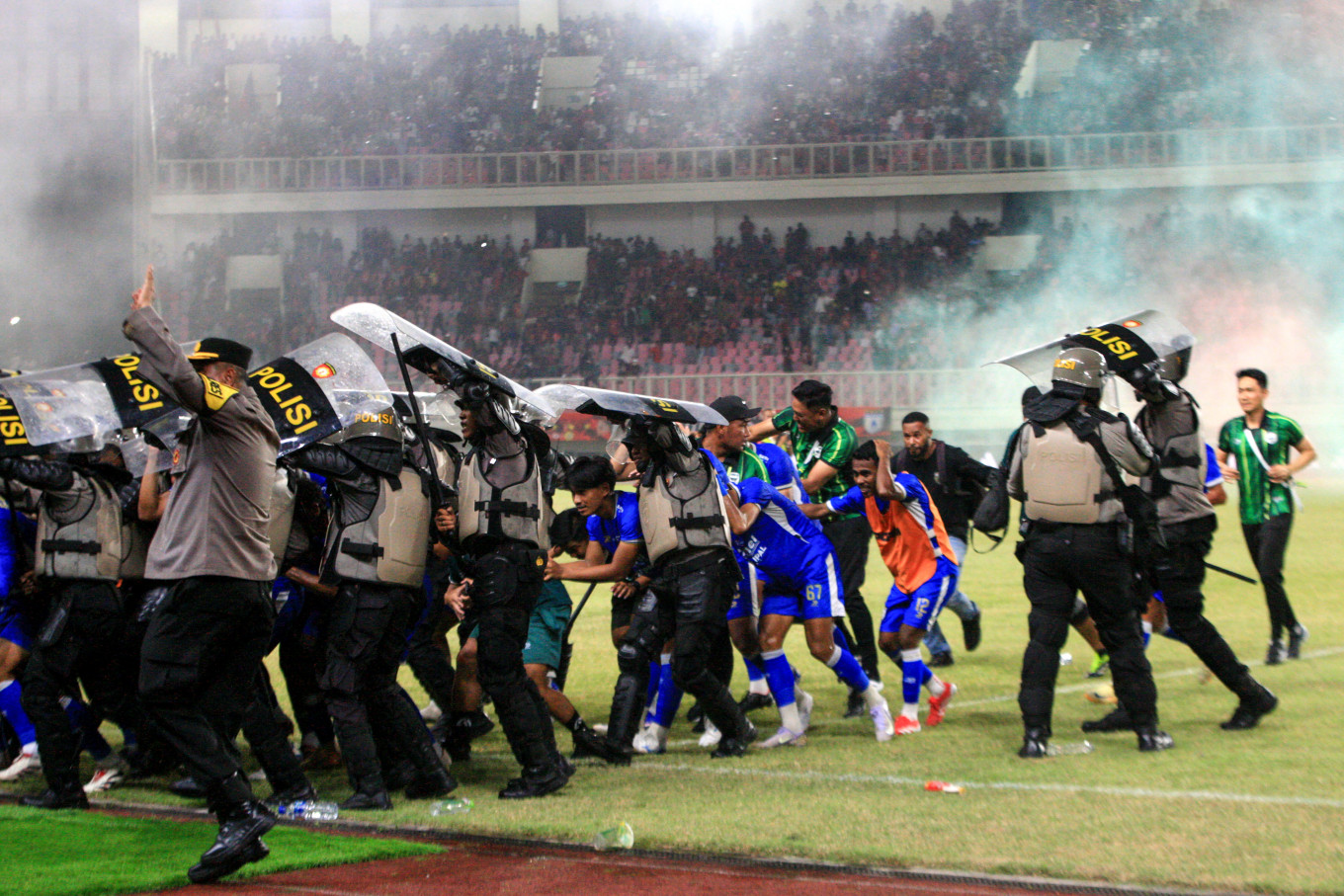 Police officers evacuate players and officials of Adhyaksa FC Banten during unrest following a playoff match against Persipura Jayapura in the 2025-2026 Pegadaian Championship, Indonesia’s second-tier soccer league, at Lukas Enembe Stadium in Jayapura, Papua, on May 8, 2026. (Antara/Gusti Tanati)
T
he House of Representatives’ passage of the revised Police Law has closed a debate that dominated public discussion for months. The government frames this revision as a broader effort to transform the force into a more professional, transparent, modern and service-oriented institution. On the surface, few would object to such goals.
In politics, however, the real issue rarely lies in proclaimed objectives. More often, it lies in the institutional arrangements created to achieve them.
A closer reading of the revised law reveals a paradox. On one hand, it emphasizes transparency, oversight, political neutrality, human rights-based education and a strengthened National Police Commission (Kompolnas). On the other, it expands the police's institutional reach without introducing an equivalent expansion of civilian oversight.
The fundamental question is no longer whether the police will become more professional, but rather: Who will oversee an institution that is becoming increasingly powerful?
In any modern democracy, the police are indispensable. Yet history suggests that security institutions naturally expand their sphere of influence when opportunities arise. Political scientist Samuel P. Huntington argued in The Soldier and the State that security organizations inherently seek greater autonomy. Therefore, democratic systems require oversight mechanisms capable of balancing operational effectiveness with public accountability.
The debate over active police officers occupying civilian positions illustrates this dilemma perfectly. Article 28A of the revised law allows active officers to hold positions outside the police force, provided those roles relate to "police functions". While this provision appears straightforward, its simplicity is precisely where the problem begins.

What actually constitutes a police function? In contemporary governance, the answer is remarkably elastic. Cybersecurity, border management, counterterrorism, anti-narcotics, anti-money laundering, food security and critical infrastructure protection can all be tied to law enforcement. The broader the definition, the wider the room for interpretation.