TheJakartaPost
Please Update your browser
Your browser is out of date, and may not be compatible with our website. A list of the most popular web browsers can be found below.
Just click on the icons to get to the download page.


Popular Reads
Top Results
No results found. Please check your search term and try again
Can't find what you're looking for?
View all search results
Popular Reads
Top Results
No results found. Please check your search term and try again
Can't find what you're looking for?
View all search resultsCharity scandal highlights weak regulation
In a country that regularly ranks high on lists of the world’s most generous nations, the incident has exposed a lack of safeguards for the nation's charitable giving.
Change text size
Gift Premium Articles
to Anyone
Share the best of The Jakarta Post with friends, family, or colleagues. As a subscriber, you can gift 3 to 5 articles each month that anyone can read—no subscription needed!
T
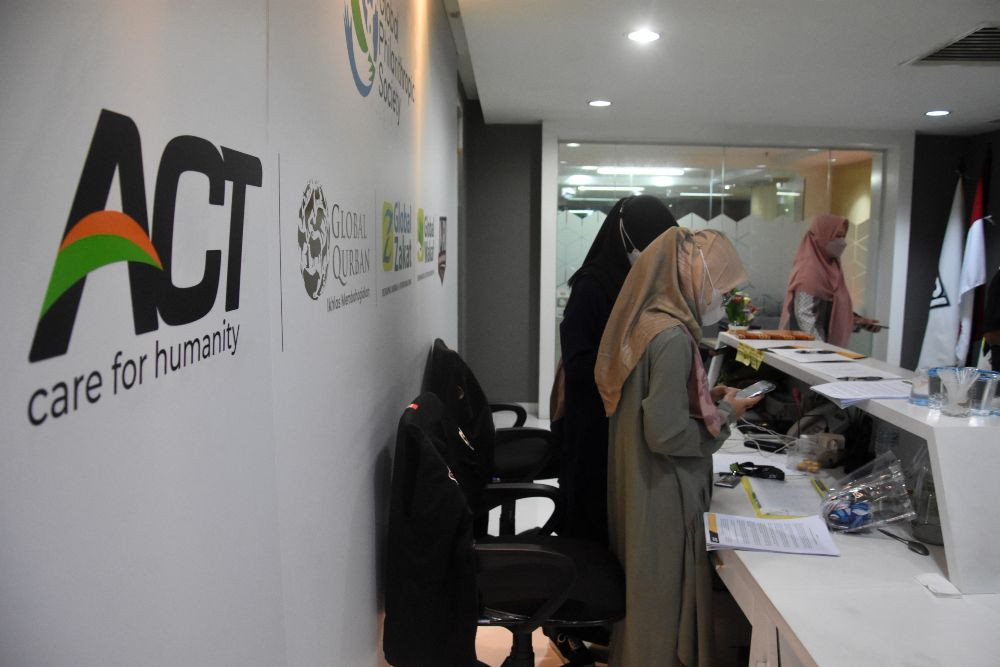
he embezzlement scandal surrounding popular humanitarian organization Aksi Cepat Tanggap (ACT) has highlighted the country’s lack of regulation of philanthropic groups, analysts have said, noting that the 60-year-old law that governs charitable activity offers little in the way of oversight.
Following a July 2 Tempo exposé that alleged that ACT had misappropriated charitable funds for the benefit of top executives and for expenses unrelated to the organization’s philanthropic activities, a broad investigation into the nonprofit has been opened.
ACT is one of the country’s most successful charities, having collected Rp 519 billion (US$6.7 million) in donations in 2020 alone.
But in a country that regularly ranks high on lists of the world’s most generous nations, the incident has exposed a lack of safeguards for the nation’s charitable giving.
“The main rule was issued in 1961. A lot of things have changed since then,” said Hamid Abidin, executive board secretary at Filantropi Indonesia, an independent association of philanthropic activists and organizations.
The country has at least three sets of rules that govern charitable activity: the 1961 Charity Law, the derivative Government Regulation No. 29/1980 on the collection of donations and the recently issued Social Affairs Ministerial Regulation No. 8/2021 on managing the collection of money or goods.
The 1961 law and its 1980 implementing regulation only cover licensing requirements, while the 2021 ministerial regulation requires only that registered charities submit a financial report to the government.
The law stipulates that organizations with or without a license that violate regulatory provisions are to be punished, but the details of those violations are largely absent from the legislation.
In the 1961 law, the only explicitly mentioned violation is the collection of funds without a license, punishable by a fine of Rp 10,000 (67 US cents) or three months’ imprisonment.
Hamid said his group had been pushing for the revision of the law since 2018 to ensure accountability and transparency in charitable activities.
He added that an update of the rules should also seek to recognize, register and regulate online crowdfunding initiatives.
“However, I see that neither the government nor the House of Representatives has prioritized the revision of this law,” he told The Jakarta Post.
More general ethical conduct provisions, such as those stipulated in the 2010 Money Laundering Law, the 2018 Terrorism Law and the 2008 Electronic Information and Transactions Law remain the only legal means to hold charitable organizations accountable.
Separately, House lawmaker Maman Imanulhaq of the National Awakening Party (PKB), who serves on Commission VIII overseeing social affairs, acknowledged the need to pass new legislation to improve the accountability of charities.
He said an oversight agency needed to be established to ensure transparency on funding sources, beneficiaries, the purpose of fund collection and the disbursement process.
Maman referred to the United Kingdom’s 2011 Charities Act, which registers and regulates all charities in the country under the oversight of the Charity Commission, as a potential model.
“I agree that the regulations must be tightened to improve surveillance, transparency and accountability. And the oversight agency will be chosen through a constitutional mechanism so that it can act independently,” he said.
The ACT case has attracted wide attention from the public and authorities.
Most recently, the National Police’s Criminal Investigation Department (Bareskrim) interrogated two senior ACT executives in relation to the case.
Last week, the Financial Transaction Reports and Analysis Center (PPATK) froze 60 accounts affiliated with the organization at 33 financial institutions.
In a review that PPATK began in 2018, it discovered transactions worth Rp 30 billion made between ACT and a company owned by one of its founders.
It also found indications that ACT had failed to use funds it had collected from donors for their stated purpose. The PPATK said the nonprofit allegedly used the donations to generate profit instead of disbursing them as intended.
The Social Affairs Ministry has revoked ACT’s charitable collection license, contending that it violated a regulation stipulating that licensed entities may use a maximum 10 percent of their charitable funds to cover operating costs.
Bivitri Susanti, a constitutional law expert from the Jentera School of Law, said that while ACT should be held accountable for any proven embezzlement, the case could not be considered graft under Indonesian law because the funds were not public and the entity was not a state body.
Nevertheless, Bivitri noted, the scandal should offer the government and the House the necessary impetus to improve the regulation of philanthropic organizations.
“The government should be monitoring organizations that collect funds from the public so that the money is not misappropriated for private ends. One of the ways to do this is consistent law enforcement,” Bivitri told the Post.
Last year, Indonesia topped the annual World Giving Index (WGI) by the Charities Aid Foundation with a score of 69, making it, by that measure, the most generous country in the world.
More than eight in 10 Indonesians donated money in 2021, according to the index, and the country’s rate of volunteering was more than three times the global average.
Many of the donations took the form of zakat, Muslim alms-giving, the proceeds of which are redistributed to the needy.
According to the annual United Nations Refugee Agency (UNHCR) report on Islamic philanthropy, $48.6 million was given in zakat in 2020.