TheJakartaPost
Please Update your browser
Your browser is out of date, and may not be compatible with our website. A list of the most popular web browsers can be found below.
Just click on the icons to get to the download page.


Popular Reads
Top Results
No results found. Please check your search term and try again
Can't find what you're looking for?
View all search results
Popular Reads
Top Results
No results found. Please check your search term and try again
Can't find what you're looking for?
View all search resultsSlander case proceeds against activists despite calls for reform
Change text size
Gift Premium Articles
to Anyone
Share the best of The Jakarta Post with friends, family, or colleagues. As a subscriber, you can gift 3 to 5 articles each month that anyone can read—no subscription needed!
A
ctivists and scholars are questioning the government’s commitment to free speech as the police press ahead with an online defamation case against two human rights defenders under a law that President Joko “Jokowi” Widodo has said should be reformed.
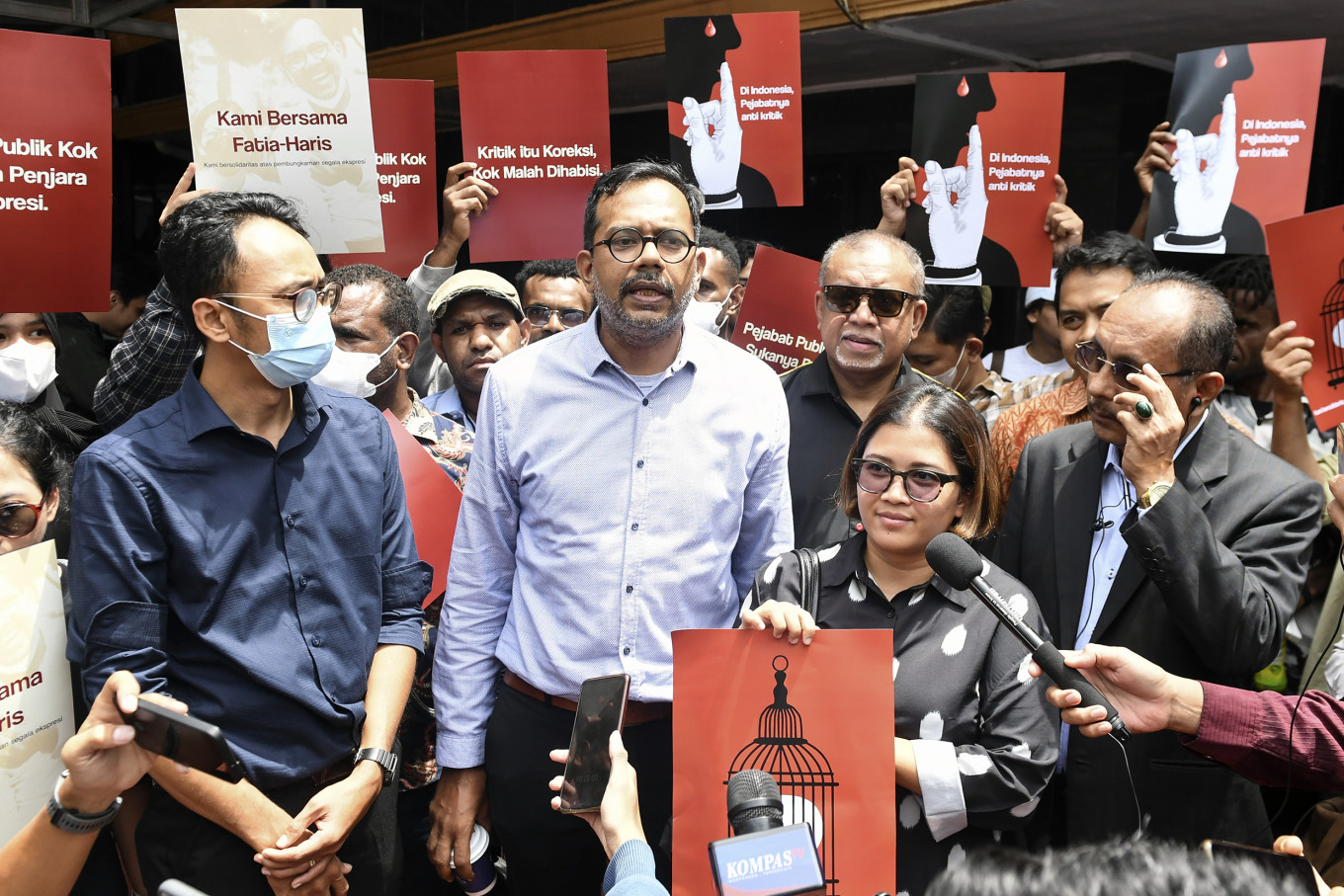
On Monday, the Jakarta Police reportedly submitted a dossier to the East Jakarta Prosecutor’s Office outlining a defamation case against activists Haris Azhar of the Lokataru Foundation and Fatia Maulidiyanti of the Commission for Missing Persons and Victims of Violence (Kontras).
Fatia and Haris went to the Jakarta Police headquarters on the same day to protest what they said was an attempt to “criminalize human rights defenders”.
They were supported by some 20 civil groups, including Kontras, the Jakarta Legal Aid Institute and Amnesty International Indonesia, which urged the police and the prosecutors’ office to stop pursuing the case as it violated a series of policies enacted since 2021 intended to limit the criminalization of criticism.
They were referring to a joint decree signed by the police, the attorney general and the communications and information minister in mid-2021, as well as an internal circular letter signed by National Police chief Gen. Listyo Sigit Prabowo earlier that year.
The decree says criminal charges for online defamation may only be brought against people who intended to harm another’s reputation with their statements and that simply stating opinions or facts was not grounds for prosecution. The circular letter, which was issued not long after President Joko “Jokowi” Widodo said the ITE law and its vague provisions were “the source” of the problem, orders police personnel to use a “restorative justice” approach in enforcing the cyberlaw.
The case of Haris and Fatia began in September 2021 when Coordinating Maritime Affairs and Investment Minister Luhut Binsar Pandjaitan reported the two activists to the police for their statements in a video featured on Haris’ YouTube channel. Luhut’s side said it had filed the report after two separate demands for a public explanation and apology from Haris and Fatia were ignored.
'Lip service'
Activists say the continuing prosecution of the two activists shows the government’s lack of seriousness about protecting free speech.
"It seems that the government is only paying lip service to the public instead of truly upholding free speech," law expert Bivitri Susanti of the Jentera School of Law in Jakarta told The Jakarta Post on Monday.
Amnesty International Indonesia executive director Usman Hamid, meanwhile, said, "The government doesn't walk the talk."
The House of Representatives, at Jokowi’s behest, is set to begin discussing revisions to the ITE after lawmakers return from recess next week. They are expected to soften provisions on online defamation, obscenity and hate speech on the internet to bring them in line with the new, more moderate Criminal Code.
But the revised Criminal Code, too, has alarmed activists and scholars as it reintroduces previously repealed lèse-majesté provisions. It is set to come into effect three years after its Jan. 2 enactment.
A recent study by the Southeast Asia Freedom of Expression Network (SAFEnet) found that 2022 was the worst year for freedom of expression in nine years, based on the high number of cases against critics of the government and state institutions.