TheJakartaPost
Please Update your browser
Your browser is out of date, and may not be compatible with our website. A list of the most popular web browsers can be found below.
Just click on the icons to get to the download page.


Popular Reads
Top Results
No results found. Please check your search term and try again
Can't find what you're looking for?
View all search results
Popular Reads
Top Results
No results found. Please check your search term and try again
Can't find what you're looking for?
View all search resultsWhy vehicle electrification is not enough to tackle climate crisis
Recent studies showed air pollution causes more than 10,000 deaths, 5,000 hospitalizations and 7,000 children experience various health problems every year in Jakarta, costing trillions of rupiah.
Change text size
Gift Premium Articles
to Anyone
Share the best of The Jakarta Post with friends, family, or colleagues. As a subscriber, you can gift 3 to 5 articles each month that anyone can read—no subscription needed!
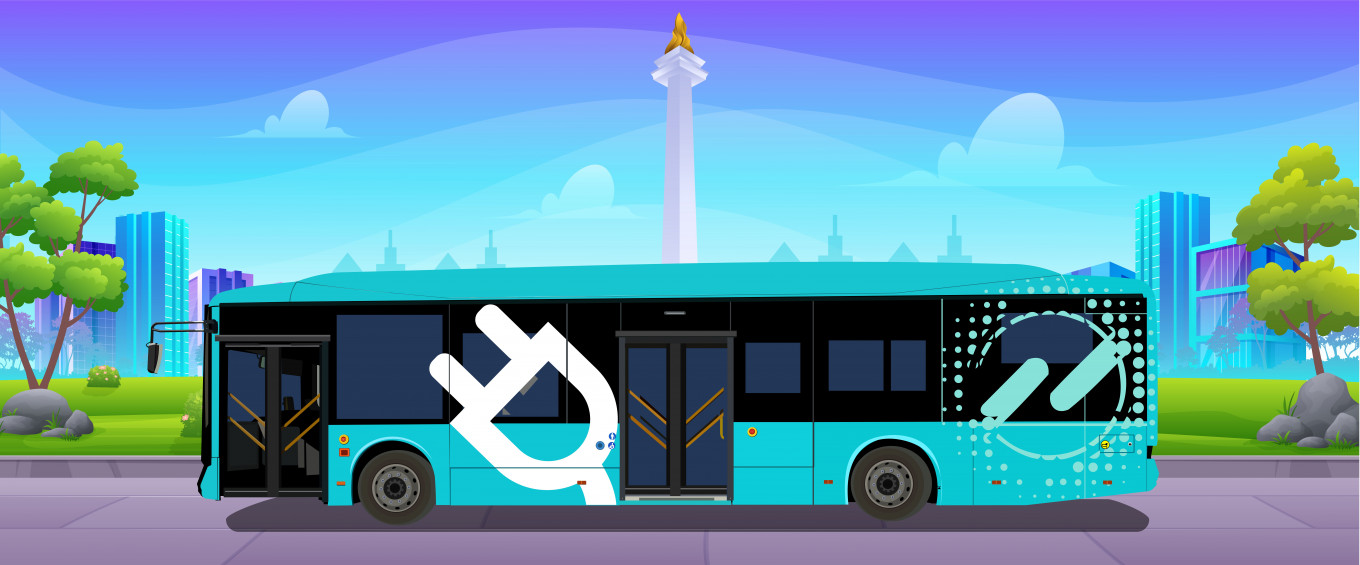
Work It Right is a weekly column that provides practical and insightful advice on the complexities of urban transportation.
The fuss surrounding electric vehicles (EVs) on the internet doesn’t hit even the main problem and its supposed goals, whether to decrease air pollution in the city or solve the congestion. The EVissue is only a small part and the final step toward creating a pollution-free city.
The impacts of climate change are already wreaking havoc on ecosystems and economies worldwide, including in Jakarta. Recent studies showed air pollution causes more than 10,000 deaths, 5,000 hospitalizations and 7,000 children experience various health problems every year in Jakarta, costing trillions of rupiah (Ginanjar Syuhada of Singapore's Environmental, Climate and Urban Health Division Vital Strategies and team in the February issue of the journal Environmental Research and Public Health).
Based on a 2020 study, the transportation sector contributed 67.03 percent to the particulate matter (pm) 2.5 burden in Jakarta, the road transportation sector in particular contributed 87.9 percent to the pm 2.5 burden, according to rendahemisi.jakarta.go.id. With the limit of global warming to less than 1.5 degrees Celsius as per the Paris Climate Agreement, governments worldwide, including Jakarta, need to take action and use every tool to reduce the emissions from transportation.
With the rise of the climate crisis in Jakarta, such efforts have been taken by the city, such as deploying public transportation from TransJakarta, the MRT and LRT in Jakarta and revitalizing sidewalks and bike lanes, with these initiatives developing for almost 20 years.
But is the problem solved? The congestion? The air pollution? And now the electrification issue is entering the scene.
Jakarta started deploying its first TransJakarta Electric buses in 2022 and pledged to electrify the entire TransJakarta fleet in 2030. The state government released policies to boost the electrification of vehicles, especially cars and motorcycles. It then sparked a debate about whether the subsidy goes to public transportation, such as buses, or only private vehicles.
Electrified public transportation
It is unfortunate that public transportation electrification is not given the spotlight as the private vehicle segment is. Public transportation fleets have much higher mileage than private vehicles every day, hence can have a higher emissions reduction per vehicle. Moreover, buses carry a significantly higher number of passengers compared with cars and motorcycles. More people can benefit from reduced emissions and improved air quality by electrifying these fleets.
The transition process toward using electric fleets in public transportation systems is not without challenges. The biggest challenge that public transportation operators must now face is the capital cost of implementing electric buses in their fleets. The price of electric buses in Indonesia is still higher than diesel buses. Furthermore, there is an additional investment that needs to be spent to build charging infrastructure.
Despite that, recent studies from Institute for Transportation and Development Policy (ITDP), supported by the United Kingdom Partnering for Accelerated Climate Transitions (UK PACT), show that large-scale electrification of the TransJakarta fleet is both financially and economically viable and needs to be implemented to maximize the benefits. Electrification in 2030 is projected to generate cumulative net economic and social benefits of Rp 4.2 trillion (US$281 million) by 2030 and reduce nearly 60 percent of greenhouse gas (GHG) emissions compared with the business-as-usual scenario. According to the study, if we implement the proposed changes, we can expect a significant decrease in harmful vehicle emissions from tailpipes. Specifically, PM2.5, nitric oxide and dioxide (NOx) and sulfur oxide (SOx) emissions will be reduced by 45, 47 and 47 percent, respectively, compared with the current situation. This improvement in air quality and reduction in noise pollution will positively impact the lives of over 10 million people in Jakarta and nearby areas. It will contribute to a healthier and livelier community overall.
Electrification not a silver bullet
However, extensive vehicle electrification only lowers emissions by a portion of what is needed. A joint study between ITDP and the University of California, Davis, found that the only way to prevent the worst effects of climate change is to engage in a comprehensive strategy of compact, mixed-use cities built around walking, cycling and public transportation combined with investments in EVs. In 2015 urban passenger transportation accounted for around 10 percent of global emissions. To prevent catastrophic climate change and align with the objectives of the Paris Agreement, it is crucial to reduce cumulative carbon dioxide equivalent emissions from urban passenger transportation by approximately 54 gigatonnes (Gt) within the next three decades, deviating from the current upward trend. Combining these two approaches, compact city and electrification, the GHG emissions from urban passenger transportation can be cut by 59 Gt CO2-eq by 2050.
It is clear that electrification alone is not enough if we want to aim for enough impact to tackle the climate crisis. If the electrification efforts do not start or are followed by a city oriented on walking, cycling and public transportation, the crisis, I fear, is still the greatest threat humans must face in the (near) future.
-- Have a question about urban transportation? Send it to wir@thejakartapost.com with your name and current location (anonymous submissions may also be considered). Please note that The Jakarta Post reserves the right to edit your letters for publication.
***
The writer is a senior communications and partnership manager at the Institute for Transportation and Development Policy (ITDP).