TheJakartaPost
Please Update your browser
Your browser is out of date, and may not be compatible with our website. A list of the most popular web browsers can be found below.
Just click on the icons to get to the download page.


Popular Reads
Top Results
No results found. Please check your search term and try again
Can't find what you're looking for?
View all search results
Popular Reads
Top Results
No results found. Please check your search term and try again
Can't find what you're looking for?
View all search resultsNavigating Indonesia's solar development dilemma
The government faces a complex dilemma in providing affordable energy to everyone, which means coal, while aligning with the global transition to cleaner energy, such as solar.
Change text size
Gift Premium Articles
to Anyone
Share the best of The Jakarta Post with friends, family, or colleagues. As a subscriber, you can gift 3 to 5 articles each month that anyone can read—no subscription needed!
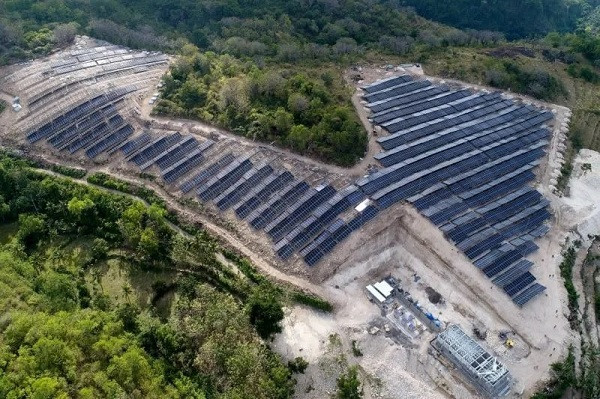
A striking problem looms over the rooftops of residential and business buildings alike in Indonesia’s big cities.
Febby, a typical middle-class employee who likes to plan for the future, started a project that uses sunlight for energy by installing solar panels on his roof, hoping to help the environment by using cleaner energy.
However, despite taking action, the rules and processes of state electricity company PLN have delayed his plans. Febby has been nine months without approval from PLN, which has made him lose hope and wonder if the promise to use solar energy instead of conventional energy will be fulfilled.
Febby is not alone. Many customers, including businesses, are stuck waiting painfully for months just to start the process of installing solar panels, primarily for on-grid projects. This is occurring even though the regulations of the Energy and Mineral Resources Ministry state that the issue should be resolved within 65 working days.
Consumers and enterprises are experiencing heightened frustration, particularly in light of the Association of Solar Energy Indonesia (AESI) urging expedited measures. Supporters of solar energy are grappling with disillusionment due to the significant gap between government commitments and actual outcomes.
The final nail in the coffin would be the unfavorable potential changes to Ministerial Regulation No. 26/202 regarding on-grid solar systems. If enforced, these changes would make installing and transitioning to solar energy extremely difficult and discouraging.
For instance, consumers would not be able to export and sell surplus solar energy to PLN (net metering), capacity charges would change for all customers (instead of only businesses), the process of approving solar installations would depend on PLN’s discretion, and the time frame for registering solar installations would become more stringent. Due to these unfavorable changes, the future of solar adoption seems bleak.
The net metering changes have direct economic consequences that render solar less attractive. The policy allowing sales of surplus energy generated from solar panels has been proven to dramatically increase solar adoption, as seen in Brazil, where adoption increased by 110 times in six years.
While the rest of the world is embracing more solar-friendly regulations, Indonesia seems to be doing the opposite. The removal of net metering is a setback for Indonesia's solar panel industry.
Aside from regulations, Indonesia has also not made any significant progress in terms of investment. For example, the government invested US$113 million in the electric vehicle (EV) industry in 2023. In stark contrast, the solar sector received a comparatively modest boost of $1 million in 2022 through various tax incentives, including tax allowances and tax holidays.
This discrepancy highlights that government support for clean energy is limited to specific groups. The lack of investment and unfavorable regulations has resulted in Indonesia achieving an energy capacity of only 213 megawatts out of its 2025 target of 35 gigawatts (GW), which includes rooftop, floating and ground-mounted solar panel installations to generate electricity.
The bulk of the challenge to solar transition is financing. In Indonesia, there is large uncertainty about who should be responsible for financing, as transitioning to solar carries risks that no one wants to bear. The private sector may hesitate to invest unless they see equal commitment from the government.
Lessons from other countries suggest that the government could play a starting or catalytic role in this. The governments of China and Brazil, for example, are bearing the initial investment risks to stimulate solar sector growth.
Once government takes the first step, other key stakeholders are more likely to participate in advancing the transition to solar energy. Collective investment in this transformation then lays the groundwork for future dividends, allowing the financial burden to be shared as the market flourishes.
However, why the Indonesian government is hesitant to take the first significant step is understandable. The country’s heavy reliance on coal as its primary energy source remains a formidable stumbling block: Coal's dominance as an energy source grew from 54 percent in 2016 to a staggering 67 percent in 2022.
Abundant reserves make coal cheap and reliable, posing little economic incentive for Indonesia to transition to solar in either the short or long term. Many argue that the current progress in solar energy is merely a public relations tactic to project a green global image.
In addition to the challenge of transitioning from cheap and abundant coal, significant investment in Indonesia's energy grid is necessary. Solar energy's intermittent nature poses a "duck curve" challenge to grid stability worldwide. To counter this, an automated system providing real-time data on electricity supply and demand is crucial. Indonesia's outdated grid requires substantial investment to transform.
Vietnam, for instance, invested $29 million annually per GW in smart grid development. This investment to upgrade its energy grid further dampens the economic case for government to make the transition.
Another important factor in the solar sector is energy storage, i.e. batteries. Batteries are needed to counter the intermittent nature of solar energy. But they're not cheap. The cost of solar batteries makes up around 30 percent of total solar energy cost, according to experts from German development agency GIZ.
The high cost of energy storage adds another layer to the already weak economic case for transitioning to a solar energy system.
The Indonesian government faces a complex dilemma. On the one hand, it must ensure that everyone can afford energy from PLN, which is economically feasible due to coal. On the other hand, global pressure from developed countries and international organizations demands the use of clean and sustainable energy. The government is currently utilizing PLN as the gatekeeper of decisions on electricity usage in Indonesia, especially for regulating on-grid solar panels.
In the middle of these complicated issues, respected experts, nongovernmental groups and research organizations are all speaking up for sensible changes. Among the main culprits in the lack of solar investment from the private sector is the overshoot estimate and planning of renewable energy numbers in the Electricity Supply Business Plan. This exaggeration leads businesses to misplan and distrust the government’s commitment. Their mistrust will disincentivize future solar investments from the private sector.
Experts, think tanks and NGOs suggest making practical changes in the business plan’s assumption in order to provide reliable planning. It is still better to invest and reap smaller margins vis-à-vis promising higher returns on investment to end in losses.
Another workaround to the small economic incentive is procuring funding from wealthy nations. Drawing inspiration from Brazil, the government could use money from big international funds like the Sustainable Energy Fund (SEF) and the Just Energy Transition Partnership (JETP). Valued respectively at $23 billion and $20 billion, these funds could invigorate Indonesia's budding solar dream by fostering collaboration between international support and domestic transformation.
However, the challenges in accessing these funds include governance, transparency, accountability and bureaucratic complexity as a result of multiple stakeholders.
Additionally, the decreasing global cost of solar energy due to investments and technological advancements offers a glimmer of hope for Indonesia's solar industry. Furthermore, a small hope also resides in the country’s upstream solar energy business.
The plans to establish solar panel factories in Bangka Belitung, in a shift from assembly to production, offer promise. The proposed ban on quartz sand could catalyze domestic solar panel manufacturing by reducing costs. This is crucial, since locally made solar panels cost $1 per watt peak (Wp) while global prices range from 20-30 US cents per Wp, according to the energy minister. The lack of support for upstream businesses has reduced solar panel factories from 14 to just two.
***
The writer is lead consultant of policy advocacy firm Mandala Consulting. The views presented in this article are personal.