TheJakartaPost
Please Update your browser
Your browser is out of date, and may not be compatible with our website. A list of the most popular web browsers can be found below.
Just click on the icons to get to the download page.


Popular Reads
No popular reads data found
Top Results
No results found. Please check your search term and try again
Can't find what you're looking for?
View all search results
Popular Reads
No popular reads data found
Top Results
No results found. Please check your search term and try again
Can't find what you're looking for?
View all search resultsAnak-Krakatau


National 7 years ago
Tsunami survivors recall higher waves, louder rumbles, brighter lava from Anak Krakatau
When the clock struck at around 9:00 p.m. on Saturday, fisherman Walid saw fiery lava spit out from Anak Krakatau. Slowly, he began to feel the sea level fall and noticed that waves at the far shore had turned white.
National 7 years ago
Indonesia to investigate origins of 'silent' Sunda Strait tsunami after volcano collapse
A team of experts from the nation's meteorology, technology and energy institutions are to conduct underwater geological and topological surveys of the area around Anak Krakatau as soon as conditions are safe to do so.

National 7 years ago
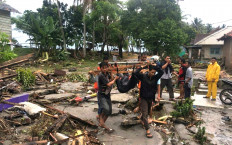
Participants in corporate year-end gatherings among tsunami victims
PLN corporate communication head I Made Suprateka said 199 people – employees and family members – had gone to Tanjung Lesung in Pandeglang, Banten, to participate in an employee gathering at the beach. At least 27 of them had died, while another 13 were still missing as of 3 p.m. on Sunday.
National 7 years ago
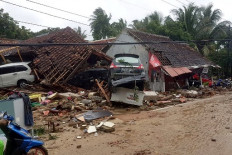
BMKG under fire for conflicting cues on Sunda Strait tsunami
The BMKG initially announced on Saturday night that there had been a tidal wave in the Sunda Strait, refuting tsunami claims, prompting other officials to spread similar incorrect information, saying there had been no tsunami.

City 7 years ago
Indonesia has no early warning system for volcanic tsunamis: BNPB
While authorities are seeking to ascertain whether or not the Sunda Strait tsunami was caused by Mt. Anak Krakatau’s volcanic activity, it has emerged that the country has no system in place to detect volcanic tsunamis before they hit coastal areas.
National 7 years ago
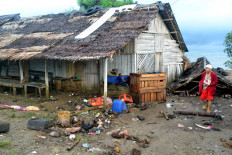
What caused the Sunda Strait tsunami?
The lack of a powerful earthquake or strong volcanic eruption caused the Meteorology, Climatology and Geophysics Agency (BMKG) to initially announce that the waves did not constitute a tsunami but were instead caused by high tide. It was only discovered hours later that the tide was three to five meters high, and potentially caused by volcanic activity of Mount Anak Krakatau, which is located in the middle of the Sunda Strait that divides Sumatra and Java.