The Jakarta Post
Please Update your browser
Your browser is out of date, and may not be compatible with our website. A list of the most popular web browsers can be found below.
Just click on the icons to get to the download page.


Popular Reads
Top Results
No results found. Please check your search term and try again
Can't find what you're looking for?
View all search results
Popular Reads
Top Results
No results found. Please check your search term and try again
Can't find what you're looking for?
View all search resultsforest-fires-2019
Archipelago 4 years ago
PREMIUM
Recent study on 2019 fires stirs debate on govt's forest data transparency
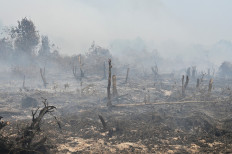
The government has disputed the recently published scientific research that claimed the area lost to forest and peatland fires in 2019 was larger than official estimates, a move which activists said highlighted the government’s lack of openness toward data gathered from independent studies.
National 6 years ago
PREMIUM
Residents’ participation vital in Jambi peatland restoration: BRG
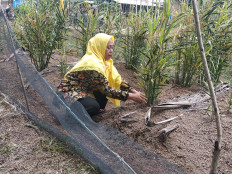
The Peatland Restoration Agency (BRG) has called on the public to support its efforts to restore peatland areas in the province of Jambi, where land clearing and fires cause trillions of rupiah in environmental damage and impact people’s livelihoods.

National 6 years ago
Look at the Amazon, not us: Indonesia claims handling forest fires better than other nations
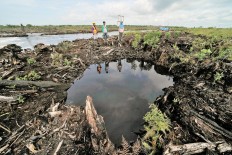
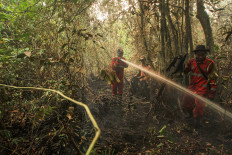
Indonesia's forest fires are once again in the spotlight after a report from the European Union’s Copernicus Atmosphere Monitoring Service found that this year’s forest fires in Indonesia have released more carbon emissions than the forest fires that are raging in the Brazilian Amazon.
National 6 years ago
PREMIUM
Indonesia's 2019 fire season not doomsday for forests, but ecological concerns remain
A satellite assessment estimated that 1.64 million hectares burned over the period across seven Indonesian provinces, including 670,000 ha -- 41 percent of the total burnt area -- in peatland.
National 6 years ago
PREMIUM
Climate change, environmental degradation may hamper Indonesia’s GDP growth
In Indonesia, an economy heavily reliant on natural resources, climate change and natural resource degradation are likely to halve potential GDP growth, from 7 percent to 3.5 percent, by 2050, according to a recent study.
Opinion 6 years ago
PREMIUM
Beyond swidden agriculture: Rethinking approach to fires
The use of fire in swidden agriculture is not as simple as just burning down the forest. It presents an interconnected relationship between ecological knowledge and socialcultural values. However, swiddening communities are often accused as being one of the contributors to catastrophic fires in Indonesia. In addition, they often become victims of reactive fire policies (e.g. the prohibition of using fire).
Opinion 6 years ago
PREMIUM
Compensation from forest fire cases: Urgency to reform law enforcement
According to the National Disaster Mitigation Agency (BNPB), Indonesia has experienced 1,226 forest fires in the last 10 years. Many companies have been penalized by the court but the number of forest fires have only increased, suggesting hardly any deterrence effect on the companies.
Editor's Picks
Popular
- Indonesia calls for more representative UN amid changing world order
- Safeguarding Indonesia's AI future
- Jakarta water shortages worsen as dry season drags on
- Recentralization concerns in fiscal, education heighten
- Twenty years on, BRICS faces a defining choice
- Court decision tightens House oversight on free meals funding
- Govt under pressure as 3 million home drive hits cracks
- Gontor leader’s blunt remarks highlight ‘pesantren’ political independence
- Indian arrested for smuggling gold bars to Thailand via N. Sumatra airport
- Popular discontent is justified. Authoritarianism is not the answer


