The Jakarta Post
Please Update your browser
Your browser is out of date, and may not be compatible with our website. A list of the most popular web browsers can be found below.
Just click on the icons to get to the download page.


Popular Reads
Top Results
No results found. Please check your search term and try again
Can't find what you're looking for?
View all search results
Popular Reads
Top Results
No results found. Please check your search term and try again
Can't find what you're looking for?
View all search resultsterrorism

Academia 2 days ago
PREMIUM
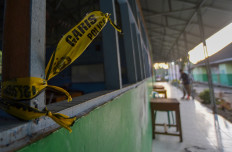
When violence falls between the cracks
As youth violence shifts from organized terrorist dogma to decentralized digital subcultures, Southeast Asia must confront a new reality: how do you stop an impending attack when there is no ideology to deradicalize and no network to map?

Americas 1 month ago
PREMIUM
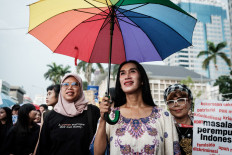
Indonesia's ‘balanced’ response signals quiet pushback on US far-left terrorism push
Indonesia's response to the United States' push to globally combat "far-left terrorism" amounted to a form of quiet resistance, analysts say, as Jakarta uses carefully chosen diplomatic language to signal it will not simply adopt Washington's framing, even as it seeks to maintain bilateral ties under President Prabowo Subianto's leadership.

Middle East and Africa 2 months ago
Macron safe, continuing visit after Damascus blast
Macron had left the hotel when the explosions took place, and is currently in the Syrian presidential palace for a meeting with his counterpart Ahmed al-Sharaa and their respective delegations, followed by a one-on-one meeting with Sharaa, according to the French presidency.

Politics 4 months ago
PREMIUM
Abuse concerns linger over extremism prevention plan
The new Perpres notes that while Indonesia has seen a decline in terrorist attacks in recent years, including what it describes as “zero terrorist attacks” in the past two years, threats persist beneath the surface, with more than 1,000 suspected militants arrested between 2020 and 2024.
Academia 6 months ago
PREMIUM
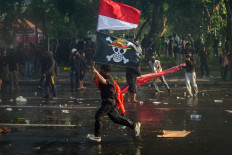
State terrorism: The criminalization of dissent and the failure of governance
As the Indonesian state weaponizes the stigma of "terrorism" to mask its failures of governance, a systematic campaign of criminalization is silencing public voices demanding accountability: a chilling descent into neo-authoritarianism revealing a regime that would rather trade democratic values for elite consolidation than address the people's economic grievances.
Jakarta 8 months ago
PREMIUM
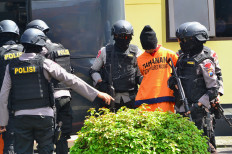
Ten years after Sarinah attack, Indonesia’s fight against terror moves online
A decade after the deadly Sarinah attack that shook the nation, Indonesia has seen a gradual decline in conventional terrorist incidents, though authorities warn that extremist threats are shifting to cyberspace.
Politics 8 months ago
PREMIUM
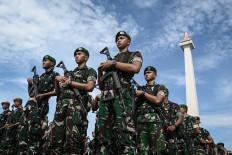
Plan to expand military role in counterterrorism draws flak
A draft Presidential Regulation (Perpres) lays out the military’s responsibilities in combating terrorism, including three roles for the Indonesian Military (TNI), which activists argue should be mainly carried out by civilian institutions such as the National Counterterrorism Agency (BNPT).

Asia & Pacific 8 months ago
China calls for joint counter-terrorism efforts with Pakistan
Efforts should be made to "effectively address various risks and challenges, and jointly safeguard the national security and social stability of both countries," Wang said, according to a statement released by his ministry.
Editor's Picks
Popular
- PISA gains belie Indonesia’s persistent education crisis
- Not the Ministry of Magic
- Suahasil seen to prioritize fiscal discipline, continuity
- The benefit of the doubt has expired
- Ed Sheeran struggles against Gaza tide
- Another company flees Batam, abandons 1,025 workers
- Is Indonesia returning to fiscal orthodoxy?
- Indonesian Navy welcomes former Italian warship as its first aircraft carrier
- Osama the gamer: A list of Bin Laden’s video games from his hard drive
- How obscure yttrium became a global flashpoint


