TheJakartaPost
Please Update your browser
Your browser is out of date, and may not be compatible with our website. A list of the most popular web browsers can be found below.
Just click on the icons to get to the download page.


Popular Reads
Top Results
No results found. Please check your search term and try again
Can't find what you're looking for?
View all search results
Popular Reads
Top Results
No results found. Please check your search term and try again
Can't find what you're looking for?
View all search resultsThe Bondi tragedy: The rising specter of inspirational terrorism
In today's interconnected, borderless digital world, counterterrorism strategies must evolve to one of preparedness that emphasizes the early detection of online narratives that glorify violence, so as to nip inspirational terrorism in the bud.
Change text size
Gift Premium Articles
to Anyone
Share the best of The Jakarta Post with friends, family, or colleagues. As a subscriber, you can gift 3 to 5 articles each month that anyone can read—no subscription needed!
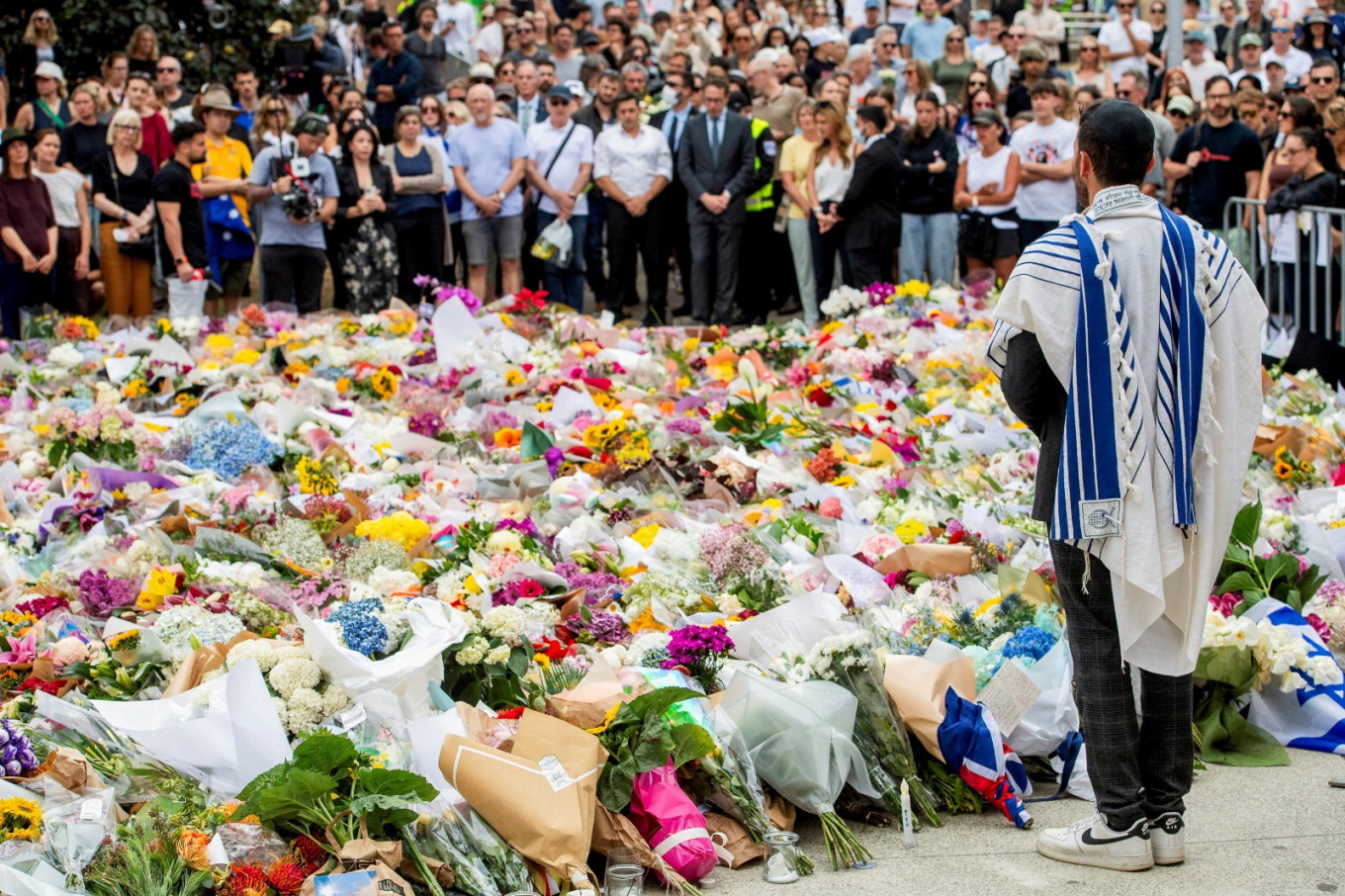 Beach in tears: A member of the Jewish community stands at a floral memorial on Dec. 16, 2025 at Bondi Beach, Sydney, Australia in honor of the victims of the mass shooting targeting a Hanukkah celebration on Dec. 14. (Reuters/Jeremy Piper)
T
he mass shooting at a religious gathering near Sydney’s Bondi Beach on Sunday that targeted Australia’s Jewish community has exposed a critical evolution in contemporary counterterrorism: Violent extremism no longer relies on command structures; it travels through inspiration.
While Australian authorities are handling the attack as a domestic security matter, its ripples extend well beyond national borders, particularly for countries like Indonesia that are deeply embedded in the global digital ecosystem.
For policymakers, the urgent question is not whether the Bondi tragedy will directly trigger an attack elsewhere, but whether such incidents increase the viral potential of copycat violence. In our hyperconnected reality, the strategic impact of a terrorist attack is never confined to its physical location.
As a former terrorist offender who now works as a social researcher, I recognized the pattern immediately.
Acts of violence are rapidly transformed into symbolic content online. Within hours, narratives emerge framing the attack not as a crime but as an ideological statement. Sympathizers, often unaffiliated with any formal group, reinterpret the bloodshed as legitimacy, resistance or proof of relevance.
This dynamic is best described as "inspirational terrorism". Unlike traditional models that rely on hierarchical organizations, this form of terror operates through exposure, repetition and emotional resonance. Individuals do not radicalize because they receive orders; they radicalize because they continuously engage with narratives that glorify violence.

For Indonesia, this presents a distinct policy challenge. Over the past decade, the country has made significant progress in dismantling organized terror networks. However, the primary risk has now shifted to self-radicalized individuals or small, loosely connected cells inspired by global events rather than directed by global organizations.