TheJakartaPost
Please Update your browser
Your browser is out of date, and may not be compatible with our website. A list of the most popular web browsers can be found below.
Just click on the icons to get to the download page.


Popular Reads
Top Results
No results found. Please check your search term and try again
Can't find what you're looking for?
View all search results
Popular Reads
Top Results
No results found. Please check your search term and try again
Can't find what you're looking for?
View all search resultsAs ecological disasters intensify, judiciary can lead the way
The judiciary is our last line of defense in driving an urgent rethink of Indonesia's growth-centric policies, which are inherently unconstitutional, toward a mindset that embraces the strong sustainability approach.
Change text size
Gift Premium Articles
to Anyone
Share the best of The Jakarta Post with friends, family, or colleagues. As a subscriber, you can gift 3 to 5 articles each month that anyone can read—no subscription needed!
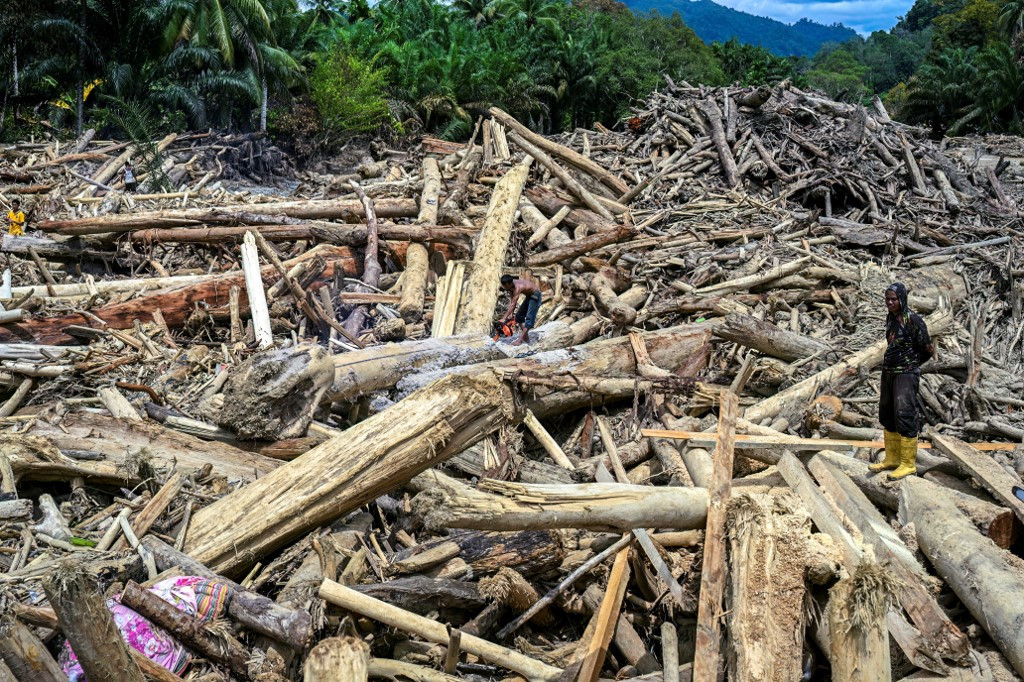 A man stands atop a log amid a pile of wood debris left by floodwaters in North Sumatra’s Garoga village on Dec. 4, 2025, as other residents scavenge usable materials to rebuild their damaged homes. (AFP/YT Hariono)
E
cological disasters are no longer distant threats. They are intrusions into our daily lives, hitting our communities with increasing scale and frequency. With global temperatures now exceeding 1.5 degrees Celsius above preindustrial levels and emissions continuing to rise, we face a new normal of floods, wildfires, heat waves and tropical cyclones (Intergovernmental Panel on Climate Change, 2024; World Meteorological Organization, 2025).
The impact is most severe where the Earth’s carrying capacity has been systematically eroded. This pattern is starkly visible in Aceh and other parts of Sumatra. Between 1990 and 2024, these regions suffered extensive forest loss driven by land conversion: 690,777 hectares for oil palm, 69,733 ha for industrial timber and thousands more for mining and urban expansion (Kompas, 2025).
The human cost is devastating. According to the National Disaster Mitigation Agency (BNPB), ecological disasters in these regions have claimed 1,059 lives, left 192 missing and injured over 7,600 people as of Wednesday.
These tragedies expose the rot at the core of the national economic policy: a growth-centric obsession that ignores ecological limits. Current policies overlook the irreplaceability of critical ecosystems and the rights of vulnerable communities to steward their environments.
This approach reflects a development model based on the fallacy that growth can proceed without ecological constraints, a concept known as "weak sustainability". This mindset is embodied in the controversial Law No. 6/2023 on job creation and its implementing regulations.
Many of today’s disasters could have been prevented had we applied the approach of strong sustainability, which holds that critical natural capital (CNC), or essential ecosystems, cannot be substituted by man-made wealth.

The 1945 Constitution supports this. In 2010, the Constitutional Court interpreted Article 33(3) to mean that state control over natural resources must serve the people's greatest prosperity as assessed by four criteria: (1) actual public benefits; (2) equitable distribution; (3) meaningful public participation; and (4) respect for intergenerational and customary rights.