The Jakarta Post
Please Update your browser
Your browser is out of date, and may not be compatible with our website. A list of the most popular web browsers can be found below.
Just click on the icons to get to the download page.


Popular Reads
Top Results
No results found. Please check your search term and try again
Can't find what you're looking for?
View all search results
Popular Reads
Top Results
No results found. Please check your search term and try again
Can't find what you're looking for?
View all search resultsthe-brief
Opinion 1 month ago
PREMIUM
Analysis: Investment inflows hide deeper vulnerabilities
Indonesia's investment figures are improving, with investment realization exceeding Rp 1,000 trillion (US$57 billion) and portfolio inflows rebounding strongly in the first half of 2026. But the recovery has yet to dispel investor concerns. Policy uncertainty, governance issues and continued pressure on the rupiah suggest that confidence in Indonesia's long-term investment climate remains fragile.
Opinion 1 month ago
PREMIUM
Analysis: Keeping elites out of high-stakes corruption case
Public concern continues to mount over the handling of the high-profile graft case involving Febrie Adriansyah, the former assistant attorney general for special crimes (Jampidsus). The National Police's Corruption Eradication Corps (Kortastipidkor) has declared Febrie a suspect and subsequently handed over the case files to the Attorney General's Office (AGO), but he has not been detained. The prosecution’s foot-dragging has fueled suspicion about horse trading among the elite rather than a steadfast commitment to eliminating corruption.

Opinion 1 month ago
PREMIUM
Analysis: Consumer confidence slips as livelihoods come under pressure
The Consumer Confidence Index (CCI) fell 3.1 points from 120.9 in May to 117.8 in June, the lowest reading since the index stood at 115 in September 2025, driven by weaker assessments of both current economic conditions and future expectations.
Opinion 1 month ago
PREMIUM
Analysis: Domestic bottlenecks in RI’s electricity export strategy
State asset fund Danantara recently signed two memorandums of understanding (MoUs) with Singapore's Keppel Electric, Sembcorp Industries and Singapore Energy Interconnections for a cross-border renewable electricity project, marking another milestone in the long-running effort to export Indonesia’s renewable power to the island state. Despite the progress, Energy and Mineral Resources (ESDM) Minister Bahlil Lahadalia said the two countries had yet to reach an agreement on the electricity pricing framework.

Opinion 1 month ago
PREMIUM
Analysis: Credit growth rebounds, but households remain under pressure
Indonesia's banking sector appears to be recovering, with credit growth returning to double digits in May. Yet beneath the encouraging headline, households face mounting financial pressure as consumer lending slows, layoffs rise, savings decline and purchasing power weakens. The contrast highlights a broader challenge: A banking recovery does not necessarily signal an improvement in the real economy.

Opinion 1 month ago
PREMIUM
Analysis: The anti-LGBTQ push and the securitization of identity
Lesbian, gay, bisexual, transgender and queer (LGBTQ) issues have once again surged to the forefront of Indonesia's political and social discourse. Two recent, overlapping developments warrant close examination: the formal classification of the "spread of LGBTQ culture" as a nonmilitary threat under the national defense policy, and a concerted legislative push to introduce criminal sanctions targeting LGBTQ people and advocacy.
Opinion 1 month ago
PREMIUM
Analysis: KDMP, the great cooperative gamble
Fourteen months after President Prabowo Subianto unveiled the Red and White Cooperatives (KDMP) program as a vehicle for rural economic empowerment, the initiative increasingly resembles not a grassroots cooperative movement but a large-scale fiscal and governance experiment whose long-term sustainability remains uncertain.
Opinion 1 month ago
PREMIUM
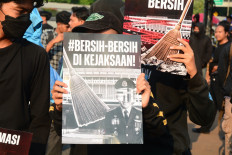
Analysis: Indonesia's Police-Prosecutor turf war: A fragile truce
For much of the past week, Indonesia's two most powerful law enforcement institutions, the National Police and the Attorney General's Office (AGO), appeared locked in open confrontation, complete with dueling corruption probes and troops guarding a prosecutor's house. That confrontation now looks to be ending in retreat rather than resolution.
Opinion 1 month ago
PREMIUM
Analysis: Weakening competitiveness highlights structural challenges
Indonesia's position in the World Competitiveness Ranking (WCR) continued its downward trend in 2026, falling eight places to 48th out of 70 economies, according to the World Competitiveness Yearbook (WCY) 2026 published by the International Institute for Management Development (IMD) in June. The ranking evaluates 70 economies using global, regional and national data, alongside surveys of senior executives. Indonesia's latest decline highlights persistent structural weaknesses and growing fiscal pressures.
Opinion 1 month ago
PREMIUM
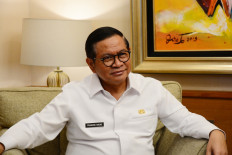
Analysis: Jakarta turns to Indonesia's first municipal bond
In a landmark move for Indonesia's local government financing, the Jakarta provincial administration is set to issue a Rp 3.5 trillion (US$193.66 million) municipal bond. The province plans to tap the capital market directly after regional transfers from the central government were reduced by Rp 15 trillion, falling from Rp 27.5 trillion in 2025 to just Rp 11 trillion in 2026. The sharp decline has created significant fiscal pressure on the province and prompted the search for alternative sources of funding.
Editor's Picks
Popular
- Mass poisonings cast doubt on free meals reforms
- Much ado about asset forfeiture
- New data rules could unlock cross-border data flows
- Children are no longer the priority, were they ever?
- Indonesia, Hong Kong to host new 14-team FIFA ASEAN Cup
- Assessing the merit of the strategic commodities bill
- Free meals face seven-day ultimatum, possible lawsuit
- Prabowo’s approval slide fuels warm-up to 2029 elections
- Volcanic eruptions take toll on economy
- Osama the gamer: A list of Bin Laden’s video games from his hard drive


