TheJakartaPost
Please Update your browser
Your browser is out of date, and may not be compatible with our website. A list of the most popular web browsers can be found below.
Just click on the icons to get to the download page.


Popular Reads
Top Results
No results found. Please check your search term and try again
Can't find what you're looking for?
View all search results
Popular Reads
Top Results
No results found. Please check your search term and try again
Can't find what you're looking for?
View all search resultsBandung legacy key to global decolonization process: Forum
Indonesia needs to be more active in promoting values or legacies of the 1955 Bandung Conference to advance the global decolonization process in today’s more fractured world, international law experts have said.
Change text size
Gift Premium Articles
to Anyone
Share the best of The Jakarta Post with friends, family, or colleagues. As a subscriber, you can gift 3 to 5 articles each month that anyone can read—no subscription needed!
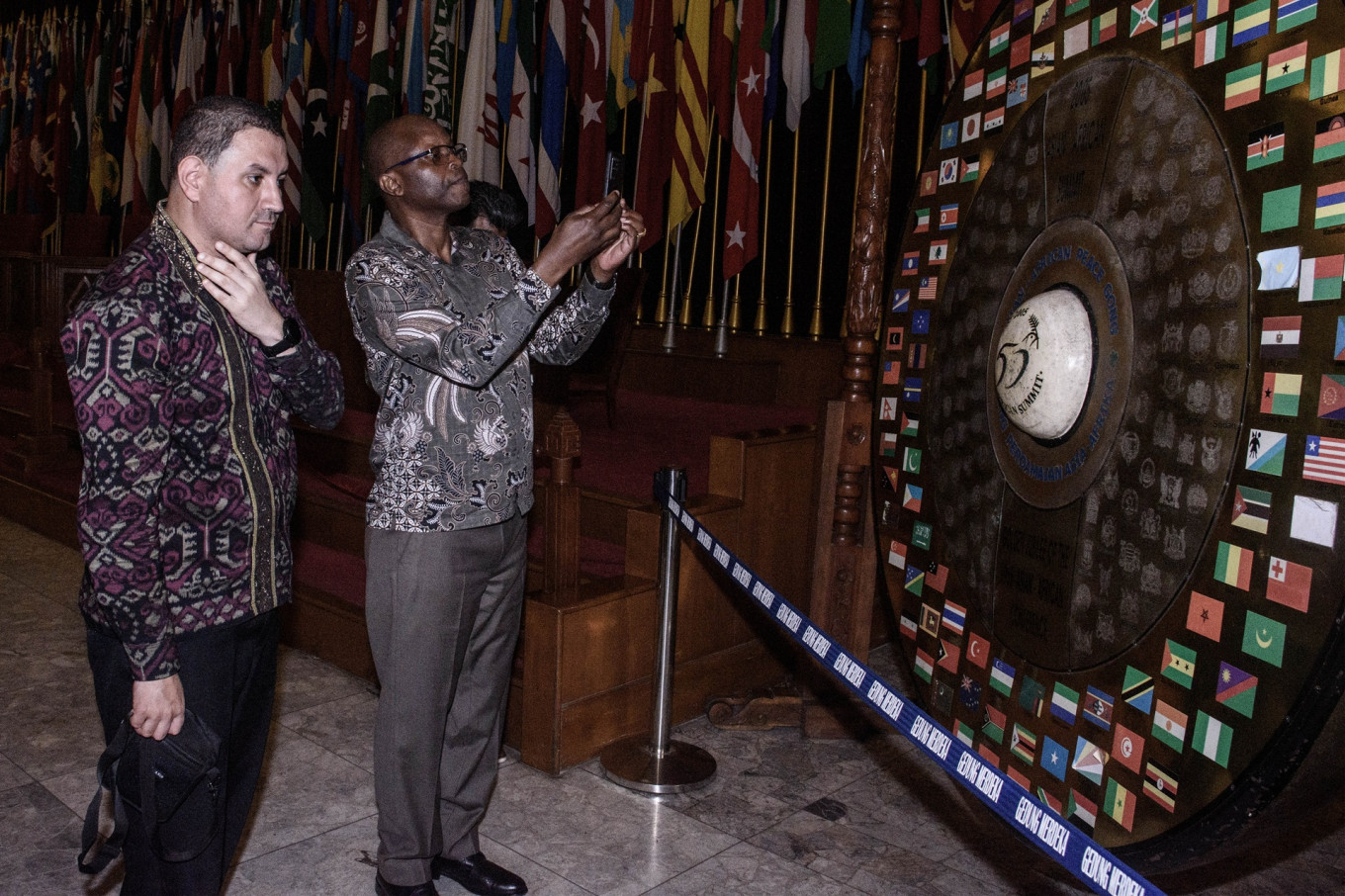 Two diplomatic delegates inspect the gong that was used to officiate the 50th anniversary of the 1955 Asia-Africa Conference,on April 23 at the Merdeka Building in Bandung, West Java. More than a dozen foreign dignitaries visited the Asia-Africa Museum as part of an event to commemorate the 70th anniversary of the conference in 2025. (Antara/Novrian Arbi)
I
ndonesia, which once hosted a conference between newly emerging Asian and African countries in the 1950s, was recently urged to pursue a more active and strategic foreign policy to advance global decolonization through Global South advocacy and the reform of a system that puts developing nations at a disadvantage.
Diplomats, academics and legal practitioners from Asian and African countries gathered at a colloquium hosted by the Indonesian International Islamic University (UIII) in Depok, West Java, on Wednesday to discuss ways for developing countries to play a bigger role in reshaping global rules and institutions still seen as favoring former colonial powers.
They also reflected on the legacies of the 1955 Asia Africa Conference, often dubbed the Bandung Conference, wherein Asian and African nations came together for the first time to challenge colonial dominance and Cold War power blocs.
In his opening remarks, UIII’s Indonesian Institute for Foreign Affairs (IIFA) international law center director Zezen Zaenal Mutaqin described the 1955 conference as “revolutionary”, citing it as among the first “decolonial interventions” seeking to challenge a Eurocentric international legal order.
But he lamented what he described as waning Indonesian engagement in carrying forward the conference’s advocacy, noting that foreign academics have increasingly been more active than locals in researching the landmark event.
“This absence breeds the urgent need for a renewed intellectual engagement,” Zezen said. “If we don’t reclaim this narrative, it will become the object of study of others, rather than leaving a framework shaped by Indonesian scholarship.”