The Jakarta Post
Please Update your browser
Your browser is out of date, and may not be compatible with our website. A list of the most popular web browsers can be found below.
Just click on the icons to get to the download page.


Popular Reads
Top Results
No results found. Please check your search term and try again
Can't find what you're looking for?
View all search results
Popular Reads
Top Results
No results found. Please check your search term and try again
Can't find what you're looking for?
View all search resultsStateless Rohingya rue Myanmar's election from exile
For the Rohingya minority, violence began well before the 2021 coup, with a military crackdown in 2017 sending legions of the mostly Muslim group fleeing Myanmar's Rakhine state to neighboring Muslim-majority Bangladesh.
Change text size
Gift Premium Articles
to Anyone
Share the best of The Jakarta Post with friends, family, or colleagues. As a subscriber, you can gift 3 to 5 articles each month that anyone can read—no subscription needed!
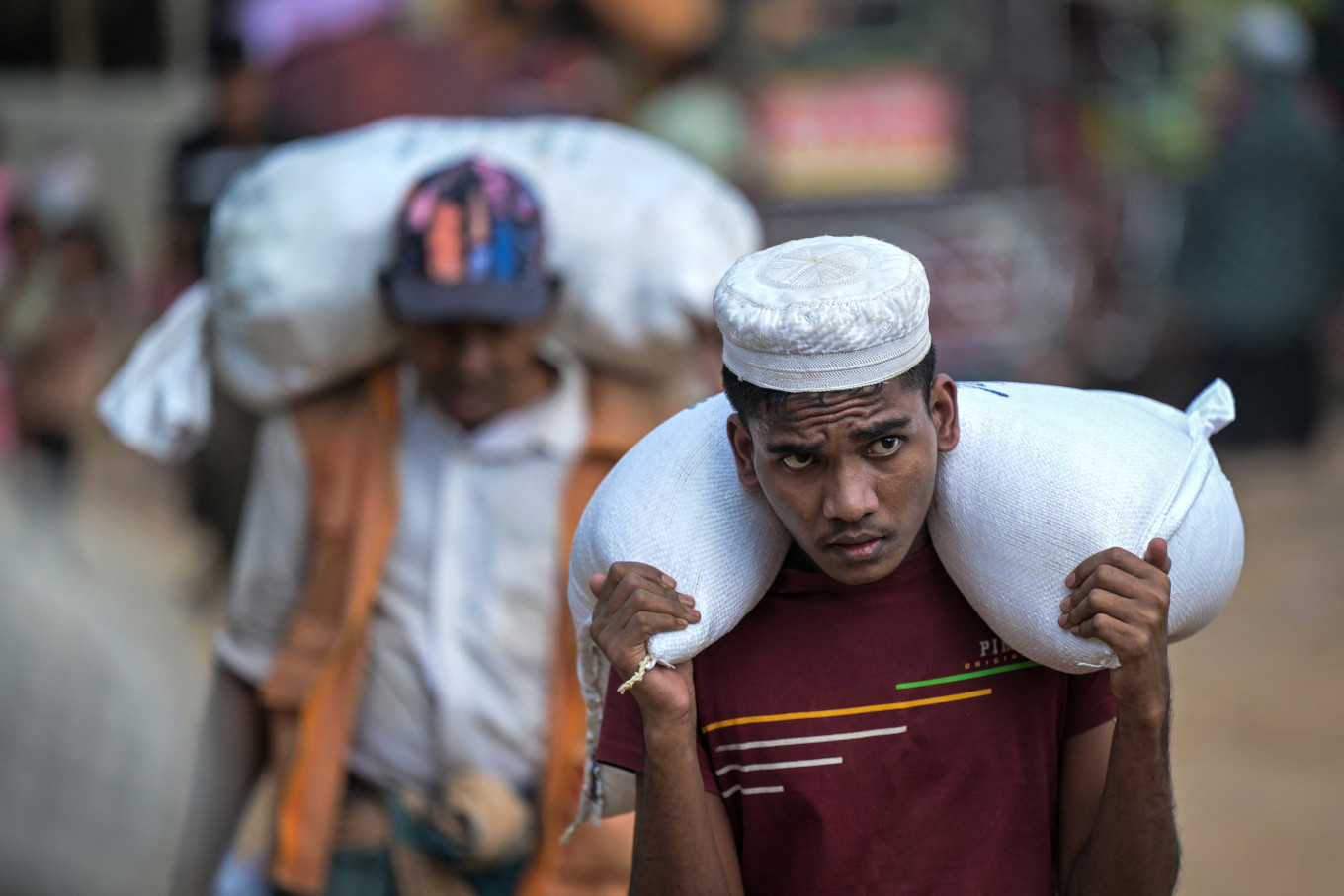 This photograph taken on Dec. 17, 2025 shows a Rohingya refugee carrying relief materials after collecting them from a distribution point at the Kutupalong refugee camp in Bangladesh's Ukhia.
Myanmar's military portrays its general election as a path to democracy and peace, but the vote offers neither to a million Rohingya exiles, robbed of citizenship rights and evicted from their homeland by force. (AFP/Munir Uz Zaman)
This photograph taken on Dec. 17, 2025 shows a Rohingya refugee carrying relief materials after collecting them from a distribution point at the Kutupalong refugee camp in Bangladesh's Ukhia.
Myanmar's military portrays its general election as a path to democracy and peace, but the vote offers neither to a million Rohingya exiles, robbed of citizenship rights and evicted from their homeland by force. (AFP/Munir Uz Zaman)
M
yanmar's military portrays its general election as a path to democracy and peace, but the vote offers neither to a million Rohingya exiles, robbed of citizenship rights and evicted from their homeland by force.
"How can you call this an election when the inhabitants are gone and a war is raging?" said 51-year-old Kabir Ahmed in Bangladesh's Kutupalong, the world's largest refugee camp complex.
Heavily restricted polls are due to start Sunday in areas of Myanmar governed by the military, which snatched power in a 2021 coup that triggered civil war.
But for the Rohingya minority, violence began well before that, with a military crackdown in 2017 sending legions of the mostly Muslim group fleeing Myanmar's Rakhine state to neighboring Muslim-majority Bangladesh.
The month-long election will be the third national poll since they were stripped of their voting rights a decade ago, but comes amid a fresh exodus fueled by the all-out war.
Ahmed once served as chairman of a village of more than 8,000 Rohingya in Myanmar's Maungdaw township, just over the border from Cox's Bazar in Bangladesh.
After their eviction, the area is now a "wasteland", he told AFP.
"Who will appear on the ballot?" he asked.
"Who is going to vote?"
'Send us back'
Today 1.17 million Rohingya live crammed in dilapidated camps spread over 8,000 acres in Cox's Bazar.
The majority came in the 2017 crackdown, which is now the subject of a United Nations genocide court case, with allegations of rampant rape, executions and arson.
Civil war has brought fresh violence, with the Rohingya caught between the warring military and separatist group the Arakan Army, one of the many factions challenging the junta's rule.
Both forces have committed atrocities against the Rohingya, monitors say.
Some 150,000 people fled the persecution to Bangladesh in the 18 months to July, according to UN analysis.
The UN refugee agency said it was the largest surge in arrivals since 2017.
Aged 18, Mohammad Rahim would have been eligible to vote this year – if he was back home, if his country acknowledged his citizenship and if polling went ahead despite the war.
"I just want the war to end and for steps to be taken to send us back to Myanmar," said Rahim, the eldest of four siblings who have all grown up in the squalid camps.
The Arakan Army controls all but three of Rakhine's 17 townships, according to conflict monitors, meaning the military's long-promised polls are likely to be extremely limited there.
The military has blockaded the coastal western state, driving a stark hunger and humanitarian crisis.
Rahim still craves a homecoming.
"If I were a citizen, I would negotiate for my rights. I could vote," he said.
"I would have the right to education, vote for whoever I wanted, and work towards a better future."
Read also: Myanmar junta's shift from battlefield to ballots faces long odds
Fate 'unchanged'
Successive military and civilian governments in Myanmar have eroded the citizenship of the Rohingya, dubbing them "Bengali" as descendants of immigrants who arrived during British colonial rule.
A 1982 law excluded them from full citizenship – unlike the other 135 ethnic groups recognized in Myanmar – and they were issued separate ID cards.
They were then deprived of the right to vote in 2015, just as most other people in Myanmar won more freedoms and military rule was relaxed.
"Will anyone who wins recognize us as citizens?" asked 52-year-old refugee Rehana Bibi.
"We are not a concern for anyone in Myanmar," the mother of six lamented in her tarpaulin-covered hut.
"Whether military-backed candidates or others win, the fate of the Rohingyas will remain unchanged."
In July, for the first time since their influx began eight years ago, Rohingyas held an election for their representatives inside 33 camps in Cox's Bazar.
"We printed ballot papers and ran awareness programs on democracy with the hope that someday we would return home and practice it there," said 33-year-old community leader Sayed Ullah.
Ahmed, the exiled village chairman, still dreams of an election back home.
"I was a teacher, but my people wanted me to lead them," he said. "I won three times straight."
"I am sure I would win again if only I got the chance," he said, his face lighting up.