The Jakarta Post
Please Update your browser
Your browser is out of date, and may not be compatible with our website. A list of the most popular web browsers can be found below.
Just click on the icons to get to the download page.


Popular Reads
Top Results
No results found. Please check your search term and try again
Can't find what you're looking for?
View all search results
Popular Reads
Top Results
No results found. Please check your search term and try again
Can't find what you're looking for?
View all search resultsMyanmar junta's shift from battlefield to ballots faces long odds
Six parties are competing nationwide, including the military-backed Union Solidarity and Development Party that is tipped to win the polls, creating conditions for members of the junta regime to take a civilian role.
Change text size
Gift Premium Articles
to Anyone
Share the best of The Jakarta Post with friends, family, or colleagues. As a subscriber, you can gift 3 to 5 articles each month that anyone can read—no subscription needed!
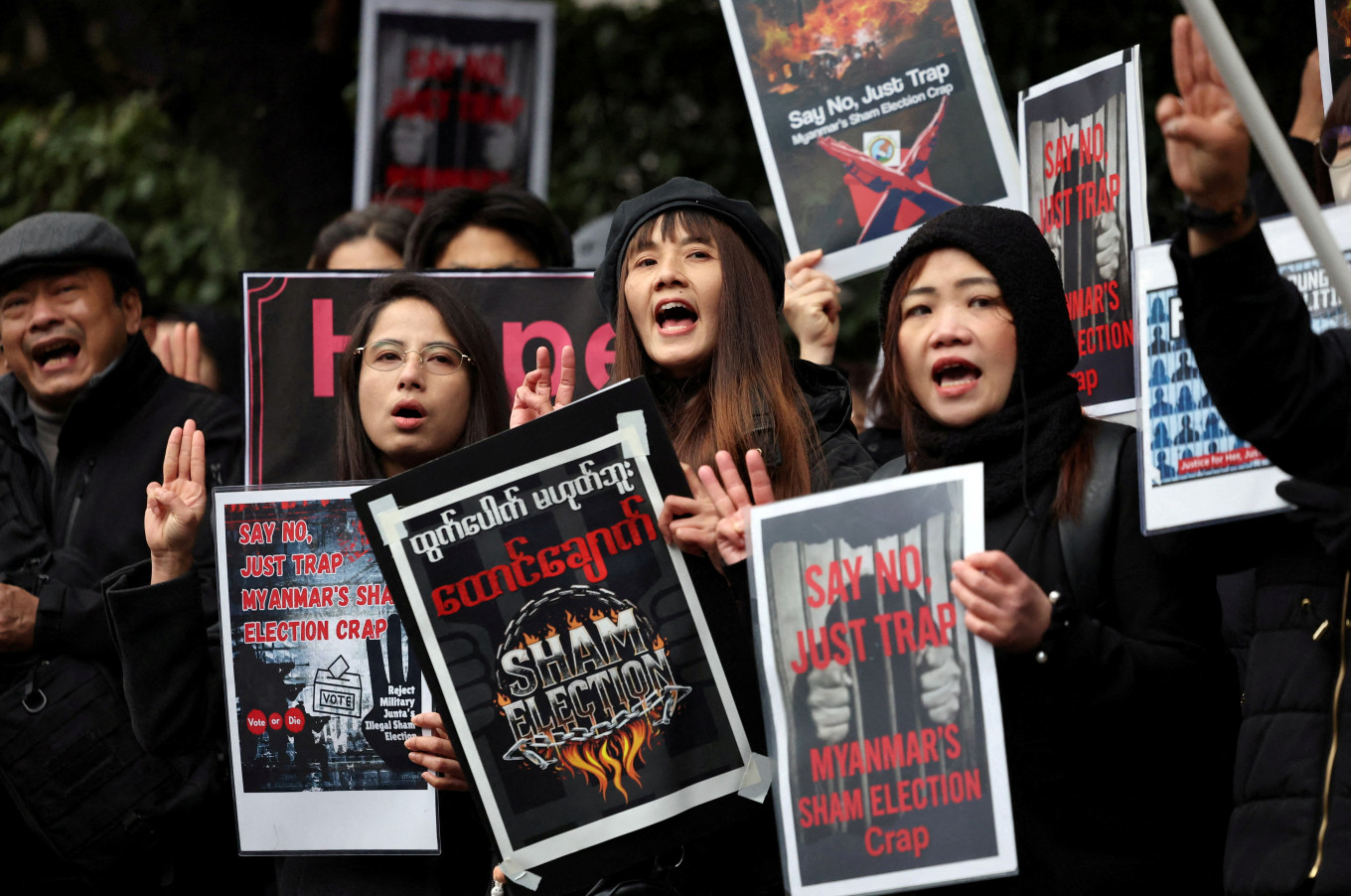 Myanmar protesters residing in Japan hold placards and raise three-finger salutes during a rally denouncing an upcoming election led by the military junta and demanding the immediate release of Myanmar's detained former leader Aung San Suu Kyi and all political prisoners, outside Myanmar's embassy in Tokyo, Japan, on Dec. 14, 2025. (Reuters/Issei Kato)
F
rom inside a military base last week, Myanmar's junta chief Min Aung Hlaing announced who he wanted voters to pick in Sunday's general election, nearly five years after seizing power in a coup.
"He suggested that during the upcoming election period, voters should choose candidates who can cooperate with the Tatmadaw," state-run media reported, referring to Myanmar's powerful armed forces.
The comments underline the junta's attempts to hold on to power as it uses ballots to do what it couldn't on the battlefield – cement its control over the country in the face of fierce armed resistance that has emerged since the coup, while gaining some international legitimacy for its rule.
But analysts and diplomats say the aim of establishing a stable administration in the Southeast Asian nation is far-fetched since the civil war is still raging, and a military-controlled government with a civilian veneer is unlikely to win many backers overseas.
"A new iteration of indirect military rule will do nothing to resolve the armed conflict or civil resistance, and Myanmar will remain mired in crisis," said Richard Horsey, Senior Myanmar Adviser at Crisis Group.
Voting will be held in two phases, on Sunday and Jan. 11, in only 202 of Myanmar's 330 townships where the military has varying degrees of control.
Dates for a potential third phase, counting or results have not been announced.
Future of Min Aung Hlaing
The battle-hardened Tatmadaw has long dominated politics in Myanmar, which won independence from Britain in 1948, with a string of military chiefs running the country with an iron grip.
Min Aung Hlaing joined their ranks in February 2021, when he ousted a civilian government led by Nobel laureate Aung San Suu Kyi on the unproven allegation of electoral fraud by her party, which had won the preceding years' polls by a landslide.
"The military is incapable of anything but cosmetic change that will not threaten their core interests of central control," said David Mathieson, an independent Myanmar analyst.
Suu Kyi's National League for Democracy, which won the last two general elections in 2020 and 2015, remains dissolved by the election commission, and many other anti-junta political outfits are not in the running.
Six parties are competing nationwide, including the military-backed Union Solidarity and Development Party that has the largest slate of candidates and is tipped to win the polls, creating conditions for the junta chief to take a civilian role.
"The USDP already has established political leaders within its ranks," said political analyst Sai Kyi Zin Soe, suggesting that Min Aung Hlaing's route to presidency may not be straightforward, although the general is expected to remain tremendously powerful.
"While it is likely that a national leader will emerge from the military-aligned USDP, we have to wait and see if that leader will be Min Aung Hlaing," he said.
Read also: Myanmar’s vote and the real contest in the north
Signals from the past
In a military-managed election in 2010, the Tatmadaw installed a former general as a civilian president, a move intended to oversee a tightly controlled political opening.
President Thein Sein later launched reforms that surprised critics and supporters alike. These included freeing political prisoners, easing long-standing media censorship and overseeing the 2015 election that resulted in a transfer of power to Suu Kyi after his party lost the vote.
But comparisons between the current situation and past processes can be flawed, partly because of the unprecedented violence that has ravaged Myanmar since the coup, as a popular armed resistance has combined with long-standing ethnic armies in the country's borderlands to challenge the Tatmadaw.
"Rather than stabilising the country, military-orchestrated elections are likely to intensify violence while failing to generate durable political or economic stability," said Ye Myo Hein, a senior fellow at the Southeast Asia Peace Institute non-profit.
Uncertain path for recognition
The elections are also a move by Min Aung Hlaing and his brass to seek foreign legitimacy after being shunned by the international community in the wake of the coup, the analysts said.
Although planned with the backing of key ally China, the junta is seeking to gather broader support for the elections, including from neighbours such as India and Thailand as well as the 11-member ASEAN bloc that has barred the ruling generals from its summits.
Thailand's foreign minister said last month that ASEAN would find it difficult to re-engage with Myanmar because the election was being held without the necessary "inclusive dialogue," and also called for Suu Kyi's release.
The United Nations, human rights groups and many nations have been vocal in their criticism of the elections that the junta is carrying out with the help of a law that punishes dissent and under which it has charged hundreds of people.
"Any meaningful election requires an end to violence and dialogue amongst all parties concerned," Britain said at the UN Security Council this week. "And there are no indications that the planned elections will be perceived as free or fair."
The junta insists that the polls have popular support, denying that they are being conducted with coercion, force or suppression.
"The election is being conducted for the people of Myanmar, not for the international community," junta spokesman Zaw Min Tun told reporters this month, according to state-run media.
"Whether the international community is satisfied or not is irrelevant."