TheJakartaPost
Please Update your browser
Your browser is out of date, and may not be compatible with our website. A list of the most popular web browsers can be found below.
Just click on the icons to get to the download page.


Popular Reads
Top Results
No results found. Please check your search term and try again
Can't find what you're looking for?
View all search results
Popular Reads
Top Results
No results found. Please check your search term and try again
Can't find what you're looking for?
View all search resultsIndonesia urges renewed US-Russia nuclear talks amid heightened risks
Change text size
Gift Premium Articles
to Anyone
Share the best of The Jakarta Post with friends, family, or colleagues. As a subscriber, you can gift 3 to 5 articles each month that anyone can read—no subscription needed!
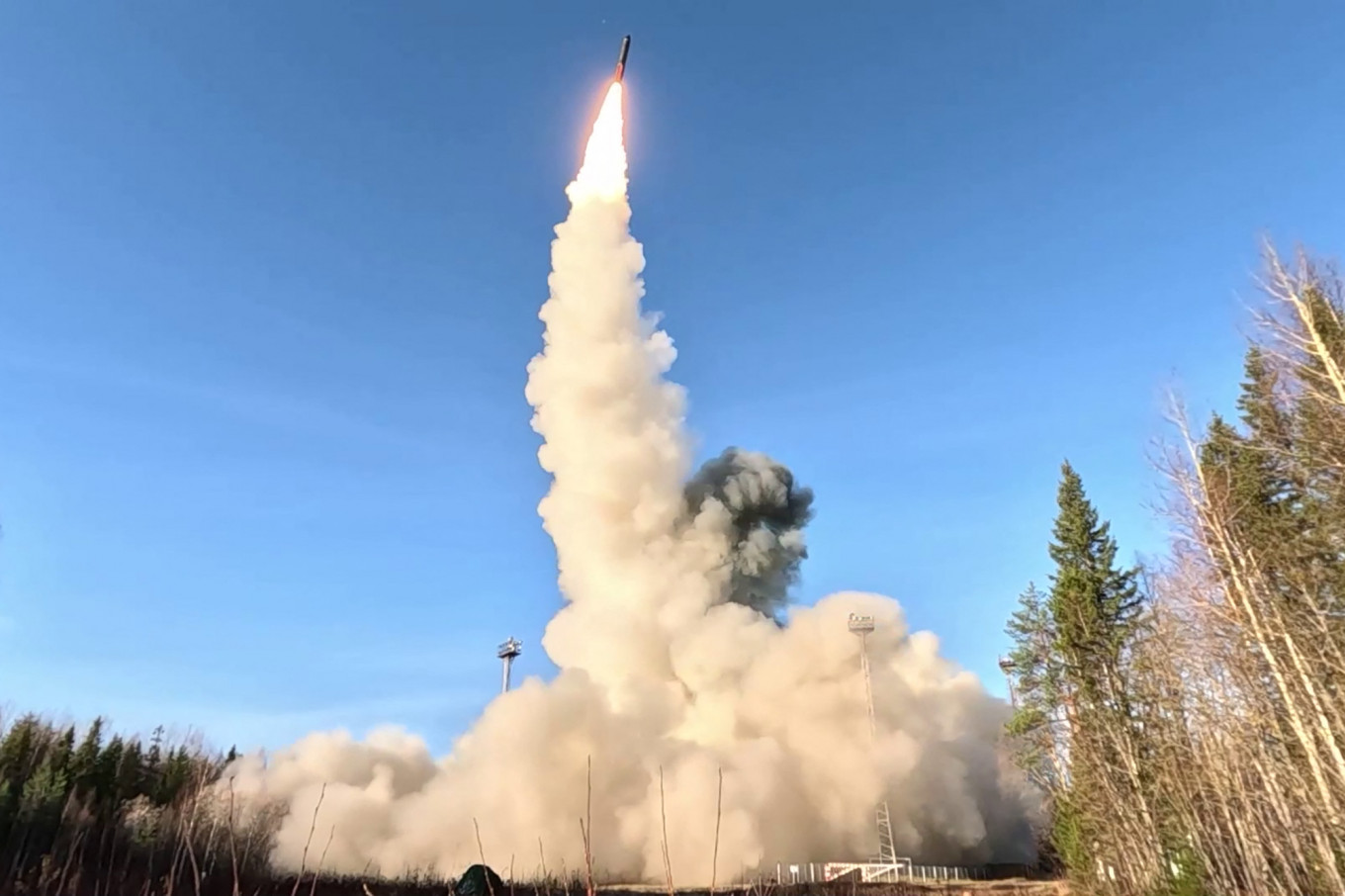 Strike capabilities: A screengrab from footage released on Oct. 22 shows the launch of a Yars intercontinental ballistic missile at the Plesetsk testing field in northern Russia during drills by the country’s nuclear forces. (AFP/Handout/Russian Defence Ministry/AFP/Handout/Russian Defence Ministry)
I
ndonesia has expressed “deep concern” over the expiration of the United States-Russia nuclear arms reduction treaty, urging both countries to continue negotiations to prevent a regulatory vacuum that could escalate nuclear risks worldwide.
The treaty, formally known as the New Strategic Arms Reduction Treaty (New START), had long limited the number of deployed strategic warheads and delivery systems held by the US and Russia, the world’s two largest nuclear arsenals. Its expiration on Thursday marks the first time since the 1970s that the two countries are no longer bound by bilateral limits on strategic offensive weapons.
Any miscalculation or escalation involving nuclear weapons, the Indonesian Foreign Ministry warned, would “threaten the survival and future of humanity” and could produce “catastrophic humanitarian consequences.” The ministry called on both nations to maintain dialogue and negotiate renewed limitations to prevent dangerous misunderstandings.
“Indonesia urges the United States and the Russian Federation to continue negotiations on renewed limitations and reductions of strategic offensive arms, and to maintain essential channels of communication to prevent miscalculation and escalation,” the ministry said in a statement.
“[The treaty’s expiration] adds further uncertainty to the global security environment and heightens the risk of a renewed arms race and nuclear weapons use, underscoring the urgent need for tangible progress in nuclear disarmament,” it added.
Read also: Prabowo invited to US for Trump Board of Peace meeting, eyes trade deal signing
First signed in 2010, the treaty capped arsenals at 1,550 deployed warheads, roughly two-thirds below Cold War levels, across 700 delivery systems, and limited the number of strategic launchers each side could maintain.