The Jakarta Post
Please Update your browser
Your browser is out of date, and may not be compatible with our website. A list of the most popular web browsers can be found below.
Just click on the icons to get to the download page.


Popular Reads
Top Results
No results found. Please check your search term and try again
Can't find what you're looking for?
View all search results
Popular Reads
Top Results
No results found. Please check your search term and try again
Can't find what you're looking for?
View all search resultsChina boosts defence spending 7% in drive to modernise by 2035
Security analysts and regional military attaches are watching China's budget closely as it scrambles to modernise the military by 2035, while stepping up deployments across East Asia and purging the top brass to tackle graft.
Change text size
Gift Premium Articles
to Anyone
Share the best of The Jakarta Post with friends, family, or colleagues. As a subscriber, you can gift 3 to 5 articles each month that anyone can read—no subscription needed!
 Set as preferred source
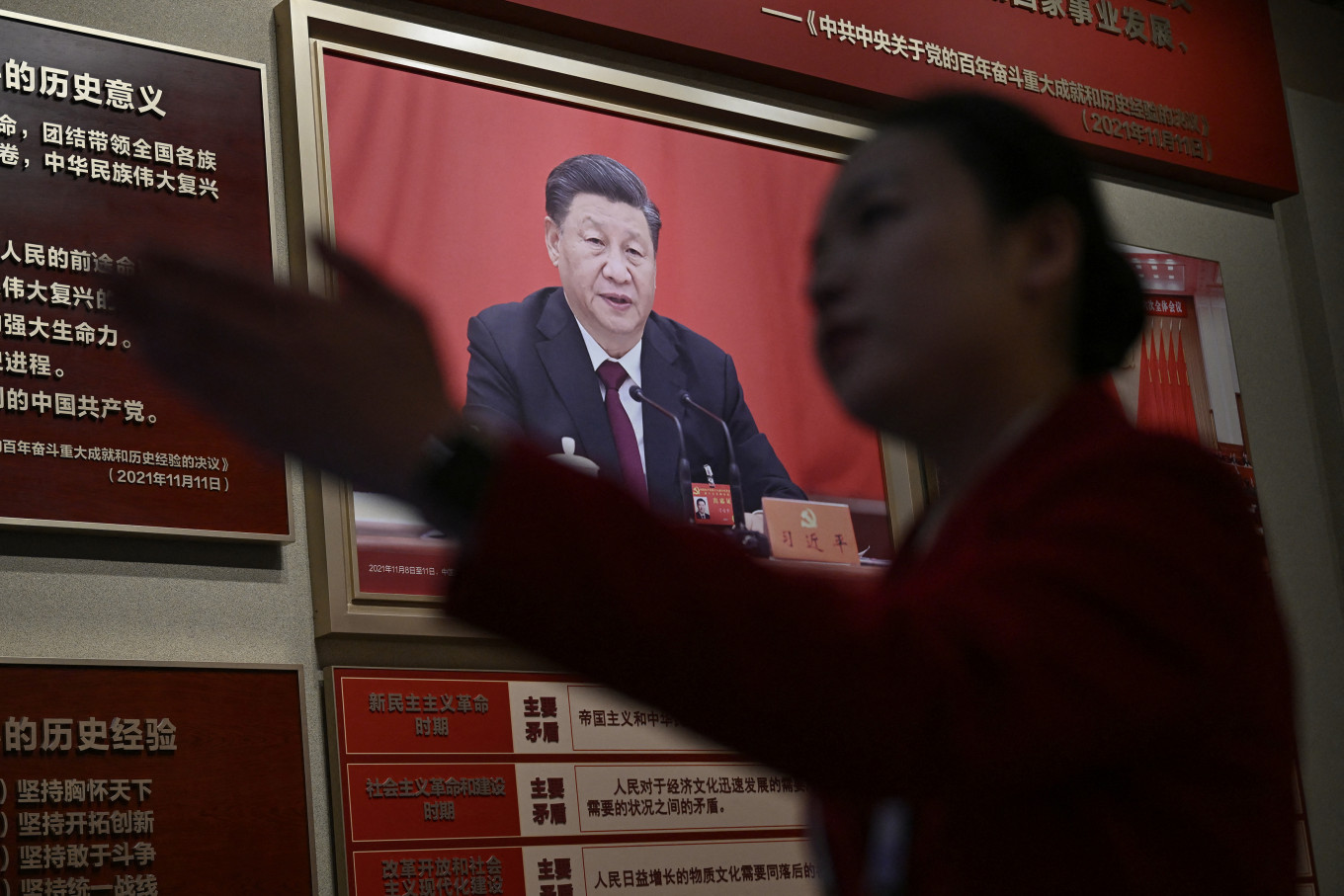 Political figure: A woman walks past a portrait of Chinaʼs President Xi Jinping on Sunday, March 1, 2026 at the Museum of the Communist Party of China in Beijing, ahead of the opening of the annual session of the National People’s Congress (NPC). (AFP/Pedro Pardo)
C
hina will boost defence spending by 7 percent in 2026, it said on Thursday, the lowest rate in five years but still outpacing wider economic growth targets and the rest of Asia at a time of growing regional tension, including over Taiwan.
Security analysts and regional military attaches are watching China's budget closely as it scrambles to modernise the military by 2035, while stepping up deployments across East Asia and purging the top brass to tackle graft.
China will improve combat readiness and accelerate the development of "advanced combat capabilities", Premier Li Qiang said at the opening of parliament's annual meeting, at which he unveiled a broader GDP growth forecast of 4.5 percent to 5 percent.
"All these steps will boost our strategic capacity to safeguard China's sovereignty, security and development interests," Li said in his work report, adding that President Xi Jinping held ultimate command responsibility.
The figure of 7 percent, which follows three years of annual rises of 7.2 percent and is the lowest since 6.8 percent in 2021, is part of a spending campaign in which China's military has developed new advanced missiles, ships, submarines and surveillance methods.
This year's increase showed Beijing was keeping to a long-held principle of balancing economic growth with national defence goals, said James Char of the S. Rajaratnam School of International Studies in Singapore.
"Essentially, the People's Liberation Army budget has been growing at a fairly consistent rate as a percentage of GDP ... roughly the rate of GDP growth plus inflation," added Char, a China defence scholar.
It comes amid the highest-profile purge of upper military ranks in decades, with the two most senior generals ensnared in disciplinary investigations.
Zhang Youxia, a veteran military ally of Xi, was placed under investigation in January, while another, He Weidong, was expelled in October last year.
The purge leaves just two members of the usual seven on the supreme Central Military Commission, Xi himself as its chair, and a newly promoted vice chairman, Zhang Shengmin.
The corruption crackdown showed "Beijing will keep a tighter watch on military spending," said Wen-Ti Sung, a security analyst based in Taiwan, although it was clear all levels of government were getting more frugal.
The government remains committed to the ruling Communist Party's "absolute leadership over the armed forces", Li added.
"Guided by the principle of ensuring political loyalty in the military, we will continue to improve military political conduct and make major strides towards the centenary goals of the People's Liberation Army."
Some regional analysts believe the founding anniversary, which falls next year will bring further increases in military drills and deployments around Taiwan, the democratically-governed island that Beijing views as its territory.