The Jakarta Post
Please Update your browser
Your browser is out of date, and may not be compatible with our website. A list of the most popular web browsers can be found below.
Just click on the icons to get to the download page.


Popular Reads
Top Results
No results found. Please check your search term and try again
Can't find what you're looking for?
View all search results
Popular Reads
Top Results
No results found. Please check your search term and try again
Can't find what you're looking for?
View all search resultsDiplomacy key to Indonesia’s energy shift: Report
The Transformation Partnerships for Indonesia’s Clean Energy Transition report was prepared by Synergy Policies and the Foreign Ministry’s Foreign Policy Strategy Agency over 11 months to examine how foreign policy could aid Indonesia’s shift to clean energy.
Change text size
Gift Premium Articles
to Anyone
Share the best of The Jakarta Post with friends, family, or colleagues. As a subscriber, you can gift 3 to 5 articles each month that anyone can read—no subscription needed!
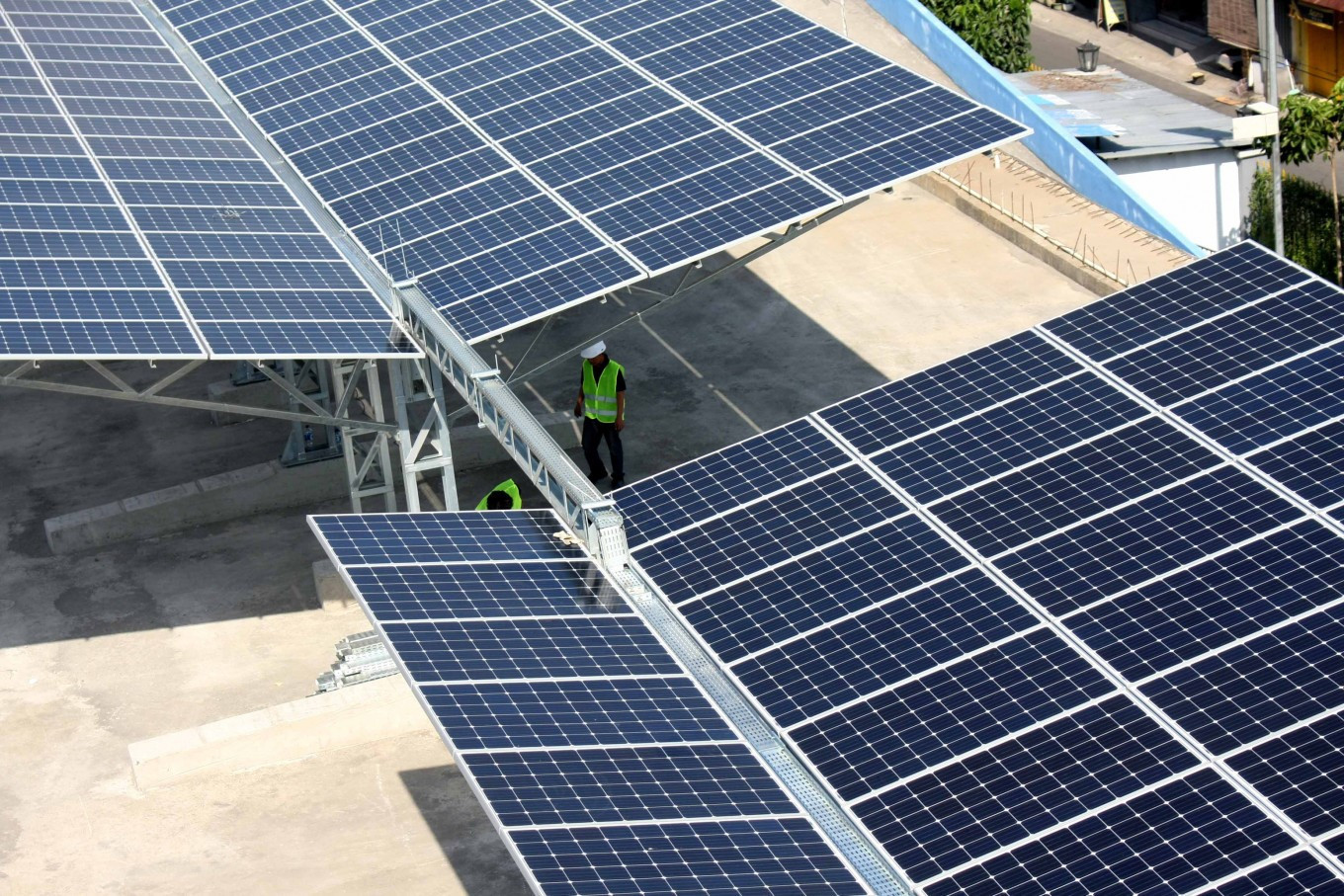 Workers check solar panels at Tirtonadi Terminal in Surakarta, Central Java, for a Transportation Ministry project capable of producing 500,000 watts of electricity to power operations of the terminal, in this undated photo. (JP/Ganug Nugroho Adi)
I
ndonesia, as a developing country, needs to navigate its clean energy transition with a comprehensive diplomatic strategy that also strengthens domestic capabilities amid new and volatile geopolitical tensions, a report by Jakarta-based think tank Synergy Policies has said.
The Transformation Partnerships for Indonesia’s Clean Energy Transition report was prepared by Synergy Policies and the Foreign Ministry’s Foreign Policy Strategy Agency over 11 months to examine how foreign policy could aid Indonesia’s shift to clean energy, Synergy Policies founder Dinna Prapto Raharja said during the report’s launch in Jakarta on Monday.
“We found many gaps [in the energy transition] if we look beyond trade volume and investments. We found that the Foreign Ministry holds an important role to build a clean energy transition,” Dinna said.
She said the report found that trade and investment alone would not be sufficient to accelerate partnerships in clean energy. For cooperation to become transformative, clean energy transition efforts must be backed by industrial policies and financing that penetrate the market and are cost competitive.
“Partnership should go beyond securing deals. It should go toward equitable agreements grounded on mutual benefits,” Dinna said.
The report also examined Indonesia and China’s bilateral relations to identify issues in the energy transition, Dinna said, and found two key aspects to ensuring an effective clean energy shift in Indonesia.
On the supply side, businesses need regulatory certainty and firm government commitments to ensure participation in the energy transition. On the demand side, infrastructure for clean energy distribution across the country still requires improvement.
The Foreign Ministry’s Foreign Policy Strategy Agency Chief Strategist for the America and Europe Region Spica Alphanya Tutuhatunewa said the energy transition has become one of the ministry’s diplomatic priorities in engaging partners, not only at its headquarters in Jakarta but also through Indonesian missions abroad.
“The Foreign Ministry values cooperation and understands that nowadays foreign policy not only belongs to the Foreign Ministry or diplomats,” she said.
“There are many actors participating in and engaged with the Foreign Ministry and diplomats to formulate foreign policies that not only will represent the interests of the nation, but most importantly, will directly impact the people. The energy transition is one of them,” Spica said during the report’s launch.
She encouraged input from both national and international partners, noting that economic diplomacy now spans many facets requiring the ministry’s engagement.
Meanwhile, Mohammad Fadhil Hasan, an economist and member of the National Energy Council, said Indonesia’s clean energy transition was no longer merely a technical or environmental agenda, but a strategic objective in itself.
“It has evolved into the strategic domain, which is shifting our economic resilience, industrial capability and foreign policy orientation,” Fadhil said during the report’s launch.
He also noted that geopolitical realities, including the current conflict in Iran, would influence countries’ energy transition agendas. For Indonesia, he said, the transition is not only about reducing emissions but also about ensuring self-reliance and sovereignty.
Wijayanto Samirin, an economist at Paramadina University, warned that persistent mindset issues could hinder Indonesia’s clean energy transition.
The first problem, Wijayanto said, is the belief that Indonesia is rich in conventional energy resources. Indonesia’s energy resource value is only about half of Venezuela’s, however.
The second problem is the perception that renewable energy remains expensive, particularly when factoring in energy storage systems. The third is the tendency to view the energy transition purely as an environmental issue.
“The fourth [problem] when it comes to policy, oftentimes the policy is not consistent,” Wijayanto said, pointing to the government’s flagship 35,000-megawatt electricity procurement program introduced in 2015, which led to electricity oversupply in 2017 and left limited room for renewable energy investment.