The Jakarta Post
Please Update your browser
Your browser is out of date, and may not be compatible with our website. A list of the most popular web browsers can be found below.
Just click on the icons to get to the download page.


Popular Reads
Top Results
No results found. Please check your search term and try again
Can't find what you're looking for?
View all search results
Popular Reads
Top Results
No results found. Please check your search term and try again
Can't find what you're looking for?
View all search resultsKF-21 to drive S. Korea's defense ambitions, carry peace beyond borders, says Lee
KF-21 is a symbol of South Korea’s transformation from a buyer of foreign arms to a developer of advanced weapons.
Change text size
Gift Premium Articles
to Anyone
Share the best of The Jakarta Post with friends, family, or colleagues. As a subscriber, you can gift 3 to 5 articles each month that anyone can read—no subscription needed!
 Set as preferred source
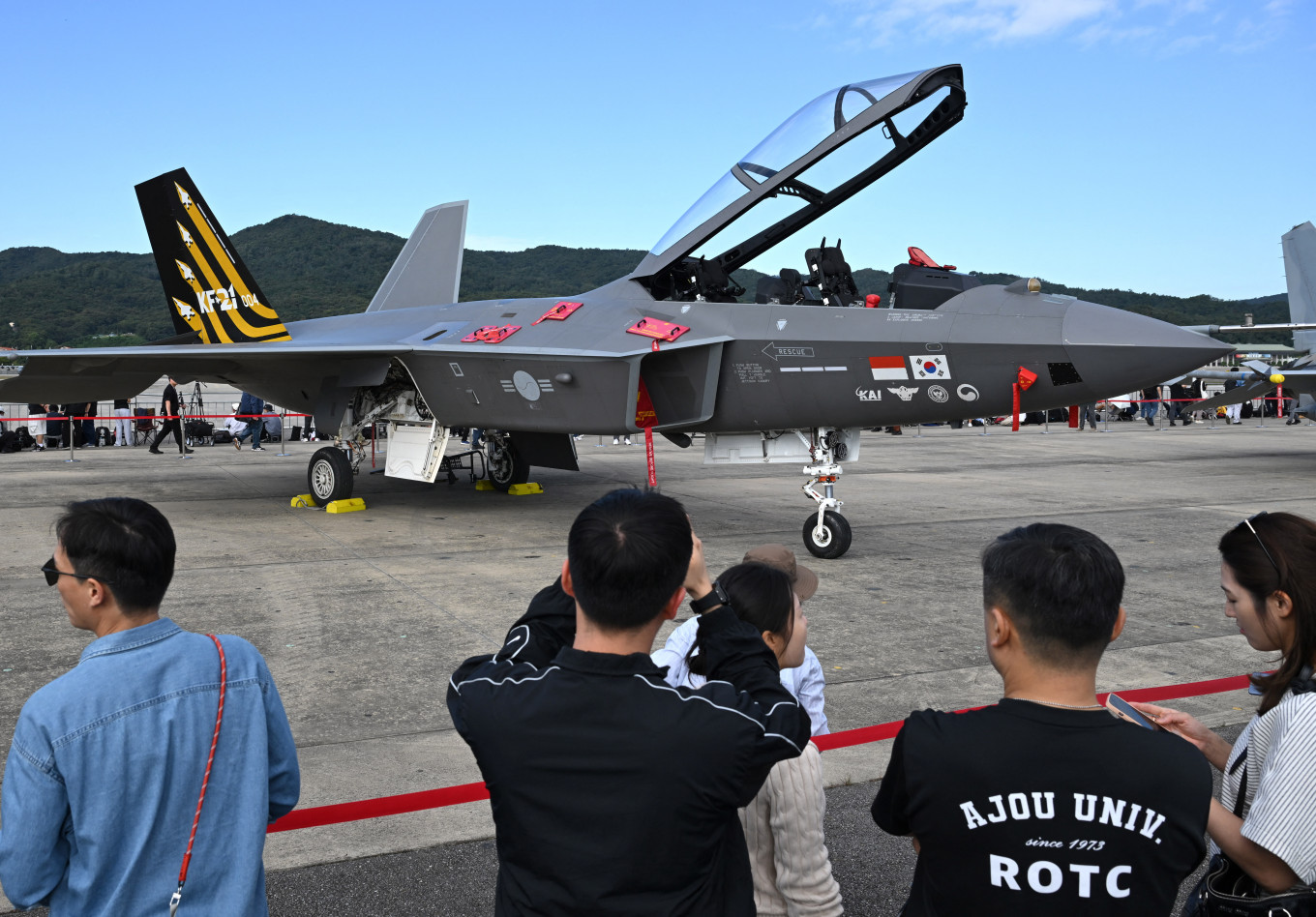 Visitors look at a KF-21 Boramae jet fighter during the Seoul International Aerospace and Defense Exhibition (ADEX) at a military airport in Seongnam, South Korea, on Oct. 17, 2025. The jet fighter was jointly developed with Indonesia as a minority partner. (AFP/Jung Yeon-je)
P
resident Lee Jae-myung said Wednesday that the rollout of the KF-21, South Korea’s first homegrown fighter jet, was more than a military achievement, describing it as a milestone in the country’s push to become one of the world’s top four defense powers.
Lee also cast the aircraft as a symbol of South Korea’s transformation from a buyer of foreign arms to a developer of advanced weapons, and as a platform that could contribute to peace and security beyond the Korean Peninsula.
Lee made the remarks at the rollout ceremony for the first mass-produced KF-21 fighter jet on Wednesday at Korea Aerospace Industries in Sacheon, South Gyeongsang province.
“Through the mass production of the KF-21, the Republic of Korea has finally come to possess weapons that safeguard peace with our own technology and will — in the skies, following the land and sea — thereby demonstrating the strength of defense self-reliance,” Lee said in his congratulatory speech, referring to South Korea by its official name.
The rollout ceremony carried strong symbolic weight, coming 25 years after President Kim Dae-jung first laid out his vision of Korea developing its fighter aircraft during a commencement address at the Korea Air Force Academy in 2001.
Lee, however, pointed out that "the success of the KF-21 is not simply a strengthening of defense capabilities."
"Rather it means that the Republic of Korea has secured a new engine that enables it to compete confidently with the world’s leading defense powers," Lee said.
“The government will take the success of the KF-21 as a firm stepping-stone toward becoming one of the world’s top four defense powers.”
According to Lee, the KF-21 had generated growing interest from overseas ahead of the rollout of its first production model because of its strong performance, cost-efficient upkeep and broad potential for further adaptation.
The KF-21 Boramae is a 4.5-generation supersonic fighter jet with reduced observability compared to fourth-generation aircraft.
In his speech, Lee pledged continued investment in advanced aerospace technologies and vowed to boost defense industry competitiveness by sharing South Korea’s weapons systems, technology and development know-how with partner countries.
“A country that once depended on foreign-supplied weapons for its defense has now become one that develops and produces advanced arms with its own technology — and one whose weapons are sought after by countries around the world,” Lee said.
“Our proud fighter jet will defend the airspace of the Republic of Korea and serve as a symbol of solidarity and a messenger of peace across the globe.”
Lee pledged that “the government will continue to move toward achieving long-envisioned defense self-reliance, while advancing South Korea’s role in contributing to global peace and prosperity.”
The KF-21 rolled out will undergo performance verification by the manufacturer and the Air Force before being deployed for the Air Force in September this year.
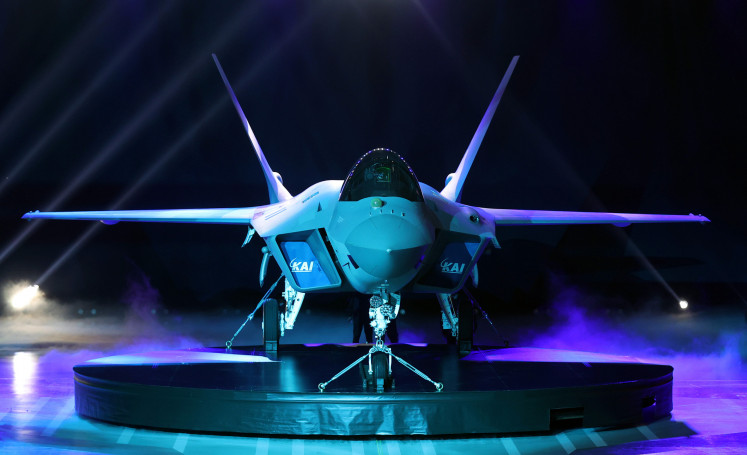
Development of the KF-21 began in December 2015, with the first prototype unveiled in April 2021. The prototype successfully completed its first flight in July 2022, and mass production began in July 2024. Developmental flight testing was completed in January of this year.
The KF-21 debut is the result of close cooperation between the Defense Acquisition Program Administration, Korea Aerospace Industries and a broad network of academic and research institutions. The scale of the effort was reflected in the testing process alone, with six prototype KF-21 used to carry out 955 ground tests and 1,601 flight tests
The ceremony drew a broad range of foreign diplomats and military officials, underscoring growing international interest in South Korea’s fighter program.
Attendees included British Ambassador to Korea Colin Crooks, Japanese Ambassador to Korea Koichi Mizushima, Indonesian Ambassador to Korea Cecep Herawan, Canadian Ambassador to Korea Philippe Lafortune and Peruvian Ambassador to Korea Paul Fernando Duclos Parodi
Diplomats from Australia, Egypt, Iraq, Poland, Thailand and the United States were also present.
The rollout ceremony came ahead of a state visit by Indonesian President Prabowo Subianto from March 31 to April 2, during which Seoul and Jakarta are expected to sign an agreement for an export contract to supply 16 KF-21 fighter jets.
Later in the day, Lee inspected the KF-21 production site, where KAI CEO Kim Jong-chool briefed him on the production process, the facility’s annual output capacity and the current lineup of aircraft under production, including the FA-50 light combat aircraft and the T-50 advanced supersonic trainer jet.
Lee was also given an overview of KAI’s manned-unmanned teaming, or MUM-T, concept — an operational system that pairs manned and unmanned platforms to enhance combat effectiveness — as well as the company’s multipurpose unmanned aircraft now under development, a core element of that future combat architecture.