TheJakartaPost
Please Update your browser
Your browser is out of date, and may not be compatible with our website. A list of the most popular web browsers can be found below.
Just click on the icons to get to the download page.


Popular Reads
Top Results
No results found. Please check your search term and try again
Can't find what you're looking for?
View all search results
Popular Reads
Top Results
No results found. Please check your search term and try again
Can't find what you're looking for?
View all search resultsRussia calls for joint food reserves with BRICS to counter Middle East crisis risks
Egypt, a BRICS member, is the largest importer of Russian wheat, while Russia also exports food to China and India, the bloc's two biggest economies.
Change text size
Gift Premium Articles
to Anyone
Share the best of The Jakarta Post with friends, family, or colleagues. As a subscriber, you can gift 3 to 5 articles each month that anyone can read—no subscription needed!
 Set as preferred source
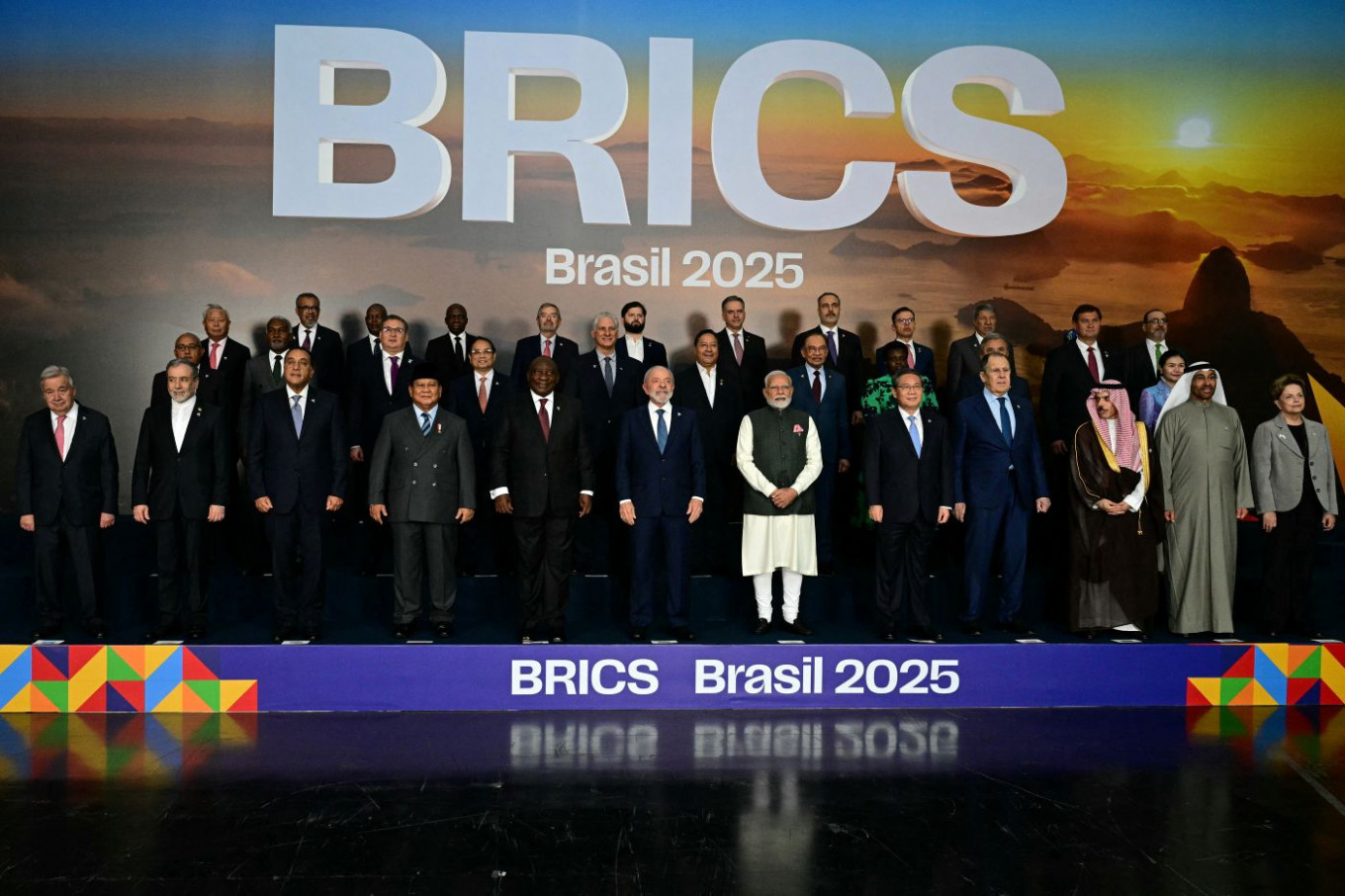 Familiar faces: Heads of state and government of member, partner and external engagement countries pose for a family photo during the BRICS Summit in Rio de Janeiro, Brazil, on July 7, 2025. (AFP/Pablo Porciuncula)
R
ussia, the world's largest wheat exporter, should create joint food reserves with fellow BRICS members and former Soviet neighbors to counter the risks to global food security stemming from the conflict in the Middle East, a senior Russian security official said on Monday.
About half of the world's food is grown using fertilizer, while one-third of global fertilizer trade used to pass through the Strait of Hormuz, a narrow shipping lane along Iran's coast that has been largely closed since the conflict began.
"To ensure food security, it is highly important to expand cooperation with friendly countries, primarily the member states of the Eurasian Economic Union and BRICS, including through the creation of joint food reserves," Alexander Maslennikov, deputy secretary of Russia's Security Council, was quoted as saying by domestic news agencies.
Chaired by President Vladimir Putin, the Security Council includes top officials and helps shape Kremlin decisions on major national security issues.
Maslennikov said the Middle East crisis posed serious risks to global food security. If the global fertilizer shortage persists until early summer, yields of major crops could fall by half, he said, fueling the sharpest rise in world food inflation in recent years.
He added that the number of hungry people worldwide could rise to a record 673 million.
The World Bank, International Monetary Fund and the UN World Food Programme warned last week that sharp increases in oil, natural gas and fertilizer prices triggered by the war in the Middle East will inevitably cause rising food prices and food insecurity.
Russia is a major producer and exporter of fertilizer but lacks the capacity to significantly increase output this year. It is also seeking to raise agricultural exports by half by 2030.
Maslennikov said the current situation, while posing risks to Russia's own food security, also created long-term opportunities for the country's agricultural producers.
"Russia is in a strong position to increase food exports to the countries of the Middle East, as well as to Asia, Africa and Latin America," he said.
Egypt, a BRICS member, is the largest importer of Russian wheat, while Russia also exports food to China and India, the bloc's two biggest economies. The Eurasian Economic Union, led by Russia, also includes grain exporter Kazakhstan, as well as Belarus, Armenia and Kyrgyzstan.