The Jakarta Post
Please Update your browser
Your browser is out of date, and may not be compatible with our website. A list of the most popular web browsers can be found below.
Just click on the icons to get to the download page.


Popular Reads
Top Results
No results found. Please check your search term and try again
Can't find what you're looking for?
View all search results
Popular Reads
Top Results
No results found. Please check your search term and try again
Can't find what you're looking for?
View all search resultsChina warns joint US, Philippines and Japan drills risk regional trust
"What the Asia-Pacific region most needs is peace and tranquility, and what it least needs is the introduction of external forces to create division and confrontation," Guo Jiakun, a ministry spokesperson, said at a regular press briefing in Beijing.
Change text size
Gift Premium Articles
to Anyone
Share the best of The Jakarta Post with friends, family, or colleagues. As a subscriber, you can gift 3 to 5 articles each month that anyone can read—no subscription needed!
 Set as preferred source
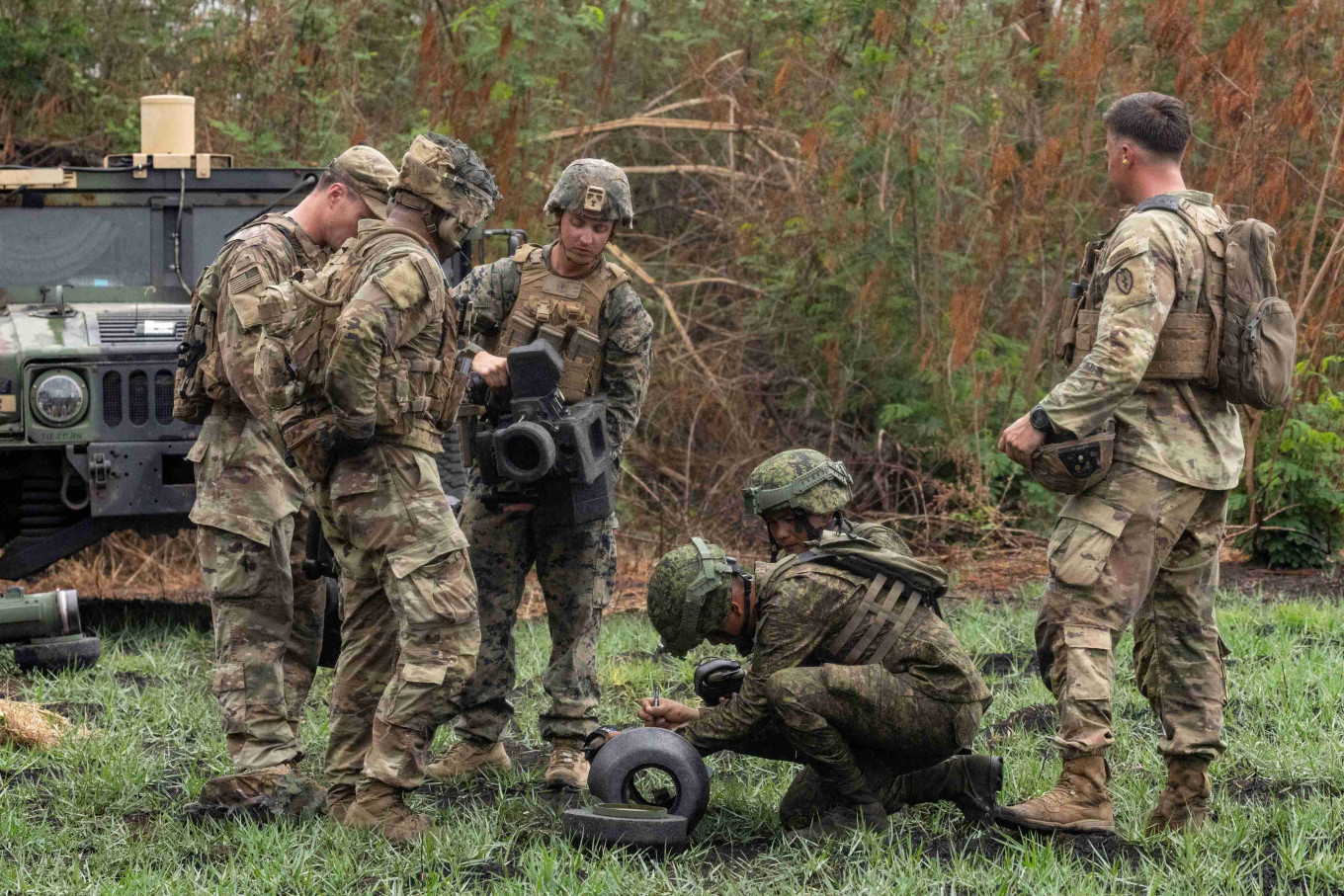 A Filipino soldier signs his name on a Javelin missile case after firing the anti-tank weapon for the first time during a live fire exercise in the annual US-Philippines joint military exercises called (Reuters/ELOISA LOPEZ)
M
ilitary cooperation between countries should not undermine mutual understanding and trust among regional countries, the Chinese foreign ministry said on Monday, when asked about the annual joint military exercises hosted by the Philippines and the United States that will also involve Japanese forces.
"What the Asia-Pacific region most needs is peace and tranquility, and what it least needs is the introduction of external forces to create division and confrontation," Guo Jiakun, a ministry spokesperson, said at a regular press briefing in Beijing.
"We would like to remind the relevant countries that persisting in tying themselves together on security will only lead to setting themselves on fire and backfiring," Guo said.
Thousands of American and Philippine troops, joined for the first time by a significant contingent of Japanese forces, began annual military exercises Monday set against the backdrop of the Middle East war.
The war games will feature live-fire exercises in the north of the country facing the Taiwan Strait, as well as a province off the disputed South China Sea, where the Philippines and China have engaged in repeated confrontations.
In one drill, the Japanese military, which is contributing about 1,400 personnel, will use a Type 88 cruise missile to sink a World War II-era minesweeper off the coast of northern Luzon island.
More than 17,000 soldiers, airmen and sailors are taking part in the 19-day Balikatan, or "Shoulder to Shoulder," exercises -- about the same number as last year's edition, including contingents from Australia, New Zealand, France and Canada.
Balikatan comes as Iran and the United States, along with Israel, edge towards the end of the two-week ceasefire that halted the Middle East war, ignited by surprise US-Israeli strikes on Iran.
Among the high-end weapons expected to be involved during the annual exercise is a US Typhon missile system that has been in the archipelago since it was left by visiting US forces in 2024, provoking outrage from Beijing.