TheJakartaPost
Please Update your browser
Your browser is out of date, and may not be compatible with our website. A list of the most popular web browsers can be found below.
Just click on the icons to get to the download page.


Popular Reads
Top Results
No results found. Please check your search term and try again
Can't find what you're looking for?
View all search results
Popular Reads
Top Results
No results found. Please check your search term and try again
Can't find what you're looking for?
View all search resultsThe (im)possible quest of making Indonesia a solar powerhouse
As renewable energy generation in Indonesia is lagging behind due to a lack of political will, a weak supportive regulatory framework and incentives; and also market barriers and doubts on grid and human resource readiness.
Change text size
Gift Premium Articles
to Anyone
Share the best of The Jakarta Post with friends, family, or colleagues. As a subscriber, you can gift 3 to 5 articles each month that anyone can read—no subscription needed!
S
olar energy is the prime mover for renewable energy development globally. Its growth has surpassed other forms of renewable energy and fossil fuel generation. Since 1990, the International Energy Agency (IEA) recorded that solar energy grew at an average annual rate of 37 percent, surpassing other renewables.
A recent IEA report confirms that solar energy is now the cheapest energy in the world. It projected the annual capacity of solar energy will grow from 100 gigawatts (GW) in 2019 to 220 GW in 2040. The higher demand is driven by the drop of the solar cell price, now 80 percent lower than in 2009, and an increasing trend in performance and efficiency.
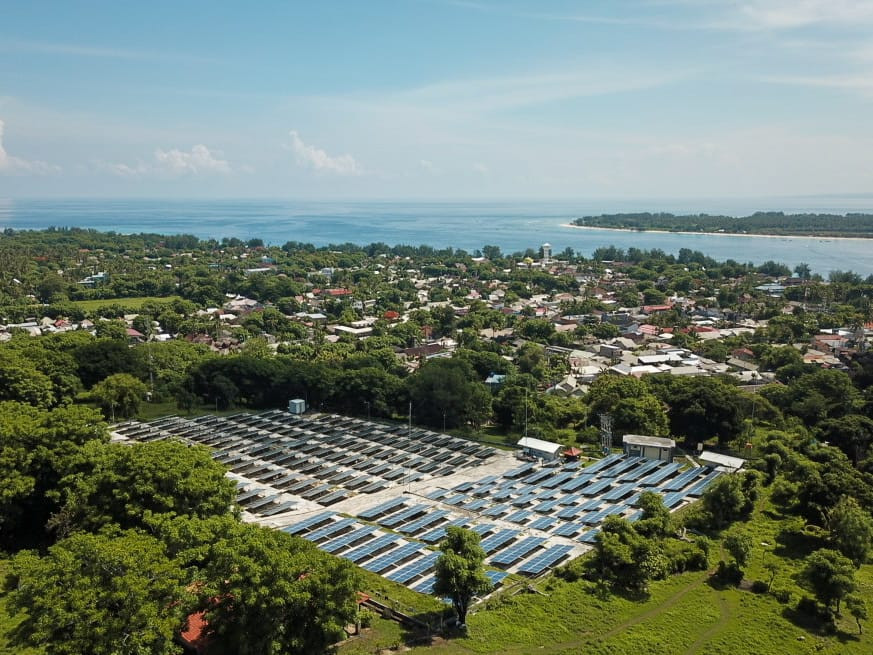
The Energy and Mineral Resources Ministry has estimated Indonesian solar power potential at 207 gigawatt-peak (GWp). The Institute for Essential Services Reform’s (IESR) calculation on only the nation’s residential buildings yielded an even higher number, 655 GWp. Ground-mounted solar energy has the potential of 1,000 GW. News media often calls this potential “untapped”. So much potential, so little utilization. As of mid-2020, cumulative installation of solar energy in Indonesia had yet to reach 200 megawatt-peak (MWp).
It is not solely on solar energy, as renewable energy generation in Indonesia is lagging behind due to a lack of political will, a weak supportive regulatory framework and incentives; and also market barriers and doubts on grid and human resource readiness. Indonesia’s renewable energy landscape is called a “frontier market” for a reason: It carries risks and, as such, is considered unattractive in terms of investment.
Apart from the government budget, an additional annual US$3 billion to $5 billion investment is required to meet the renewable energy target of 23 percent by 2025. Solar energy is the obvious answer: It is modular and hence can be installed at any scale, it is easy to deploy and many locations in Indonesia, if not all, receive a fair amount of solar irradiation.
The government’s National Energy Planning (KEN) also requires government buildings and luxury houses to use a minimum 30 percent and 20 percent of their roof area for solar installation, respectively. Yet, it comes back to reinforcement and financial constraints.
In all fairness, the government has made efforts to promote rooftop solar development by issuing several regulations and support for the One Million Rooftop Solar Initiative from residential and commercial and industry consumers is growing, with some notes. In 2017, only 268 consumers of state electricity company PLN were using rooftop solar grids. The number has increased to more than 2,300.