The Jakarta Post
Please Update your browser
Your browser is out of date, and may not be compatible with our website. A list of the most popular web browsers can be found below.
Just click on the icons to get to the download page.


Popular Reads
Top Results
No results found. Please check your search term and try again
Can't find what you're looking for?
View all search results
Popular Reads
Top Results
No results found. Please check your search term and try again
Can't find what you're looking for?
View all search resultsIndonesia, ASEAN and EU: Partners for the long haul
While Europe is currently one of the epicenters, we know this is a global fight. No one will be safe until the entire world is safe.
Change text size
Gift Premium Articles
to Anyone
Share the best of The Jakarta Post with friends, family, or colleagues. As a subscriber, you can gift 3 to 5 articles each month that anyone can read—no subscription needed!
 Set as preferred source
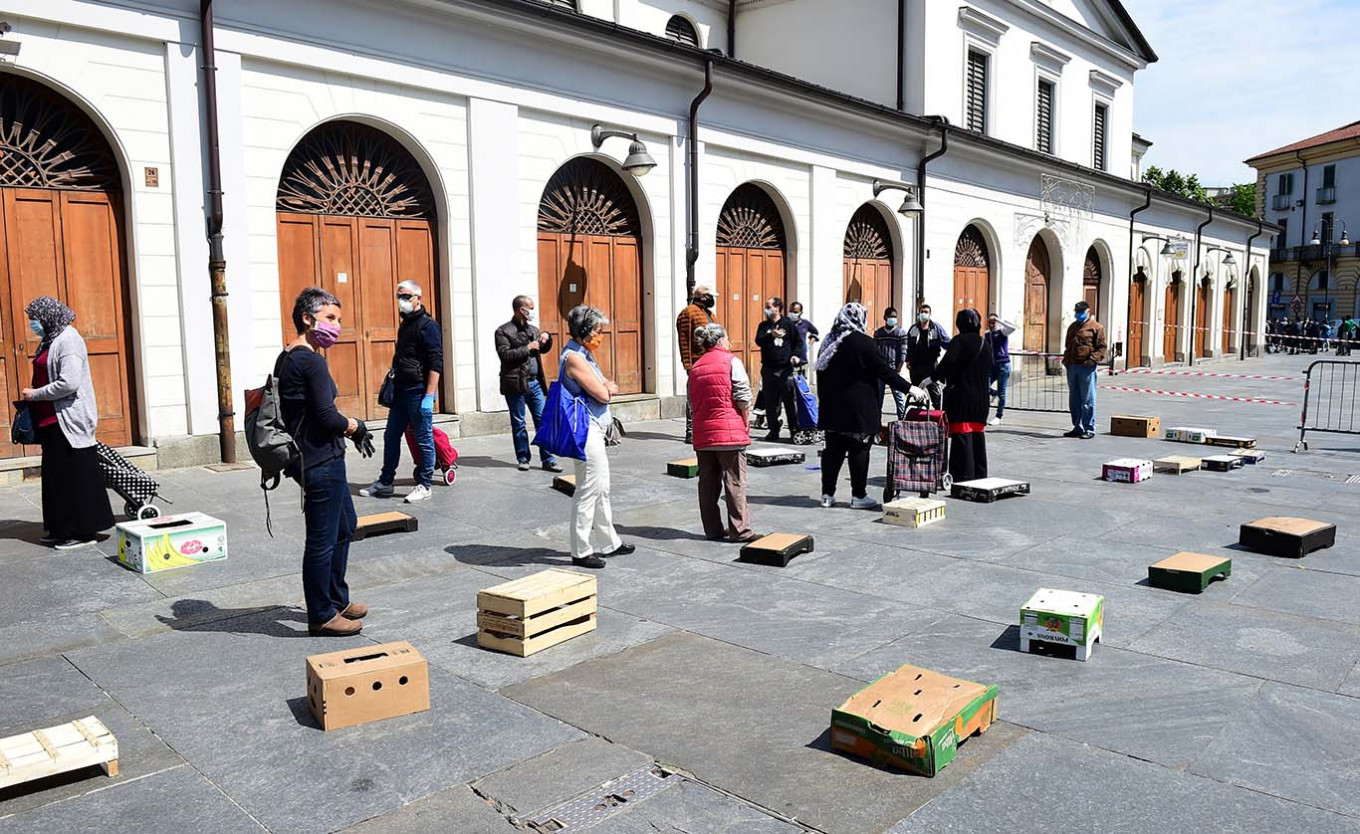 People wearing protective face masks queue at Porta Palazzo market in Turin after it reopened with social distancing rules as Italy begins a staged end to a nationwide lockdown, following the outbreak of the coronavirus disease (COVID-19), Turin, Italy, May 4, 2020. (REUTERS/Massimo Pinca)
T
he COVID-19 crisis is a colossal, global shock unlike any other in living memory. A health crisis at first, COVID-19 soon turned into an unprecedented economic and social crisis. No one could have imagined it: billions of people confined to their homes, millions out of jobs, countless enterprises in fatal financial trouble. The consequences will go far beyond what we experienced in the 2008 financial crisis.
The sudden, unprecedented and massive crisis initially took the European Union off guard. But, now our response is fully on stream, based on solidarity and mutual support. The EU helped member states procure and stockpile medical equipment and finance research into vaccines; doctors worked cross-border and patients from Italy were treated in Germany; intra-EU trade in medical products was simplified.
To contain the virus, we suspended the border-less travel within the Schengen zone for non-essential travel. These restrictions will gradually be relaxed from mid-May, hand-in-hand with an EU-wide, coordinated approach for the easing of confinement measures.
Meanwhile, the EU and member states designed a massive stimulus package to absorb the COVID socio-economic blow and prepare companies for their post-COVID rebound. They mobilized 3.4 trillion euros (US$3.7 trillion) in support of SMEs, airlines and others. New funding schemes support the most affected member states and create job opportunities across Europe. The Euro-zone members will benefit from massive liquidity up to 2 percent of their GDP, while the European Central Bank is buying up to 750 billion euros in government bonds.
While Europe is currently one of the epicenters, we know this is a global fight. No one will be safe until the entire world is safe. International solidarity is therefore not a luxury but a necessity. In a collective “Team Europe” approach, the EU and the member states mobilized over 20 billion euros for COVID assistance.
Across ASEAN, the EU will finance over EUR 350 million in grants to support health systems and economic recovery, while member states and European development banks will provide several billions of soft loans to support state budgets for overcoming the socio-economic impact of COVID-19. Mid-April ASEAN leaders decided to cooperate on health and research, provide consular assistance, maintain supply chains and stimulate the recovery, offering many opportunities for even more intense EU-ASEAN cooperation.
Indonesia is a special partner for the EU, even more so in times of crisis. We partner to improve the lives of our citizens, as illustrated by the EU financing of vulnerable people and three regional hospitals (17 million euros) in East Java, South Sulawesi and North Sulawesi. We partner to bring back our stranded citizens.
Indonesia assisted in the return of the 22,000 stranded Europeans, while EU countries helped Indonesian nationals return home from Europe. We partner to mobilize resources for research and equipment at the “Coronavirus Global Response Summit” on May 4 in the framework of the initiative “Access to Covid-19 Tools (ACT) Accelerator” supported by WHO and others international stakeholders, including the EU and members states.
Our bilateral development banks will mobilize additional funding for social and economic recovery plans. And, we partner in support of multilateralism, as shown by our joint commitment at the virtual Foreign Ministers meeting of the Alliance for Multilateralism on April 16, 2020.
This EU partnership with ASEAN and Indonesia is sometimes understated. True, the EU does not spin “politics of generosity” or focus on short-lived photo opportunities. Instead, we look for durable and joined-up solutions. And much more work awaits us.
In the medium term, we will need to reboot our economies. The 1,000 EU companies in Indonesia are helping: their total stock of investment is 33 billion euros and they offer jobs to 1.1 million Indonesians.
The poor and vulnerable people will suffer the most. They will require support, the job-less need to find work, and companies will have to restructure their debts. To be sustainable, this recovery will need to be green, addressing this other major emergency of our times: climate change.
In the longer-term, we will need to build a post-COVID world able to respond rapidly to a pandemic like the present one, because today’s crisis is unfortunately not going to be the last. All of this can only happen if we come together in solidarity with one another and look for global, coordinated, multilateral solutions.
What better partners than EU, ASEAN and Indonesia to do so.
***
Vincent Piket is the EU ambassador to Indonesia and Igor Driesmans is the EU ambassador to ASEAN. The ambassadors of Austria, Belgium, Bulgaria, Croatia, Czech Republic, Denmark, Finland, France, Germany, Greece, Italy, Ireland, Hungary, the Netherlands, Poland, Portugal, Romania, Slovakia, Spain and Sweden have also signed the article.