The Jakarta Post
Please Update your browser
Your browser is out of date, and may not be compatible with our website. A list of the most popular web browsers can be found below.
Just click on the icons to get to the download page.


Popular Reads
Top Results
No results found. Please check your search term and try again
Can't find what you're looking for?
View all search results
Popular Reads
Top Results
No results found. Please check your search term and try again
Can't find what you're looking for?
View all search resultsDollar firms, euro under pressure as energy prices surge
Change text size
Gift Premium Articles
to Anyone
Share the best of The Jakarta Post with friends, family, or colleagues. As a subscriber, you can gift 3 to 5 articles each month that anyone can read—no subscription needed!
 Set as preferred source
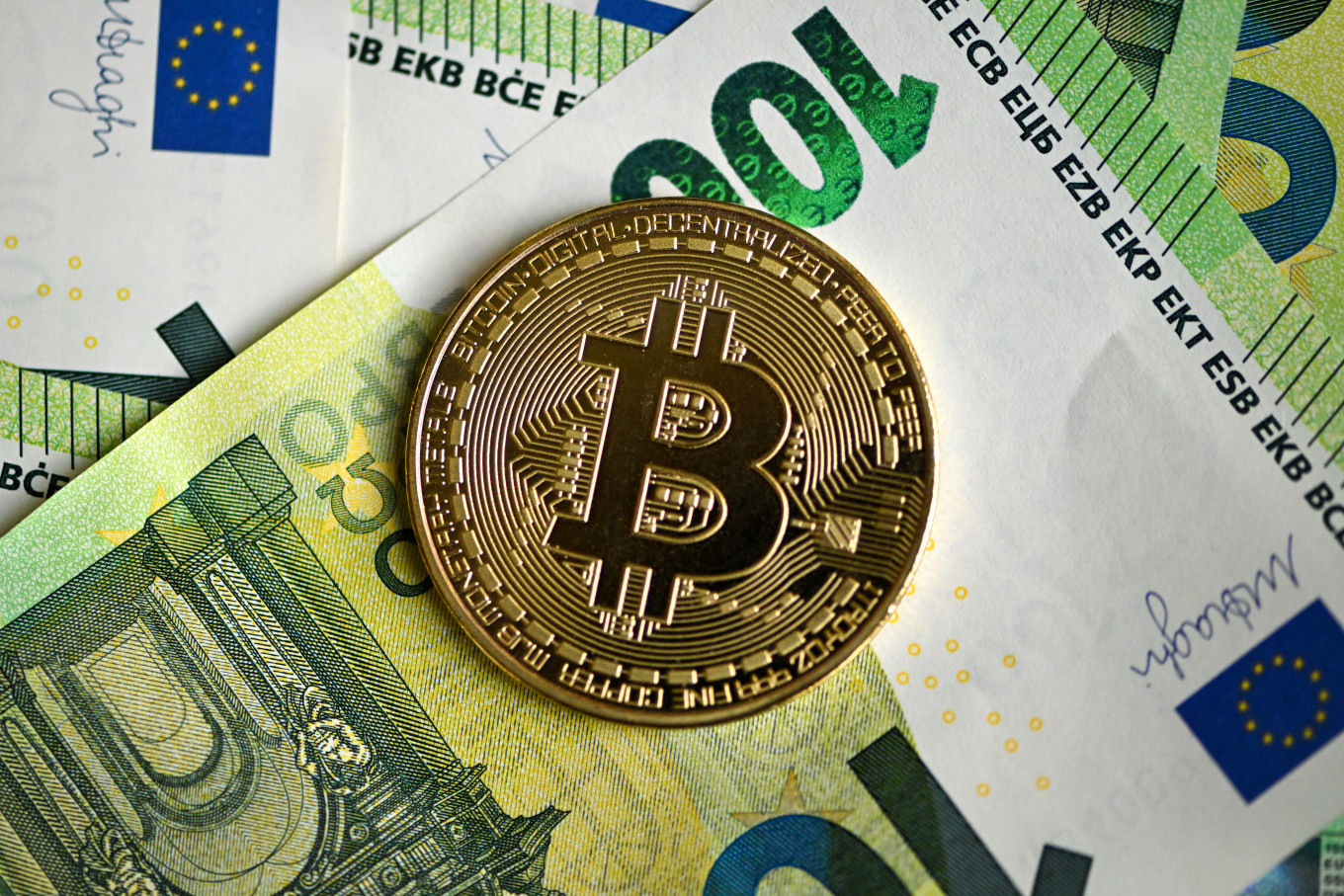 A commemorative Bitcoin coin is pictured on 100 euros notes in Dortmund, Germany, on Feb. 9, 2026. (AFP/Ina Fassbender)
T
he dollar rallied to a three-month high in early trading in Asia on Wednesday, with investors retreating from the euro as the growing conflict in the Middle East sparked fears of a sustained rise in energy prices.
The euro traded down 0.3 percent at $1.1581, extending losses into a third day after earlier hitting its weakest since late November. That followed data released on Tuesday which showed euro zone inflation at a higher-than-expected level in February before the start of the Iran conflict.
"The impact of the Iran war on EUR/USD boils down to one thing: energy," said George Saravelos, global head of FX research at Deutsche Bank. "There is a negative supply shock under way which represents a direct tax on Europeans that has to be paid to foreign producers in dollars."
Financial markets resumed their selloff on Wednesday as growing fears of a surge in inflation rippled across stocks and bonds after Israeli and US forces pounded targets across Iran, prompting a rush for cash among investors.
Global oil and gas prices have jumped as the US-Israeli war on Iran disrupts energy exports from the Middle East, with Tehran's attacks on ships and energy facilities closing navigation in the Gulf and forcing production stoppages from Qatar to Iraq.
The benchmark Brent crude oil contract gained 1.2 percent in early trading on Wednesday to $82.45 per barrel, hitting the highest since July 2024 and taking gains since Friday to 14 percent. European gas prices are up 70 percent since the end of last week.

"Suddenly, the 'good place' of the ECB is being challenged, and we doubt we will see that resolved in the very near term," analysts from ING wrote in a research report. "The possibility of ECB rate hikes poses a serious risk to carry trades and could trigger a significant widening of eurozone government bond [EGB] spreads."
The British pound slipped 0.3 percent to $1.3315.
The US dollar index, which measures the greenback's strength against a basket of six currencies, was up 0.2 percent at 99.284, its strongest since Nov. 28.
Against the yen, the dollar was flat at 157.68 yen.
Against the Chinese yuan, in offshore trade the US dollar was flat at 6.9225 yuan after PMI data for February diverged, with official gauges recording a slump in activity even as a private-sector counterpart blew past estimates.
The Australian dollar was down 0.6 percent at $0.6995, even as data showed GDP growth for the fourth quarter picked up speed, beating expectations.
"The headline figures may be overstating the weakness in private demand," analysts from Capital Economics wrote. "Although the underlying details were a mixed bag, we suspect the RBA will still be concerned that growth is running above potential in Australia."
The New Zealand dollar was down 0.3 percent at $0.5873.
Bitcoin was up 0.8 percent at $68,585.42, while ether rose 0.8 percent to $1,985.40.