The Jakarta Post
Please Update your browser
Your browser is out of date, and may not be compatible with our website. A list of the most popular web browsers can be found below.
Just click on the icons to get to the download page.


Popular Reads
Top Results
No results found. Please check your search term and try again
Can't find what you're looking for?
View all search results
Popular Reads
Top Results
No results found. Please check your search term and try again
Can't find what you're looking for?
View all search resultsUS trade push rings alarm on data sovereignty, media control
Civil society and industry groups warn that the agreement on reciprocal trade (ART) could weaken local control over Indonesian data, erode publisher rights and tilt the digital economy further toward US tech giants.
Change text size
Gift Premium Articles
to Anyone
Share the best of The Jakarta Post with friends, family, or colleagues. As a subscriber, you can gift 3 to 5 articles each month that anyone can read—no subscription needed!
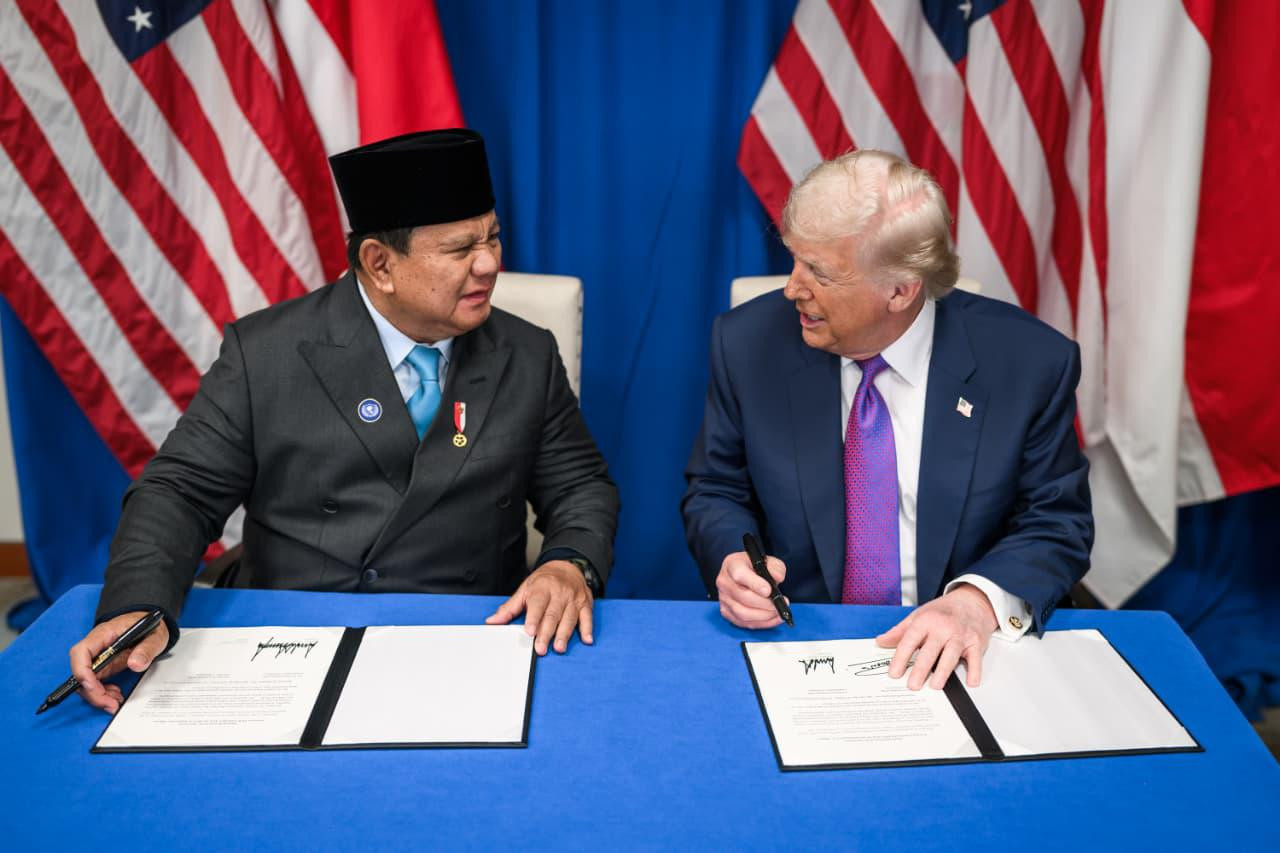 President Prabowo Subianto (left) speaks to United States President Donald Trump during the signing ceremony for the US-Indonesia Agreement on Reciprocal Tariffs (ART) in Washington, DC, on Feb. 19, 2026. (Courtesy of Presidential Secretariat/White House)
A
new bilateral trade pact with the United States significantly narrows Indonesia’s regulatory space in two sensitive areas, publisher rights and data sovereignty, associations and experts have warned, potentially weakening domestic rules governing digital platforms, cross-border data flows and media protection.
Article 3.3 of the US-Indonesia Agreement on Reciprocal Trade (ART) commits Jakarta to refraining from requiring that US digital service providers support domestic news organizations through licensing, data-sharing or profit-sharing schemes, a clause widely seen as clashing with Presidential Regulation No. 32/2024 on platform responsibility for quality journalism, also known as the publisher rights policy.
According to Indriaswati Dyah, deputy chair of the Committee for Digital Platform Responsibility to Support Quality Journalism (KTP2JB), also known as the Publisher Rights Committee, the placement of this obligation inside an annex is itself telling.
“This is an annex, which means something that may have been inserted because it could not enter the main clauses, possibly because the government understood it would violate principles of good faith in domestic regulations,” she told The Jakarta Post on Feb. 26.
“Then how would the clauses take effect? It might affect the sense that, on a practical level, when it comes to how we implement the presidential regulation, […] annex 3.3, might be used as a pretext,” she said.
The committee had found that platform compliance was weak even before the ART was signed, she added.

"The key question will be to what extent the cooperation amounts to meaningful cooperation with fair and equal leverage among parties, because there have also been complaints about the [applicable] criteria, given that only 33 out of a thousand-plus online media established in the country have actually accessed [cooperation with Google],” she said.