The Jakarta Post
Please Update your browser
Your browser is out of date, and may not be compatible with our website. A list of the most popular web browsers can be found below.
Just click on the icons to get to the download page.


Popular Reads
Top Results
No results found. Please check your search term and try again
Can't find what you're looking for?
View all search results
Popular Reads
Top Results
No results found. Please check your search term and try again
Can't find what you're looking for?
View all search resultsAustralia central bank hikes rates in tight call as Iran war stokes inflation risk
Change text size
Gift Premium Articles
to Anyone
Share the best of The Jakarta Post with friends, family, or colleagues. As a subscriber, you can gift 3 to 5 articles each month that anyone can read—no subscription needed!
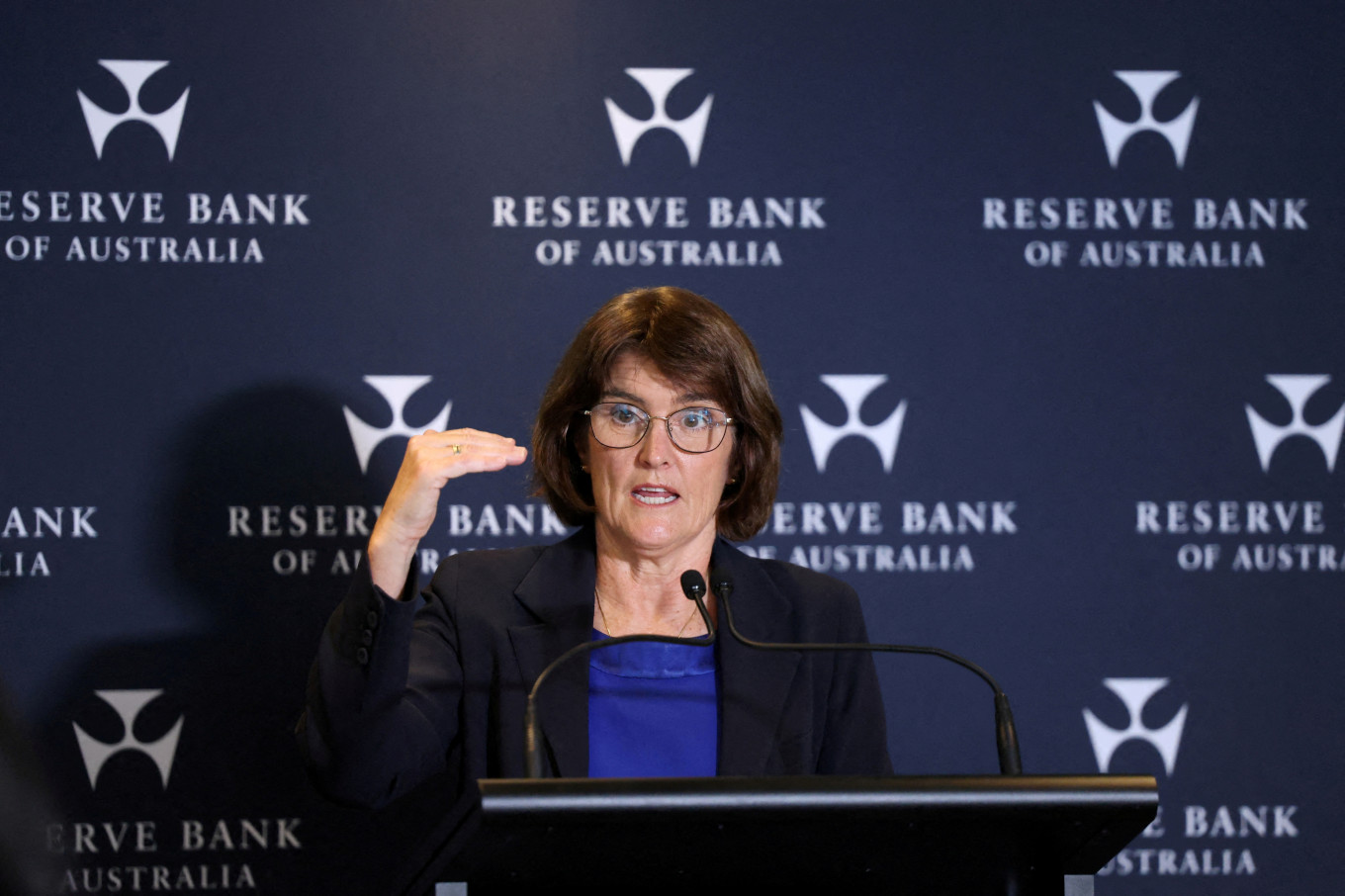 Reserve Bank of Australia Governor Michele Bullock reacts as she attends the monetary policy decision media conference, in Sydney, Australia, on April 1, 2025. (Reuters/Hollie Adams)
A
ustralia's central bank raised its cash rate for a second straight month on Tuesday, saying higher borrowing costs were needed to contain inflation, though a very tight vote suggested further tightening is far from certain.
The Reserve Bank of Australia kicked off a critical week for major central banks as the Middle East war intensifies and sharply higher oil prices threaten to re‑ignite global inflation pressures. Policymakers elsewhere, including at the Federal Reserve and the European Central Bank, are widely expected to keep interest rates unchanged.
Wrapping up the March policy meeting, the RBA raised its main cash rate by 25 basis points to 4.1 percent, a 10-month high and undoing two of the three cuts it made last year. Five board members voted for the increase, while four voted against in the closest decision since they started revealing the voting.
Markets had wagered on a 75 percent probability of a hike after senior RBA officials flagged the meeting as "live," with inflation stuck above the 2 percent-3 percent target band and the labor market still running hot. All "Big Four" Australian banks tipped a rise.
"Short-term measures of inflation expectations have already risen," the board said in a statement, noting that "the conflict in the Middle East has resulted in sharply higher fuel prices, which, if sustained, will add to inflation."
"The board judged that inflation is likely to remain above target for some time and that the risks have tilted further to the upside, including to inflation expectations."

The Australian dollar slipped 0.2 percent to US$0.7060 given the close call, while three-year government bond yields fell 7 basis points to 4.509 percent.
Investors pared back the chance for another hike in May, which is now priced around 30 percent.
"The Board is clearly worried that recent geopolitical developments could take a bad situation and make it much worse," said Abhijit Surya, senior economist at Capital Economics.
"Fundamentally, the split vote appears to have come down the elevated uncertainty about the evolution of the Iran conflict, given that it 'poses substantial risks in both directions.'"
The RBA took a gentler path than its global peers during the inflation surge, prioritizing hard-won gains in the labor market over rapid tightening. Interest rates peaked at 4.35 percent early last year before three cuts brought them down to 3.6 percent.
However, that approach saw inflation rear its head again from the second half of the year, forcing the RBA to raise rates again last month. Headline CPI ran at 3.8 percent in January and the core measure hit a 16-month high of 3.4 percent, going in the wrong direction.
The labor market also remained tight, with the jobless rate holding at a historic low of 4.1 percent. The economy grew 2.6 percent from a year earlier in the December quarter, the fastest annual pace in almost three years and way above the RBA's 2 percent estimate of potential.
With no end in sight to the Middle East conflict and oil holding above US$100 a barrel, inflation risks are firmly skewed to the upside.
Those considerations were reflected in RBA's policy statement.
"In large part, higher interest rates reflect expectations for the path of monetary policy, which have risen in Australia and most other advanced economies in response to the expected inflationary implications of the conflict in the Middle East," the board said.
The RBA's latest February forecasts already pencilled in headline inflation reaching 4.2 percent by mid-year before the war unleashed a fresh global oil shock.
Consumer confidence took a hit, with a survey from ANZ on Tuesday showing sentiment last week was at the lowest level since early 2020 when the first pandemic lockdowns were announced.