The Jakarta Post
Please Update your browser
Your browser is out of date, and may not be compatible with our website. A list of the most popular web browsers can be found below.
Just click on the icons to get to the download page.


Popular Reads
Top Results
No results found. Please check your search term and try again
Can't find what you're looking for?
View all search results
Popular Reads
Top Results
No results found. Please check your search term and try again
Can't find what you're looking for?
View all search resultsChina offers to work with Southeast Asia on energy security
China's show of willingness to work with the region of more than 700 million people would be welcome relief to Southeast Asian oil importers after an order by Beijing earlier this month to ban Chinese exports of diesel, gasoline and jet fuel.
Change text size
Gift Premium Articles
to Anyone
Share the best of The Jakarta Post with friends, family, or colleagues. As a subscriber, you can gift 3 to 5 articles each month that anyone can read—no subscription needed!
 Set as preferred source
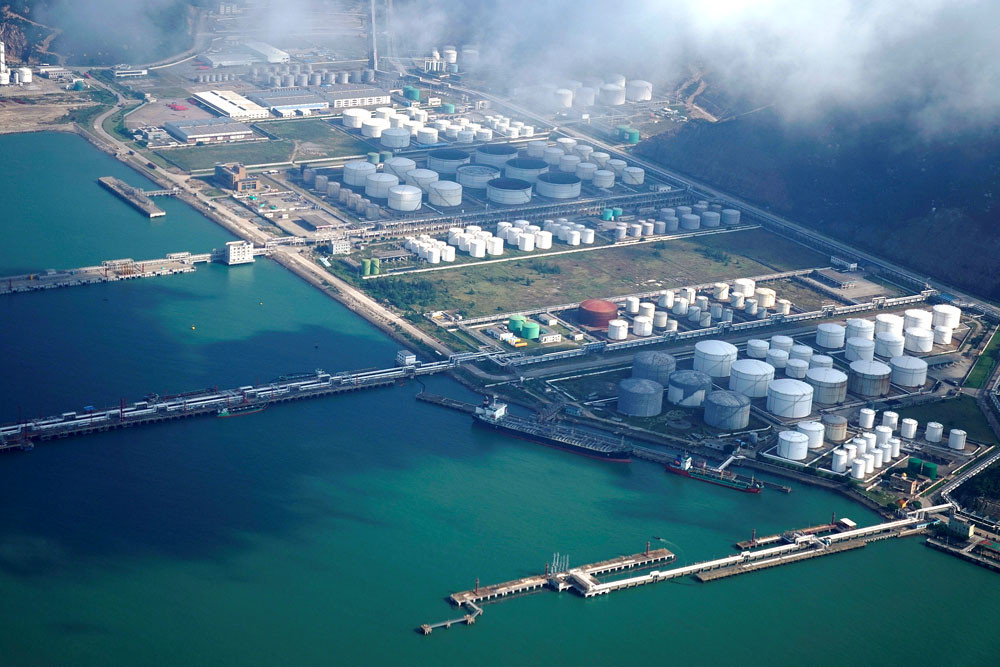 Oil and gas tanks fill a port’s storage zone in Zhuhai, China. Beijing has been drumming the message that it has plenty of room to deploy measures to spur economic growth to counter the effects of a trade war with the United States. (Reuters/Aly Song)
C
hina, home to the world's biggest oil refining sector, said it was ready to work with Southeast Asia in addressing energy problems stemming from the war in Iran and called on the parties involved to immediately cease military operations.
China's show of willingness to work with the region of more than 700 million people would be welcome relief to Southeast Asian oil importers after an order by Beijing earlier this month to ban Chinese exports of diesel, gasoline and jet fuel.
The ban would worsen shortages and further hike prices for some of China's strategic partner-nations in Southeast Asia, which have already been reeling from supply cuts brought on by the US-Israeli war against Iran.
"The situation in the Middle East has disrupted global energy security," said Lin Jian, spokesperson at the Chinese foreign ministry, told a regular news conference when asked if Southeast Asian nations had reached out to China for help.
"The countries involved should immediately cease military operations to prevent regional instability from having a greater impact on global economic development," said Lin.
"China is willing to strengthen coordination and cooperation with Southeast Asian countries to jointly address energy security issues," Lin added.

Any easing of Beijing's ban could help soothe fuel jitters in countries from the Philippines to Cambodia.
Philippine Energy Secretary Sharon Garin met with the Chinese ambassador to the Philippines on Tuesday to discuss cooperation in energy, a departure from the two countries' arguing over maritime rights in the South China Sea.
Data trackers have indicated that Iran is selecting ships from friendly countries to pass through the Strait of Hormuz.
Tehran's forces have closed off the waterway, through which a fifth of the world's oil and liquefied natural gas passes in peacetime, with deadly hits reported on vessels since the war began with US-Israeli strikes on Iran on February 28.
But at least five ships exited the Strait via Iranian waters on March 15 and 16, maritime intelligence firm Windward said in an analysis report on Tuesday.
"The new route illustrates how Iran's selective blockade has evolved to allow allies and supporters to transit", it said, citing its tracking as "rising evidence that Iran is exerting permission-based transit and control of the strait".
Natasha Kaneva, a commodities analyst at JPMorgan bank, said in an analysis on Monday that at least four ships had been tracked exiting the strait via the Larak–Qeshm Channel, near the Iranian coast, over the previous two days.
"This is not a standard route for vessels and could reflect a process designed to confirm vessel ownership and cargo, enabling passage for ships that are not affiliated to the US or its allies," she said in a note sent to AFP.
The vessels included bulk carriers and one oil tanker, the Pakistani-flagged Karachi.
Tracking site MarineTraffic said the Karachi transited the strait with its automatic transponder system activated -- where most vessels keep it turned off to avoid being targeted.
Kaneva said most of the crude passing through the strait was headed for Asia, principally China.