The Jakarta Post
Please Update your browser
Your browser is out of date, and may not be compatible with our website. A list of the most popular web browsers can be found below.
Just click on the icons to get to the download page.


Popular Reads
Top Results
No results found. Please check your search term and try again
Can't find what you're looking for?
View all search results
Popular Reads
Top Results
No results found. Please check your search term and try again
Can't find what you're looking for?
View all search resultsDouble hit on manufacturing: What are anticipatory policies?
The manufacturing sector’s growth trend is expected to face many challenges, including higher oil and energy prices due to US and Israeli attacks on Iran, as well as rupiah depreciation, which is pushing up production costs for certain industries.
Change text size
Gift Premium Articles
to Anyone
Share the best of The Jakarta Post with friends, family, or colleagues. As a subscriber, you can gift 3 to 5 articles each month that anyone can read—no subscription needed!
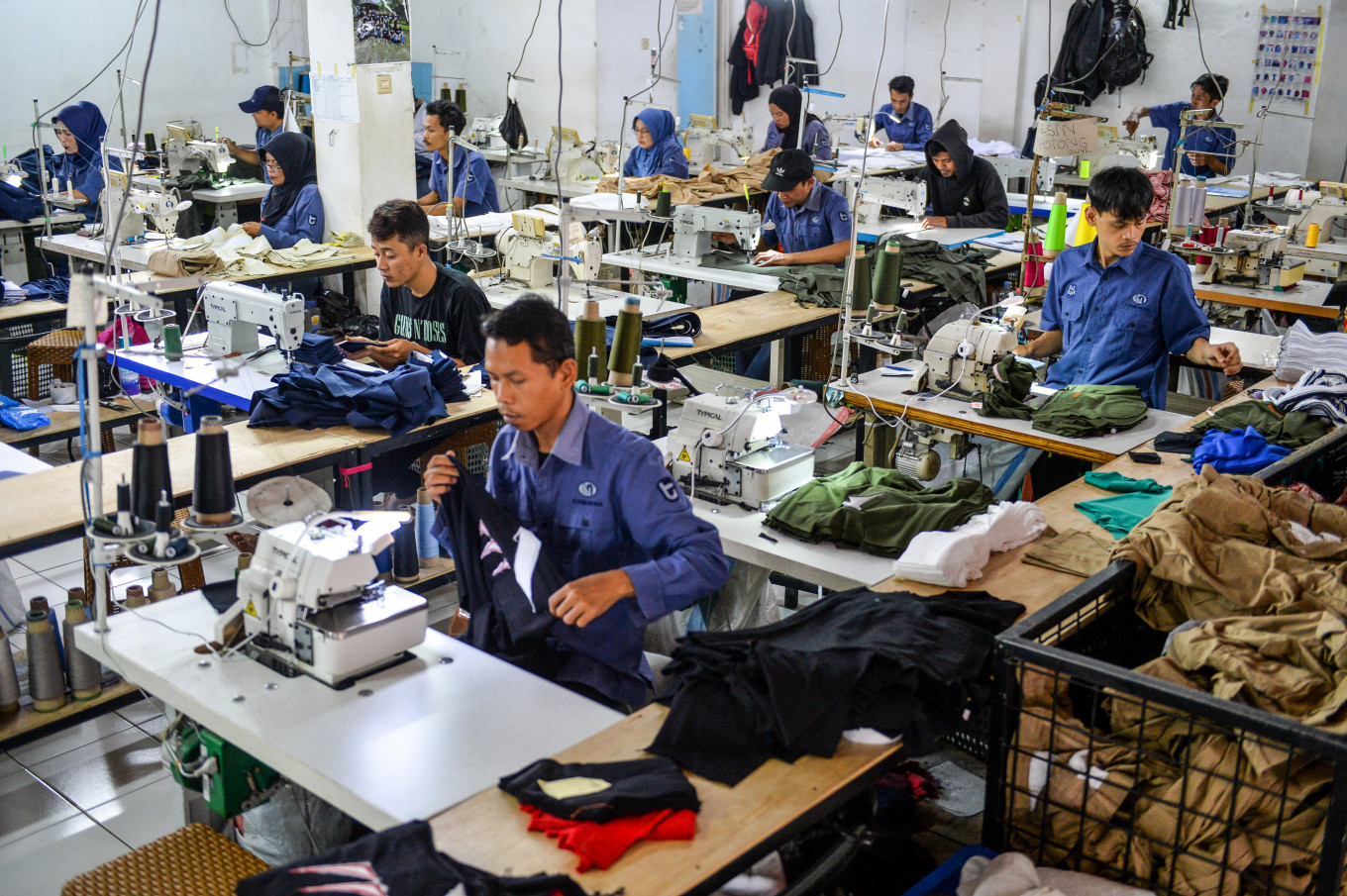 Workers complete production of fashion products on Oct. 29, 2025, at the Tectona Textile Factory in Pameungpeuk, Bandung regency, West Java. (Antara/Raisan Al Farisi)
T
he manufacturing industry is on the rise, posting 5.7 percent year-on-year (yoy) growth in Q2 2025, followed by 5.5 percent in Q3 and 5.4 percent in Q4, exceeding overall national economic growth. Surprisingly, the last time manufacturing growth outpaced national growth was more than two decades ago, in 2004.
This indicates that the manufacturing sector has made progress, driven in part by the downstream industrialization strategy.
For example, the basic metals industry has achieved double-digit growth over the past five years and grew by 15.7 percent in 2025. The data also shows strong sectoral growth in domestically oriented manufacturing, with machinery grew 13.9 percent in 2025, chemicals and pharmaceuticals grew 9.2 percent, while food and beverages grew 6.38 percent.
However, the growth trend of the manufacturing sector going forward, facing many challenges under current conditions.
The challenges are, first, rising oil and energy prices due to US and Israeli attacks on Iran, implying higher production and distribution costs. Second, rupiah depreciation, which mainly pushes up production costs for industries with high imported raw-material content. Third, weaker demand from export markets due to lower global economic growth. Fourth, weaker domestic demand as consumers postpone spending to prioritize saving in anticipation of future economic uncertainty.
In more details, a recent chart mapping the effect of a 10 percent increase in energy prices across manufacturing subsectors shows large variation in cost exposure. Non-metallic products like cement, ceramics and glass, face the largest hit, roughly a 2.2 percent rise in total costs. They are followed by coal products, aircraft manufacturing, basic metals and paper, which saw about 1.0 to 1.4 percent cost rise.

Mid-range cost impacts between 0.5 and 0.8 percent appear in chemical, repair and installation services for machinery, beverage and several heavy-processing subsectors. Labor- and input-intensive sectors such as textiles, food, printing, furniture, pharmaceuticals, motor vehicles, electronics and apparel see much smaller cost changes about 0.1 and 0.4 percent.