TheJakartaPost
Please Update your browser
Your browser is out of date, and may not be compatible with our website. A list of the most popular web browsers can be found below.
Just click on the icons to get to the download page.


Popular Reads
Top Results
No results found. Please check your search term and try again
Can't find what you're looking for?
View all search results
Popular Reads
Top Results
No results found. Please check your search term and try again
Can't find what you're looking for?
View all search resultsAirlines’ passenger demand risks stalling once again
Indonesians effectively pay more to fly from Jakarta to Surabaya than from Denpasar to Sydney, a signal that something in the structure of the domestic market is not working as it should.
Change text size
Gift Premium Articles
to Anyone
Share the best of The Jakarta Post with friends, family, or colleagues. As a subscriber, you can gift 3 to 5 articles each month that anyone can read—no subscription needed!
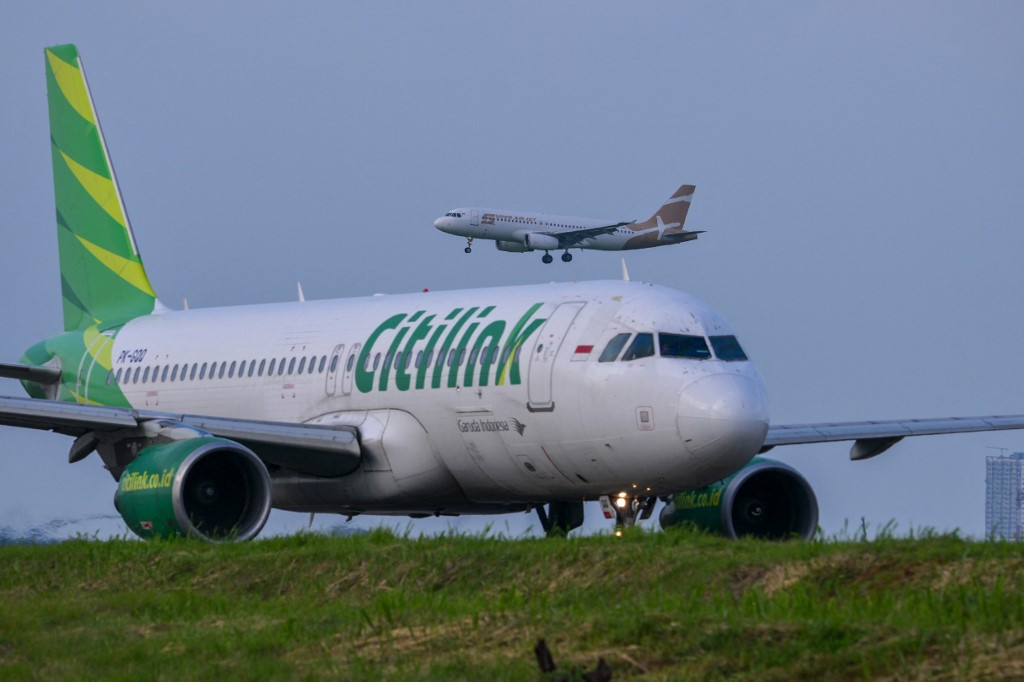 An Indonesian airline Citilink plane taxis on Jan. 10, 2025, as a Super Air Jet lands at Soekarno-Hatta International Airport in Tangerang, Banten. (AFP/Bay Ismoyo)
I
ndonesia's domestic aviation industry has yet to fully recover, and a new wave of cost pressure is already arriving to test it. The industry stands at a difficult crossroads, as the post-pandemic recovery has yet to find solid footing and operating cost pressures are mounting once again.
The question is becoming increasingly urgent: how long can passenger demand hold up before the burden becomes too heavy to bear?
The clearest indicator lies in passenger numbers. In 2023, passenger numbers recorded the highest figure since the pandemic, reaching 67.6 million. But in 2024, they actually declined by 5.8 percent to 63.7 million.
The situation worsened further in 2025, which recorded another drop of 6.2 percent to 59.8 million. The 2025 figure represents a gap of 17 million compared to 2019's 76.7 million. The gap is a reminder that the recovery is still ongoing, and the road ahead is far from short. For an archipelagic nation that depends heavily on air connectivity to bind its regions together, this lingering shortfall carries economic implications that extend well beyond aviation itself.
One factor holding back this recovery is the price of airfares, which the public still considers expensive. These high prices cannot be separated from the fact that the operating fleet has yet to fully return to pre-pandemic levels. When seat capacity is limited while demand is recovering, ticket prices struggle to return to affordable levels. This creates a vicious cycle: expensive tickets suppress demand, weak demand makes airlines hesitant to expand their fleets and a limited fleet keeps prices elevated.
A closer look at price per kilometer reveals an even more striking reality. Even before the recent fuel surge, domestic routes were consistently more expensive than several international routes departing from Indonesia. In early 2024, the average ticket price on the Jakarta-Surabaya route stood at Rp 1,643 (US$0.09) per kilometer. By May 2026, that figure had climbed to Rp 2,153 per kilometer, an increase of 31.03 percent.

Over the same period, ticket prices on international routes from Denpasar, Bali to Sydney, Australia rose even more sharply, by 52.08 percent, from Rp 738 to Rp 1,123 per kilometer. Yet despite the steeper percentage increase, the absolute price per kilometer on these international routes remains far below that of domestic ones. In other words, Indonesians effectively pay more to fly from Jakarta to Surabaya than from Denpasar to Sydney. This is not merely a curious observation, it is a signal that something in the structure of the domestic market is not working as it should.