The Jakarta Post
Please Update your browser
Your browser is out of date, and may not be compatible with our website. A list of the most popular web browsers can be found below.
Just click on the icons to get to the download page.


Popular Reads
Top Results
No results found. Please check your search term and try again
Can't find what you're looking for?
View all search results
Popular Reads
Top Results
No results found. Please check your search term and try again
Can't find what you're looking for?
View all search resultsASEAN told to strengthen approaches, frameworks for digital transformation
Beyond introducing new regulations, it is equally important to understand how institutions make decisions, coordinate implementation and respond to emerging challenges in practice.
Change text size
Gift Premium Articles
to Anyone
Share the best of The Jakarta Post with friends, family, or colleagues. As a subscriber, you can gift 3 to 5 articles each month that anyone can read—no subscription needed!
 Set as preferred source
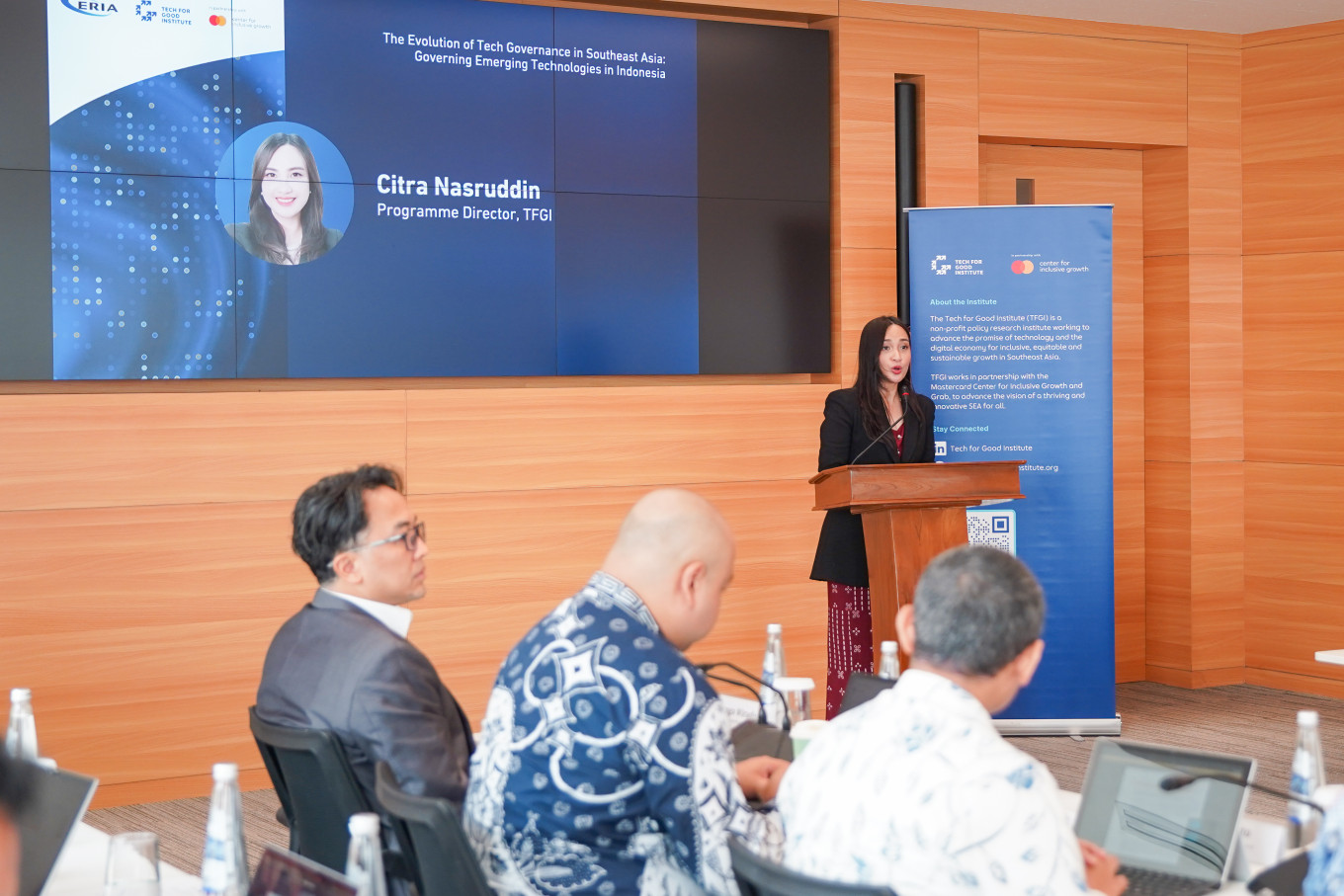 Participants listen to a presentation from Tech for Good Institute (TFGI) program director Citra Nasrudin during a closed-door roundtable on May 12 in Jakarta. Organized jointly with the Economic Research Institute for ASEAN and East Asia (ERIA), the roundtable examined ASEAN and Indonesia’s strategic priorities in governing emerging technologies. (Courtesy of ERIA/-)
E
xperts recently examined ASEAN and Indonesia’s strategic priorities in governing emerging technologies, especially on artificial intelligence (AI) governance amid rapid technological change and shifting geopolitical dynamics.
The discussion took place during a closed-door roundtable titled “The Evolution of Tech Governance in Southeast Asia: Governing Emerging Technologies in Indonesia”, organized by the Tech for Good Institute (TFGI), in collaboration with the Economic Research Institute for ASEAN and East Asia (ERIA) on May 12 in Jakarta, ERIA said in a press release.
The round table convened government officials, industry representatives and policy researchers and provided a platform for regional stakeholders to reflect on the evolving technology governance landscape across Southeast Asia.
TFGI program director Citra Nasrudin told the roundtable that governance approaches must evolve alongside technology evolutions.
“Beyond introducing new regulations, it is equally important to understand how institutions make decisions, coordinate implementation, and respond to emerging challenges in practice,” she said.
“Through this roundtable and our ongoing Tech Governance program, we hope to contribute to more informed, practical, and regionally grounded conversations on the future of digital governance.”

Meanwhile, Aladdin D. Rillo, Policy Design and Operations managing director at ERIA, emphasized that the region has reached a critical inflection point.
“ASEAN's current digital transformation has entered a new phase – the question is no longer whether to regulate, but to ensure institutional frameworks are designed with the market realities they are meant to address,” he told the roundtable.
“Regional efforts toward meaningful digital economy integration can be done better when it accounts for the varying digital maturity across all eleven ASEAN Member States.”
The discussion opened with a regional overview of technology governance developments across ASEAN-6, examining how governments are responding to key policy priorities, including AI, cybersecurity and digital platform regulation.
The session also explored broader governance trends shaping the region’s digital landscape, including evolving models of digital sovereignty, structural and institutional changes and regional coordination across Southeast Asia.
“Governance does not only mean ‘governments’. In a fast-moving industry like the digital economy, there is room for co-creation across multiple disciplines, collaboration between the public and private sectors, and cooperation across borders,” TFGI program manager Keith Detros said.
“This is to ensure we are crafting regulations that are responsive to the needs of our region.”
Meanwhile, ERIA digital and AI policy economist Randeep Kaur examined the evolving relationship between AI and data governance, highlighting the limitations of existing data protection frameworks in addressing the scale and complexity of AI systems.
The session examined emerging policy considerations related to consent, privacy, data governance and the growing need for adaptive regulatory approaches that balance innovation, trust and security.
The roundtable brought together representatives from government, academia, industry and regional policy institutions for an in-depth discussion on Indonesia’s evolving approach to AI and data governance. Participants exchanged perspectives on current regulatory developments, institutional coordination and the broader implications of regional digital integration, including ongoing ASEAN initiatives.
The discussion took place against the backdrop of Indonesia’s expanding digital economy, which continues to strengthen the urgency of developing effective governance frameworks for emerging technologies, particularly as ASEAN advances negotiations on the Digital Economy Framework Agreement (DEFA), which is targeted for completion and signing in 2026.
Drawing on findings highlighted in an ERIA report referencing the Indonesian National Development Planning Ministry, Indonesia’s digital economy is projected to increase to 20.7 percent of GDP, or around Rp 22.5 quadrillion (US$1.4 billion), by 2045.