The Jakarta Post
Please Update your browser
Your browser is out of date, and may not be compatible with our website. A list of the most popular web browsers can be found below.
Just click on the icons to get to the download page.


Popular Reads
Top Results
No results found. Please check your search term and try again
Can't find what you're looking for?
View all search results
Popular Reads
Top Results
No results found. Please check your search term and try again
Can't find what you're looking for?
View all search resultsPSN’s Nusantara 5 satellite officially starts operations
Nusantara 5 (N5) satellite is Asia's biggest with a capacity of 160 Gigabits per second (Gbps) using the very high throughput satellite (VHTS) specification
Change text size
Gift Premium Articles
to Anyone
Share the best of The Jakarta Post with friends, family, or colleagues. As a subscriber, you can gift 3 to 5 articles each month that anyone can read—no subscription needed!
 Set as preferred source
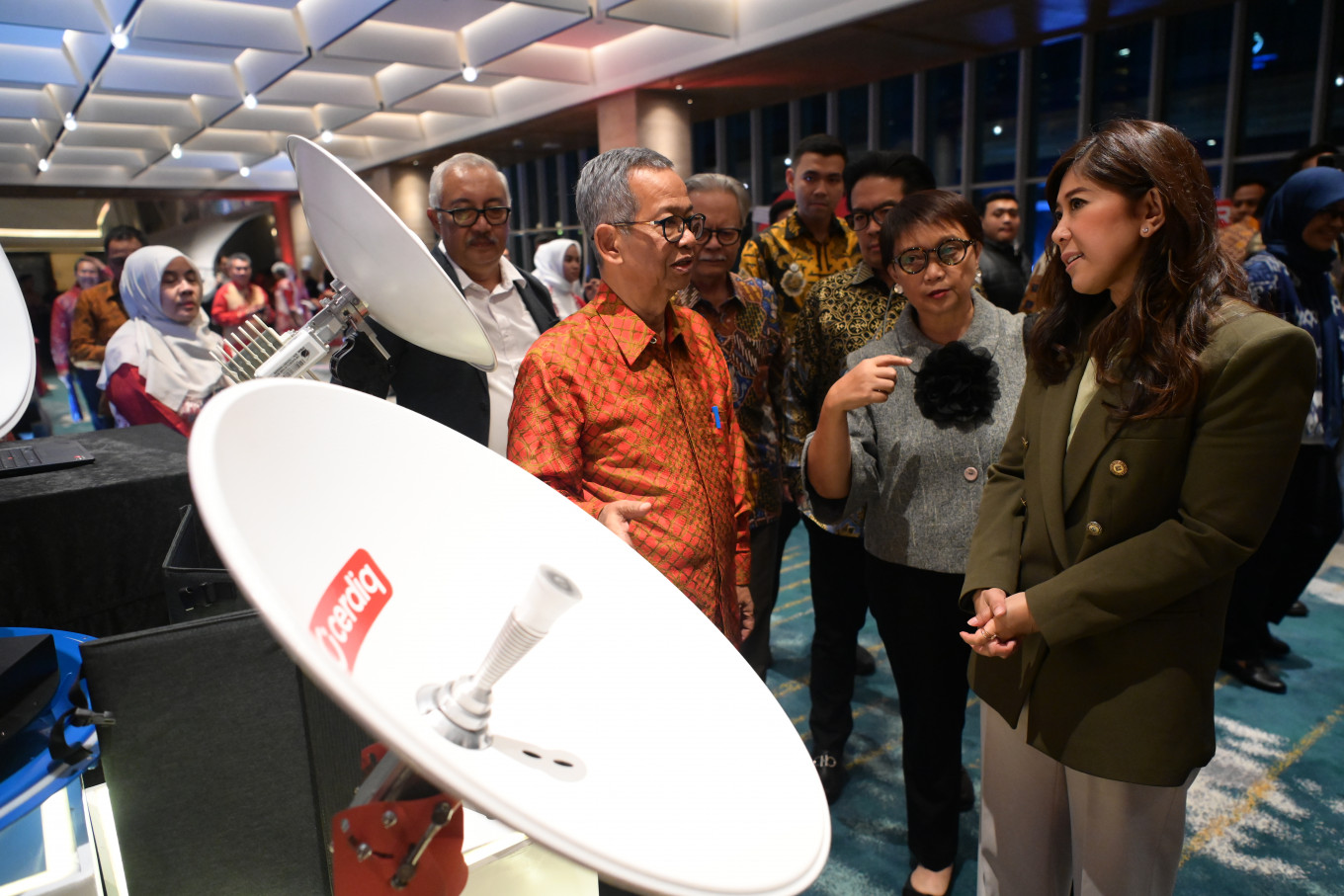 PT Pasifik Satelit Nusantara chief executive officer Adi Rahman Adiwoso (left) speaks with Communications and Digital Minister Meutya Hafid (right) on May 11 during the launch ceremony for the Nusantara 5 (N5) satellite in Jakarta. The satellite is Asia's biggest with a capacity of 160 Gigabits per second (Gbps) using the very high throughput satellite (VHTS) specification.
(Courtesy of/PT Pasifik Satelit Nusantara)
PT Pasifik Satelit Nusantara chief executive officer Adi Rahman Adiwoso (left) speaks with Communications and Digital Minister Meutya Hafid (right) on May 11 during the launch ceremony for the Nusantara 5 (N5) satellite in Jakarta. The satellite is Asia's biggest with a capacity of 160 Gigabits per second (Gbps) using the very high throughput satellite (VHTS) specification.
(Courtesy of/PT Pasifik Satelit Nusantara)
T
he Nusantara Lima (N5) satellite officially entered its operational phase and is now ready to be commercialized to support increasing internet service capacity and digital connectivity across Indonesia as well as materializing national space sovereignty.
The Boeing-made satellite, owned and operated by private satellite operator PT Pasifik Satelit Nusantara (PSN) was successfully launched from Cape Canaveral in Florida, the United States, on Sept. 12, on board the Space-X Falcon 9 partially reusable rocket.
A ceremony to officially start the satellite’s operation was held in Jakarta on May 11, attended by, among others, Communications and Digital Minister Meutya Hafid, Presidential Chief of Staff Gen. (ret) Dudung Abdurrahman, Second Deputy Higher Education, Science and Technology Minister Stella Christie and Boeing Satellite System International Inc. president Ryan Reid.
Meutya said that President Prabowo Subianto wanted Indonesia to be present in various contexts in international fora, not in term of geopolitics but also space.
“Currently digital connectivity has reached 80 percent of the total population connected with internet services,” she said, as quoted in a press release issued by PSN on May 13.
“We want all 280 million Indonesians to be connected and not only in regions close to Java but also in various regions from Sabang to Merauke, Rote to Miangas.”

The minister said the N5 Satellite could maintain the three pillars of connected, grow and safeguarded.
Also attending were Indonesian Space Association (Ariksa) board of advisor’s chairman Burhanuddin Abdullah, Arisa secretary general Aryo Djojohadikusumo, PSN Group president commissioner Sofyan Djalil, PSN Group commissioners Retno Marsudi and Erry Riana, Sinar Mas managing director Ferry Salman and all stakeholders involved in the project.
PSN president director Adi Rahman Adiwoso said the operational N5 satellite is an important symbol marking national self-sufficiency in space.
“The presence of the N5 satellite is a form of capacity increase for Indonesia to provide digital connectivity in Asia by providing service up to Malaysia and the Philippines,” he said.
“Currently, Indonesia is the biggest player in internet satellite industry in Asia with a total capacity of 403 gigabits per second (Gbps).”
N5 satellite will play a strategic and crucial role to increasing services in the education, health, government services, digital economy, defense and security sectors and in areas which do not enjoy high-quality internet services, especially in the frontier, outermost and disadvantaged (3T) regions.
The biggest satellite in Asia, the N5 satellite has a very high throughput satellite (VHTS) specification with a capacity of 160 Gbps, designed to support digital transformation all over Indonesia.
Using the Boeing 702MP platform weighing 7.8 tonnes, the satellite has 101 spot beams which work in the Ka-band frequency. The satellite is equipped with hybrid propulsion system, consisting of Xenon-Ion chemical and electronic propulsion system (XIPS), 10 times more efficient when compared to conventional satellites.
PSN operates seven ground stations: Banda Aceh, Bengkulu, Cikarang, West Java; Gresik, East Java; Banjarmasin, South Kalimantan; Tarakan, North Kalimantan, and Kupang to support N5 satellite operations and services. The ground stations are spread across western, central and eastern parts of Indonesia to allow the satellite, which has a life span of 15 years, to reach 3T regions.
Meanwhile, Boeing’s Reid said that the successful N5 satellite launch extended the positive outcome from collaboration between Indonesia and Boeing in utilizing space technology to provide the best internet for the public.
“With Indonesian geographical conditions consisting of thousands of islands, Boeing’ satellite technology is one of the answers to bridge the gap in internet access for the public,” he said.