TheJakartaPost
Please Update your browser
Your browser is out of date, and may not be compatible with our website. A list of the most popular web browsers can be found below.
Just click on the icons to get to the download page.


Popular Reads
Top Results
No results found. Please check your search term and try again
Can't find what you're looking for?
View all search results
Popular Reads
Top Results
No results found. Please check your search term and try again
Can't find what you're looking for?
View all search resultsMarket pressure amid the triple global shock
Beyond negative sentiment related to warning from global index compiler MSCI, global investors have also become more sensitive to concerns surrounding Indonesia’s fiscal resilience, particularly amid rising global energy prices.
Change text size
Gift Premium Articles
to Anyone
Share the best of The Jakarta Post with friends, family, or colleagues. As a subscriber, you can gift 3 to 5 articles each month that anyone can read—no subscription needed!
 Set as preferred source
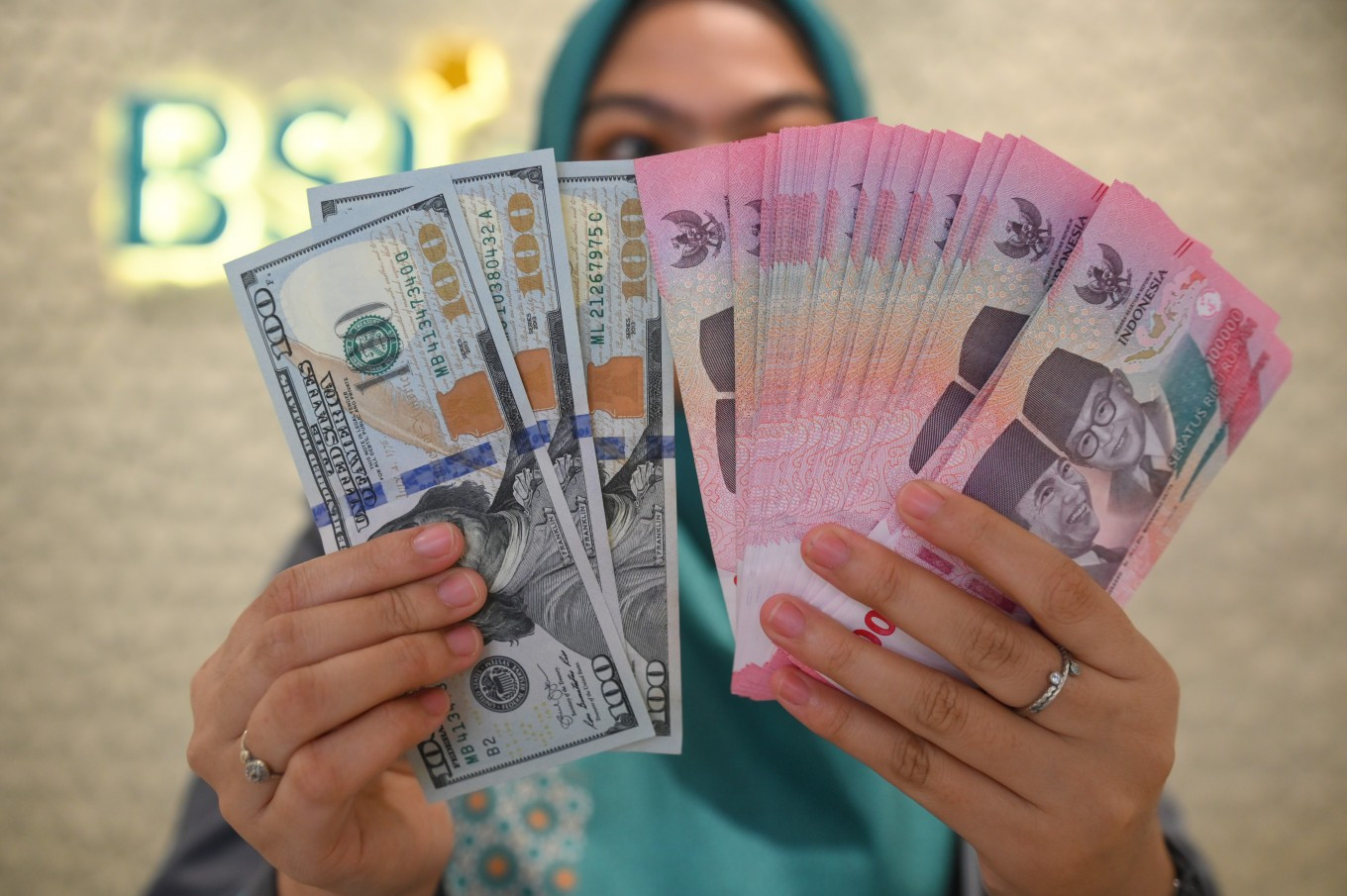 An employee displays Indonesian rupiah and United States dollar banknotes at Bank Syariah Indonesia in South Tangerang, Banten, on Jan. 21, 2026. (Antara/Hafidz Mubarak A)
P
ressure on local financial markets has intensified again as the rupiah weakened to 17,658 per United States dollar, depreciating around 5.8 percent year-to-date (ytd) as of Monday. At the same time, foreign capital outflows from domestic financial markets have continued, reaching approximately Rp 51 trillion (US$2.9 billion), consisting of around Rp 41 trillion in equity outflows and around Rp 10 trillion in bond outflows.
This reflects growing caution among global investors toward emerging market assets amid heightened global uncertainty, ranging from escalating geopolitical tensions in the Middle East and rising global oil prices, to expectations that global interest rates will remain higher for longer.
Pressure on the rupiah intensified after the renewed US-Israeli war on Iran heightened market concerns over potential disruptions to global oil supply due to possible restrictions in the Strait of Hormuz. Rising oil prices subsequently strengthened the US dollar as a safe-haven asset while also triggering risk-off sentiment across global markets.
Under such conditions, global investors tend to reduce exposure to risky assets and shift funds into US dollar assets and US Treasuries. As a result, nearly all emerging market currencies, including the rupiah, have come under pressure.
However, the current pressure on domestic markets is not solely driven by global factors. Indonesia is also facing several idiosyncratic issues that have amplified financial market volatility.
One of the key concerns among investors is the outcome of MSCI’s review and rebalancing this month. Global index compiler MSCI officially removed 13 Indonesian stocks from its Global Small Cap Indexes and continues to freeze increases in the Foreign Inclusion Factor (FIF) and Number of Shares (NOS) for Indonesian equities. This decision indicates that MSCI still highlights concerns related to free float, ownership transparency and high shareholding concentration within Indonesia’s capital market.

Markets expect that the MSCI rebalancing could trigger passive foreign outflows ahead of the effective implementation at the end of May. These outflows would further increase US dollar demand in the domestic market and heighten volatility in both the rupiah and the domestic equity market.