Enjoy This Gifted Article!
You're reading this thanks to a The Jakarta Post subscriber.
Access is available for 30 days. For unlimited access, consider subscribing.
Can't find what you're looking for?
View all search resultsCan't find what you're looking for?

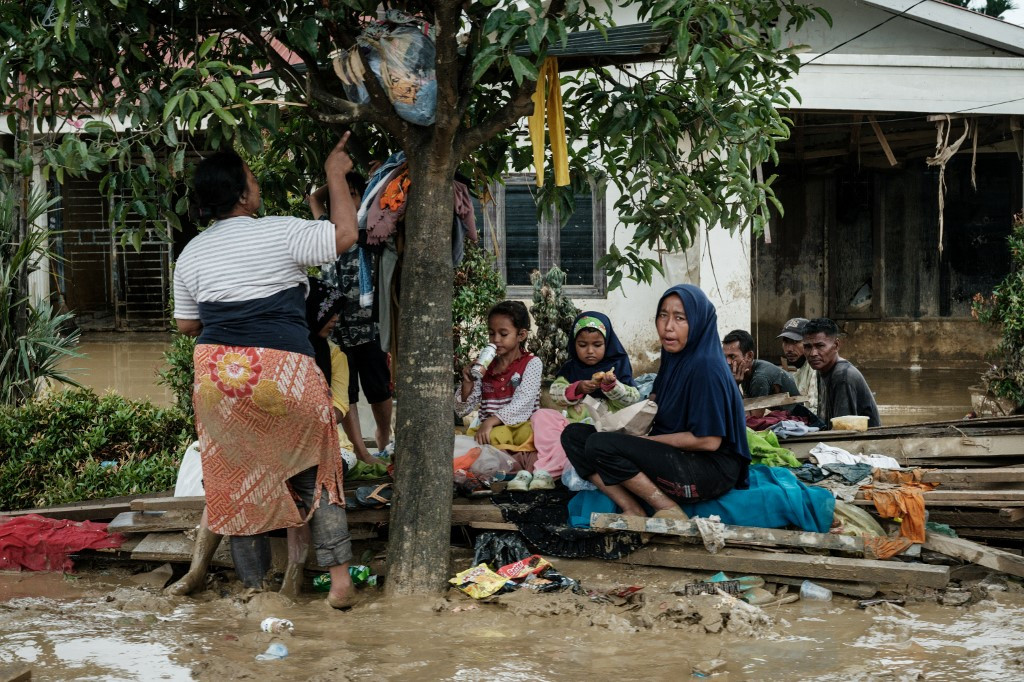
View all search resultsIn recent days, evacuees in Aceh have raised white flags along the streets in protest at what they describe as limited humanitarian assistance and delays in the government’s response.
rustration and criticism are mounting over the central government’s refusal to declare a national emergency following devastating floods in Sumatra and its blocking of international aid entering the country.
As recovery efforts continue to overwhelm local administrations’ capacities, regional leaders in the hardest-hit areas have been placed in a difficult position, forced to turn away offers of assistance from overseas while humanitarian support remains limited for more than 1 million people affected by the floods.
On Thursday, the Medan city administration in North Sumatra returned 30 tonnes of rice and 300 packages of staple foods, baby products and prayer kits from the United Arab Emirates (UAE), following “guidance” from the central government.
The aid had been handed over to Medan Mayor Rico Tri Putra Bayu Waas on Dec. 13 by Shaima Alhebsi, deputy head of mission at the UAE Embassy in Indonesia.
Rico said the decision was made after consultation with the Defense Ministry and the National Disaster Mitigation Agency (BNPB).
“After coordinating with the central government and reviewing the prevailing regulations, we decided to return the aid, as the Indonesian government does not currently accept assistance from foreign governments,” Rico Waas said on Thursday.
The decision immediately drew criticism, with Medan Legislative Council (DPRD) Speaker Wong Chun Sen calling it “embarrassing” and warning that it could harm relations with the UAE and discourage future donations.
“The aid shouldn’t have been returned. It should have been distributed to flood victims. There’s no reason to block foreign assistance, especially when so many people are still in urgent need,” he told The Jakarta Post on Friday.
Read also: Flood survivors reeling from devastation plea for global help
Local residents also expressed frustration. Khairul Fuad, a Medan resident, said, “We are disappointed with the mayor. It was rude to return aid that had already been received, especially when so many people are still in need.”
Criticism has also grown online, with many blaming the government for being unreasonable while flood-affected residents continue to struggle with limited supplies.
Responding to the backlash, Home Minister Tito Karnavian said the Medan administration had decided to accept the donation after learning that the aid came from the UAE Red Crescent, not the UAE government.
“Initially, the Medan mayor believed the aid was a government-to-government donation, for which no formal mechanism currently exists. However, we contacted the UAE ambassador to Indonesia, who informed us that the aid came from the Red Crescent,” Tito said on Friday.
He added that the Medan administration has now handed the aid to the humanitarian organization Muhammadiyah Medical Center, which will distribute it to affected residents in Medan.
Malaysia aid
The controversy over the UAE aid comes just days after another flood-hit region, Aceh, called on the government to allow the entry of 500 tonnes of humanitarian assistance from Malaysia.
The Aceh Community in Malaysia, which organized the donation, had planned to ship the aid from Port Klang in Selangor to Krueng Geukueh in Aceh using a private cargo vessel. However, the deputy chief of mission at the Indonesian Embassy in Malaysia, Danang Waskito, said the request could not be approved, as Indonesia has yet to declare the floods a national emergency, a requirement for the entry of foreign humanitarian aid.
“We are asking the central government to grant a dispensation so that humanitarian aid from the Acehnese community in Malaysia can enter the province, even though Indonesia has not declared a national emergency,” Aceh administration spokesperson Teuku Kamaruzzaman said on Sunday.
“No humanitarian aid should be delayed and must be expedited to reach displaced people in urgent need,” he added.
Read also: Aceh urges govt to allow entry of humanitarian aid from Malaysia
The government eventually allowed the donations to enter, but Tito faced widespread criticism after stating that the total value of the aid from the Malaysian public was “only” around Rp 1 billion.
“I heard that businessmen in Malaysia wanted to provide medicines for residents affected by the floods in Aceh. After reviewing, the total value of the medicines sent was slightly less than Rp 1 billion [US$59,761],” Tito said.
“The state’s budget for flood mitigation in Sumatra is far larger than that, so Rp 1 billion is not significant for us. We don’t want the perception to arise that we are reliant on foreign aid, when in reality the amount is small compared with Indonesia’s capacity,” he added.
The remarks sparked a backlash from Indonesians and Malaysians alike, including former Malaysian foreign minister Tan Sri Rais Yatim, who described the comments as impolite and said any humanitarian assistance, regardless of its size, should be met with gratitude.
Tito has since issued a public apology for the remarks.
Delayed response
The northern and western regions of Sumatra have suffered severe devastation after rare Cyclone Senyar formed in the Malacca Strait and unleashed a week of torrential rain and powerful wind gusts late last month, triggering extensive floods and landslides.
As of Friday, 1,068 people had been found dead, around 7,600 people are injured and over 158,000 houses, as well as 1,200 items of public infrastructure, have been damaged across North Sumatra, Aceh and West Sumatra, according to the BNPB. At least 190 people are still missing.
Three weeks after the disaster, at least 80 villages in Aceh and eight villages in North Sumatra remain isolated.
Power outages persist across large parts of the affected regions, and aid has not been evenly distributed, particularly to remote communities. Residents continue to struggle to access clean water, while many have fallen ill as they survive on meager rations.
Volunteers say survivors urgently need blankets, mattresses, tarpaulins and clothing, as harsh weather continues to batter the region during the ongoing rainy season.
In recent days, evacuees in Aceh have raised white flags along the streets in protest at what they describe as limited humanitarian assistance and delays in the government’s response.
Read also: Calls grow for Indonesia to accept foreign disaster aid
On Monday, President Prabowo Subianto said he had been contacted by several foreign leaders offering to send aid to Indonesia.
“I told them thank you for your concern, but we are capable. Indonesia can handle this,” he said as quoted by Kompas.com. (nal)
Share your experiences, suggestions, and any issues you've encountered on The Jakarta Post. We're here to listen.
Thank you for sharing your thoughts. We appreciate your feedback.
Quickly share this news with your network—keep everyone informed with just a single click!
Share the best of The Jakarta Post with friends, family, or colleagues. As a subscriber, you can gift 3 to 5 articles each month that anyone can read—no subscription needed!
Get the best experience—faster access, exclusive features, and a seamless way to stay updated.