The Jakarta Post
Please Update your browser
Your browser is out of date, and may not be compatible with our website. A list of the most popular web browsers can be found below.
Just click on the icons to get to the download page.


Popular Reads
Top Results
No results found. Please check your search term and try again
Can't find what you're looking for?
View all search results
Popular Reads
Top Results
No results found. Please check your search term and try again
Can't find what you're looking for?
View all search resultsCrackdown on August unrest biggest state suppression since 1998: Report
Last year's unrest resulted in Indonesia’s harshest crackdown since 1998, an independent investigation finds, citing mass arrests and alleged torture.
Change text size
Gift Premium Articles
to Anyone
Share the best of The Jakarta Post with friends, family, or colleagues. As a subscriber, you can gift 3 to 5 articles each month that anyone can read—no subscription needed!
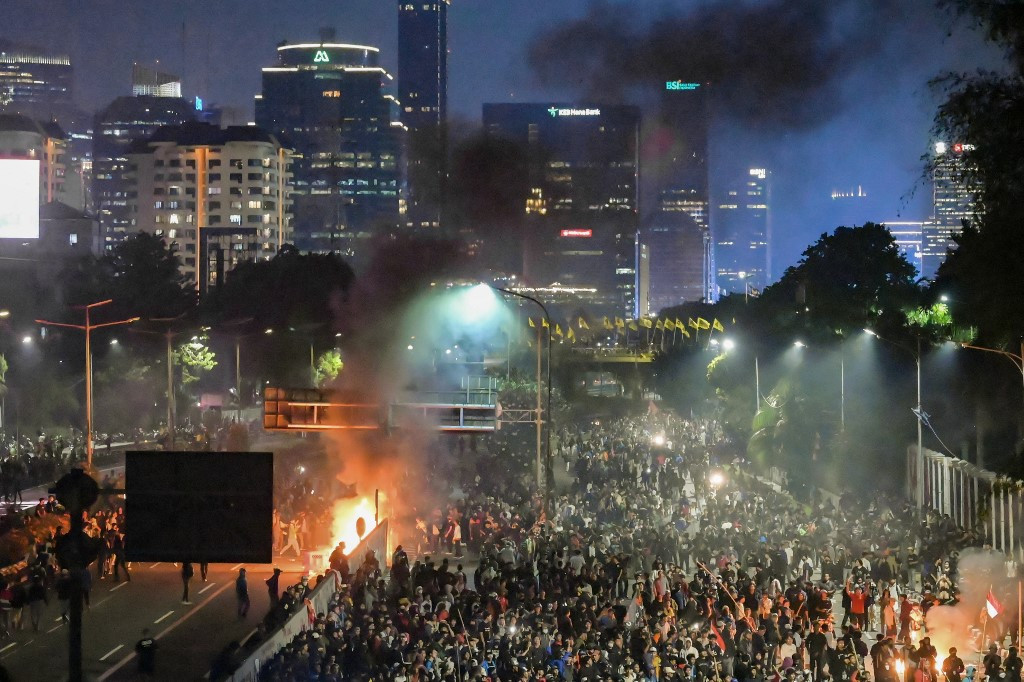 Demonstrators set fires amid clashes outside the House of Representatives building in Jakarta on Aug. 22, 2024 during a protest against a move to reverse the Constitutional Court's decision altering eligibility rules for electoral candidates. (AFP/Bay Ismoyo)
A
n independent investigation into the deadly nationwide unrest last August concluded that the state response represented Indonesia’s “largest suppression since the Reform movement [in 1998],” indiscriminately targeting activists and protesters while failing to hold accountable those who manipulated what began as a peaceful demonstration.
The findings appear in a 139-page report compiled by a fact-finding team formed by rights groups Commission for the Disappeared and Victims of Violence (KontraS), the Indonesian Legal Aid Foundation (YLBHI) and Jakarta Legal Aid Institute (LBH Jakarta). The team was established after President Prabowo Subianto declined to form an official state-led investigation into the riots, which claimed at least 13 lives.
The investigation examined 115 police interrogation reports, interviewed 63 informants and concluded field visits across eight provinces, 18 cities and three overseas locations since September.
Thousands of students, workers and civil society members took to the streets in late August to protest lawmakers’ lavish allowances, a demonstration that quickly escalated into nationwide unrest after online motorcycle transportation driver Affan Kurniawan was fatally run over by a police tactical vehicle attempting to disperse crowds.
Anger erupted into attacks on public facilities, including regional legislative council buildings and police stations across several regions, as well as looting the homes of public officials, such as then-finance minister Sri Mulyani and lawmakers whose remarks were seen as insensitive to the economic struggles of ordinary citizens.
Read also: ‘Ojol’ driver’s death fuels fury over police brutality

In the aftermath, law enforcement swiftly targeted activists, students and civilians, labeling many as “masterminds” or “agents provocateurs” based solely on social media activity or digital communications. The report described the response as the most extensive crackdown since the fall of the authoritarian New Order regime in 1998.