Enjoy This Gifted Article!
You're reading this thanks to a The Jakarta Post subscriber.
Access is available for 30 days. For unlimited access, consider subscribing.
Can't find what you're looking for?
View all search resultsCan't find what you're looking for?

View all search resultsObserving patterns of atmospheric conditions may help health authorities in better preparing mitigation and prevention efforts against the mosquito-borne disease, a recent study suggests, with the insect expected to flourish more in a warming world.
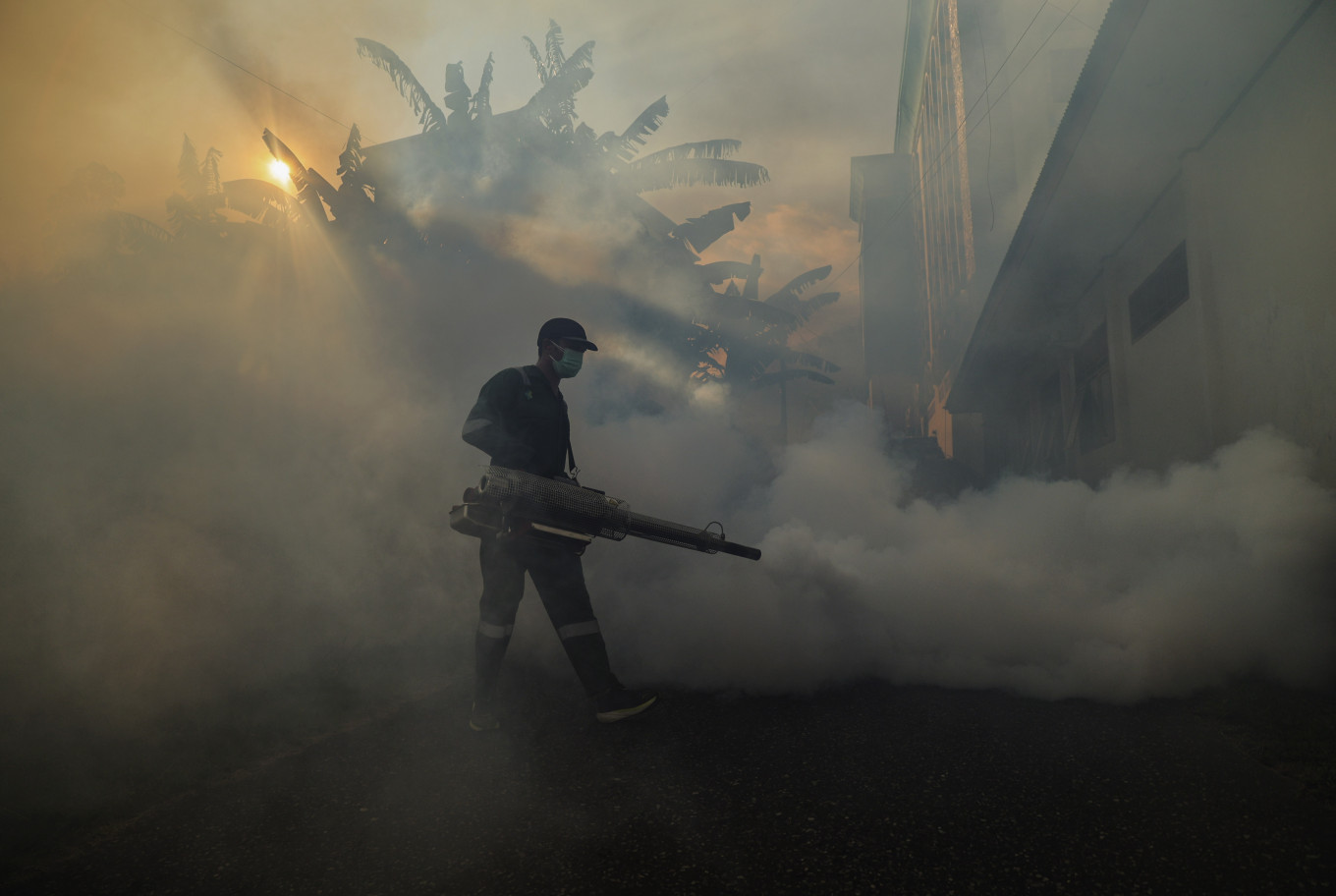
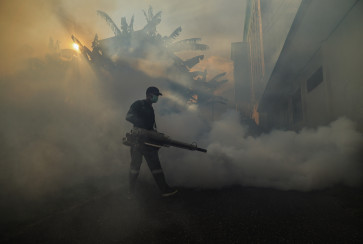
A Ternate Health Agency official sprays insecticide with a fogging machine at the city's haj dormitory in Ternate, North Maluku on April 22, 2026. Officials sprayed insecticide in bedrooms, parks and drains to prevent Aedes aegypti mosquitoes, the main vector of dengue, from flourishing. (Antara/Andri Saputra)
or decades, Indonesia has been struggling with dengue, with the country seeing new cases caused by the mosquito-borne disease each year, despite the national target of zero dengue deaths by 2030.
As of mid-April alone, 30,465 cases and 79 deaths had been confirmed in 401 of 514 regencies and cities across the country.
A recent study suggests a new addition to health authorities’ arsenal in fighting dengue, namely climate cues such as precipitation and El Niño events. Researchers found that looking at these clues might help authorities to better predict and map dengue transmission to devise an early warning system to better respond to the outbreaks that vary between regions.
The study, published on March 17 in the journal PLOS Neglected Tropical Diseases, illustrated the climate-based mapping of dengue outbreaks. The authors analyzed province-level dengue surveillance data between 2010 and 2024 and compared them with local and regional climate variables.
“Previous studies tend to lump Indonesia into a single entity when trying to forecast dengue,” said Bimandra Adiputra Djaafara, lead author of the study. “And it's probably not the best way to do that because now we see that the pattern and timing of dengue is different region to region.”
The results reveal consistent outbreak time patterns in western Indonesia, with provinces in Sumatra experiencing outbreaks up to four months earlier than those in Java and Bali. For example, North Sumatra sees the peak of the dengue outbreak in October, while Jakarta, West Java and Bali experience the peak in April.
Dengue peaks during the rainy season, which typically falls between October and March, when rainfall creates habitats for mosquitoes to breed.
But the study found that the timing of nationwide outbreaks also coincides with El Niño, a climate phenomenon marked by hotter and drier conditions in the Pacific Ocean. During the 2015-2016 and 2023-2024 periods marked by a strong El Niño, dengue incidences nearly doubled compared with normal years.
“Higher temperatures increase a mosquito’s metabolic rate,” said epidemiologist Riris Andono Ahmad, director of Gadjah Mada University’s Center for Tropical Medicine. “The hotter the weather, the bigger their protein needs are, so they’ll bite more frequently and aggressively.”
Read also: Regions seeing spikes in dengue fever during seasonal transition
Behavior change among humans in a warming world could also exacerbate dengue outbreaks, Riris added. During the dry season, people tend to store more water in buckets and other containers that, if not covered properly, can become an ideal habitat for mosquito larvae.
The big homework
Globally, dengue is substantially underreported. In 2024, there were 14.4 million cases around the world. But the figure only represented approximately 3.7 percent of the 390 million annual infection model estimate, according to a study cited by the World Health Organization (WHO).
The underreporting also applies in Indonesia. According to data from the Health Ministry, there were 257,271 cases in 2024, while the figure reported by the National Health Insurance (JKN) was six times higher at around 1.5 million cases.
A 2019 study even estimated that 7.8 million symptomatic dengue cases occurred in Indonesia in 2015.
“The high number of reported dengue cases means that our surveillance and tracking system is working, and that we’re able to capture the closest number of real cases. So, we should not be discouraged or shy away from reporting such cases,” said Asik Surya, executive chair of the Fight Dengue Joint Coalition (KOBAR Lawan Dengue), a multi-stakeholder coalition focused on the 2030 dengue mortality elimination target.
Dengue serotypes or strains can also affect its transmission. Dengue is caused by four distinct but closely related viruses, namely DENV-1 to DENV-4, each of which circulates in different regions. DENV-1, for instance, circulates widely in the Americas and Asia, whereas DENV-2 is dominant in Singapore.
“When a person gets infected by one serotype, they become immune to that strain, but they can still get infected by the other serotypes,” Bimandra explained.
A health worker shows a bucket filled with Aedes aegypti mosquito larva containing the Wolbachia bacteria in Kembangan district, West Jakarta, on Oct. 4, 2025. The Jakarta administration released the Wolbachia-infected mosquito eggs in an effort to control the spread of dengue in the city. (Antara/Rivan Awal Lingga)He added that the second dengue infection is often more severe due to a condition called antibody-dependent enhancement (ADE), where antibodies cannot neutralize the new serotype and they instead latch onto the virus, causing them to replicate faster and making the disease more severe.
In the study, the researchers also found 18 provinces with consistent rainfall-dengue timing across years, where more cases of dengue were recorded during a period of high precipitation. Such a consistency meant these regions were suitable to become trial grounds for a dengue early-warning system.
Read also: Govt mulls over expanding Wolbachia-based dengue control
Bimandra’s study produced two layers of climate-based prediction of dengue outbreaks in Indonesia.
Based on multiyear data and long-term trends, the occurrence of El Niño could predict which year will be a “bad year” for dengue outbreaks in the country. This year, the country is expected to face a strong El Niño, whose intensity is described as “Godzilla-like”, between April and October.
Meanwhile, the year-on-year data of local climate variables, such as precipitation and temperature, give better insights for government and health officials to prepare in advance at the local and provincial level, providing a window for action up to four months earlier. Measures could range from fogging to preparing other resources and health infrastructure.
“Through this study, we would like to highlight the heterogeneous landscape of dengue across the country,” Bimandra said, “which reminds us that we need to be mindful about how we strategize our dengue control program.”
Share your experiences, suggestions, and any issues you've encountered on The Jakarta Post. We're here to listen.
Thank you for sharing your thoughts. We appreciate your feedback.
Quickly share this news with your network—keep everyone informed with just a single click!
Share the best of The Jakarta Post with friends, family, or colleagues. As a subscriber, you can gift 3 to 5 articles each month that anyone can read—no subscription needed!
Get the best experience—faster access, exclusive features, and a seamless way to stay updated.