The Jakarta Post
Please Update your browser
Your browser is out of date, and may not be compatible with our website. A list of the most popular web browsers can be found below.
Just click on the icons to get to the download page.


Popular Reads
Top Results
No results found. Please check your search term and try again
Can't find what you're looking for?
View all search results
Popular Reads
Top Results
No results found. Please check your search term and try again
Can't find what you're looking for?
View all search resultsDejà vu as current 'chaos' haunt Reform anniversary
Twenty-eight years after the start of the Reform era, analysts and activists fear that Indonesia may be drifting toward conditions resembling the lead-up to the 1998 crisis.
Change text size
Gift Premium Articles
to Anyone
Share the best of The Jakarta Post with friends, family, or colleagues. As a subscriber, you can gift 3 to 5 articles each month that anyone can read—no subscription needed!
 Set as preferred source
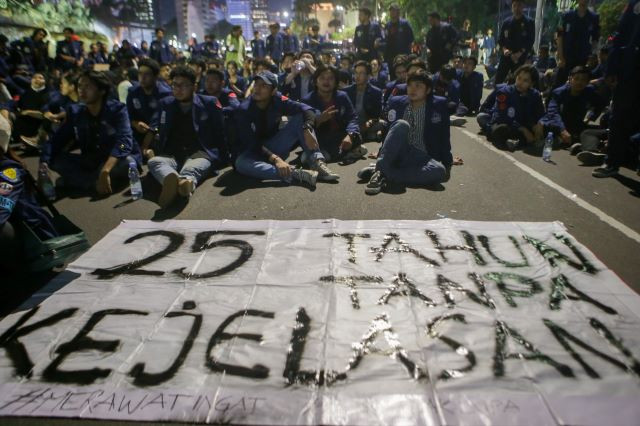 Students of Trisakti University gather on May 12, 2023, near the Arjuna Wijaya Statue in Central Jakarta to mark 25 years since the 1998 Reform movement, which heralded Indonesia’s move to democracy. The poster reads “25 years without clarity”, possibly a reference to the Trisakti Tragedy on May 12, 1998, when four Trisakti University students were killed during a peaceful protest, as well as other unresolved human rights atrocities dating back to that tumultuous period. (Antara/Fauzan)
N
early three decades on from the Asian financial crisis and the fall of authoritarian leader Soeharto, Indonesia is now showing troubling signs of parallels to the political and economic conditions that preceded that crisis.
At the time, the Asian financial crisis hit Indonesia especially hard, causing the rupiah to collapse, hundreds of businesses to fold and rising food prices that deepened economic hardship and pushed millions into poverty.
Anger then grew over what many Indonesians saw as deep-rooted corruption and nepotism within the New Order government, leading to widespread protest and riots that helped bring about the end of the three decades of Soeharto’s authoritarian rule.
Now, 28 years after the start of the Reform era, analysts and activists fear that Indonesia may be drifting toward conditions resembling the lead-up to the 1998 crisis.
The rupiah has been on a downward trend since late February amid the Middle East war, and recently fell to a record low of almost 17,600 per United States dollar, making it one of Asia’s worst-performing currencies and passing levels last seen during the 1998 financial crisis.
The Indonesia Stock Exchange (IDX) Composite index dropped 0.82 percent on Wednesday, with energy and basic materials firms leading declines, after Prabowo revealed a plan to centralize control of strategic commodity exports. The new policy has fueled concern about greater state control and weaker profitability in a key industry.

Later in the day, Bank Indonesia raised its benchmark interest rates, for the first time in over two years, by 50 basis points to 5.25 percent, prioritizing rupiah stabilization and foreign portfolio inflows.