TheJakartaPost
Please Update your browser
Your browser is out of date, and may not be compatible with our website. A list of the most popular web browsers can be found below.
Just click on the icons to get to the download page.


Popular Reads
Top Results
No results found. Please check your search term and try again
Can't find what you're looking for?
View all search results
Popular Reads
Top Results
No results found. Please check your search term and try again
Can't find what you're looking for?
View all search resultsDriving change
Pro-pluralism organization the Maarif Institute for Culture and Humanity has awarded the prestigious Maarif Award this year to a prominent figure and an influential institution that are committed to democracy, human rights and pluralism
Change text size
Gift Premium Articles
to Anyone
Share the best of The Jakarta Post with friends, family, or colleagues. As a subscriber, you can gift 3 to 5 articles each month that anyone can read—no subscription needed!

P
ro-pluralism organization the Maarif Institute for Culture and Humanity has awarded the prestigious Maarif Award this year to a prominent figure and an influential institution that are committed to democracy, human rights and pluralism. First is Masril Koto, a farmer from Agam who started and has replicated micro-finance institutions that have helped farmers across the archipelago, while the second is the Sultan Iskandar Muda Educational Foundation (YPSIM), initiated by Sofyan Tan, a community activist from Medan, North Sumatra. YPSIM has worked to tear down racism and other barriers in society. Here are their stories.
Masril Koto: The farmers' banker
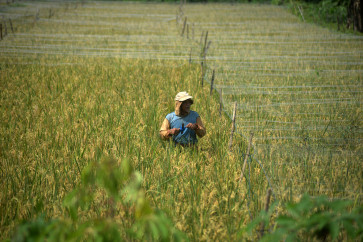
Farmer Masril Koto is the epitome of the human spirit of keeping on learning despite the odds being against him.
Masril, a small man with a friendly smile that never leaves his face, did not graduate from elementary school. He only managed to get an education up to fourth grade. Despite this, he is now viewed as a pioneer in the establishment of farmers' banks accross the archipelago.
Masril's vision of the bank dates back to 2005, when he often participated in meetings and discussions with other farmers in his hometown of Agam, West Sumatra.
'During the discussions, the farmers all felt the same about financial support from banks. We all saw that it was almost impossible to look for financing from banks because they would only provide it to people who had land ownership certificates as collateral. As farmers, we do not have that kind of certificate and that is why we often can not look for financing from banks to expand our farms and production,' Masril told The Jakarta Post.
'So, I began to think of developing banks that were specifically established to provide financing for farmers. A couple of friends believed in my idea and we began our quest to develop the farmers' bank.'
Neither Masril nor his friends knew about banks or their business models but this did not discourage them. They visited banks in West Sumatra, looking for help from the bankers.
Most of the banks ignored Masril and his four friends and they were told to return to their villages, however, a few were willing to at least point them in the right direction by providing information regarding legal requirements and documents that a bank had to have.
The five farmers were then referred to a banking seminar in Padang. With only Rp 600,000 (US$60) in their pockets, they travelled more than 100 kilometers to attend the 15-day seminar.
During that seminar they learned that they needed to garner capital of at least Rp 1 billion to start a bank. This figure surprised Masril and his friends but a Bank Indonesia (BI) official, who spoke in the seminar, told them that they could issue shares to accumulate the needed capital and thus, upon returning to their villages, they started issuing shares at a price of Rp 100,000 per share to other farmers.
'In the early stages, we managed to collect Rp 15 million of capital. We did not know anything about accounting but several young men in our villages knew so we asked for their help,' Masril said.
Masril added that BI also sent several trainers to train and to educate the farmers regarding accounting and banking administration.
Over time, they finally managed to garner enough funds to start a farmers' bank and Masril was also introduced to University of Indonesia (UI) economist Faisal Basri via a friend.
'Faisal suggested we start using computers for our administration. He donated several computer units to us. Being farmers, most of us did not know about operating computers but then again, the young men in our village were able to help us and they later taught us how to use computers as well,' Masril said.
The bank that Masril developed in his village provides multiple forms of financing for farmers, including for pregnancy assistance.
In spite of the success of the first farmers' bank, tensions began to arise among the elders in the village regarding the management of the bank.
'I decided to end my involvement in that bank and I started traveling from one village to another to teach farmers how to build their first bank. Despite the friction, I had gathered enough knowledge about starting a bank for farmers and that was what I wanted to share with my fellow farmers elsewhere,' Masril said.
Masril's activities teaching farmers in other villages did not go down well with his wife and his in-laws at first.
'They suspected that I had another wife elsewhere because I rarely went home and I kept spending money on traveling. I understand their concern. I know that back then people might see me as a man with no real work and without real purpose but that was okay because most of them had not yet seen my vision,' he said.
After several years traveling West Sumatra, the journeys of Masril, currently 40 years old, began to show results. As of now, there are at least 580 farmers' banks in West Sumatra with over 200,000 saving accounts and 50,000 shareholders. In total, those banks have assets worth Rp 250 billion.
Farmers' banks have now begun to develop in Makassar, South Sulawesi and in Central Java and all of them are developed based on Masril's teachings and concepts.
For the future, Masril says that he will continue teaching other farmers.
'I have a dream of consolidating all farmers' banks in the country to become a massive financial consortium that can purchase airplanes to transport our farm products,' he said.
Sofyan Tan: Teaching anti-racism

Back in August 1987, a young doctor in Medan, North Sumatra, set out to make his dreams and visions a reality ' a move which many, at that time, considered to be crazy.
The Chinese-Indonesian doctor, Sofyan Tan, was married to his wife Elinar for only two years and their first daughter had been born only a few months before. He had no medical practice and was only working as a freelance biology teacher.
Yet, in that year, he decided to open his own school ' an embodiment of his dream to reduce racist sentiments in Medan.
'Nobody believed in my dreams at that time. Almost everybody told me it was impossible to get Indonesian people of Chinese descent and other ethnic groups to live in harmony,' he said.
Sofyan's own experiences were what molded his dream of eradicating racism.
When Sofyan was only seven years old, he witnessed first hand the brutality of racism. He witnessed the properties belonging to people of Chinese descent in Medan being burned to the ground by anti-communists in 1966.
'Yet, for some reason, my house was not burned,' says Sofyan.
Sofyan found out the reason why when his father died in 1980. At that time a lot of people of various races, tribes and religions came to pay respect.
'That was when I knew why my family was safe. The people in my neighborhood told the anti-communists that my family was one of 'their own people'. They protected my family,' he said.
Although Sofyan's family had good relationships with their neighbours, the situation was a lot different in Medan society as a whole.
He needed to repeat his final doctorate exams five times due to his ethnicity.
'The professor who examined me always asked if I was Chinese. And he never let me pass,' Sofyan said. 'When I took the exam for the fifth time, I demanded fair treatment and to be tested in front of the dean. Only then I could become a doctor.'
The experience, he said, taught him that even a medical professor can be racist.
'So, I believe that educating young children not to become racists is the key to eradicating racism. That was when I decided to build a school that would focus on multi-culturalism.'
Creating a school was certainly not an easy task for a young doctor with no business background or financial power. 'I was born into a poor family. When my father died, I funded my college tuition by working part-time as a teacher,' Sofyan said.
After the school was finally established, Sofyan continued to face one challenge after another.
On the business side, the school faced severe cashflow issues. Sofyan's school, which he named the Sultan Iskandar Muda Educational Foundation (YPSIM), also had a mission to let poor children enroll without having to pay tuition fees.
'I kept the school floating by using my own savings, borrowings and donations from people,' he said.
From a personal side, Sofyan also faced challenges from his wife's family. His in-laws considered him a 'traitor' because he spent most of his time educating local children and because he let his degree go to waste by not opening a practice that could support his household financially.
In the school, children are taught to respect each other and to interact regardless of their social status, race, ethnicity or religion. Students are also introduced to democracy when making decisions about their school.
Sofyan also developed a cross-foster-parenting concept to help the financing of the poor children in his school.
'Foster parents from an ethnic Chinese background must finance only children of indigenous ethnicities and vice versa. This way, society learns that racism is meaningless,' he said.
Sofyan's perseverence began to receive recognition in 1989, when he won the Ashoka Innovator for the Public Award from the US for his work in bridging multiple ethnicities through his school.
This year's Maarif Award acknowledges the role of YPSIM as a beacon of pluralism in the country.
Currently, some 14,000 students, mostly from poor families, have graduated from the school.
Now 55, Sofyan, who was recently elected as a legislative member from the Indonesian Democratic Party of Struggle (PDI-P) for the 2014-2019 period, hopes the story of his life and his school will inspire others to teach pluralism, not just as jargon but also in practice.
'We must learn that differences in ethnicity, race and religion must not segregate us. These differences are assets.'