The Jakarta Post
Please Update your browser
Your browser is out of date, and may not be compatible with our website. A list of the most popular web browsers can be found below.
Just click on the icons to get to the download page.


Popular Reads
Top Results
No results found. Please check your search term and try again
Can't find what you're looking for?
View all search results
Popular Reads
Top Results
No results found. Please check your search term and try again
Can't find what you're looking for?
View all search resultsForecast for strong El Nino fans worries about global crops as Iran war bites
"The last time we saw similar signals was during the severe 2015 to 2016 El Nino," a meteorologist has said.
Change text size
Gift Premium Articles
to Anyone
Share the best of The Jakarta Post with friends, family, or colleagues. As a subscriber, you can gift 3 to 5 articles each month that anyone can read—no subscription needed!
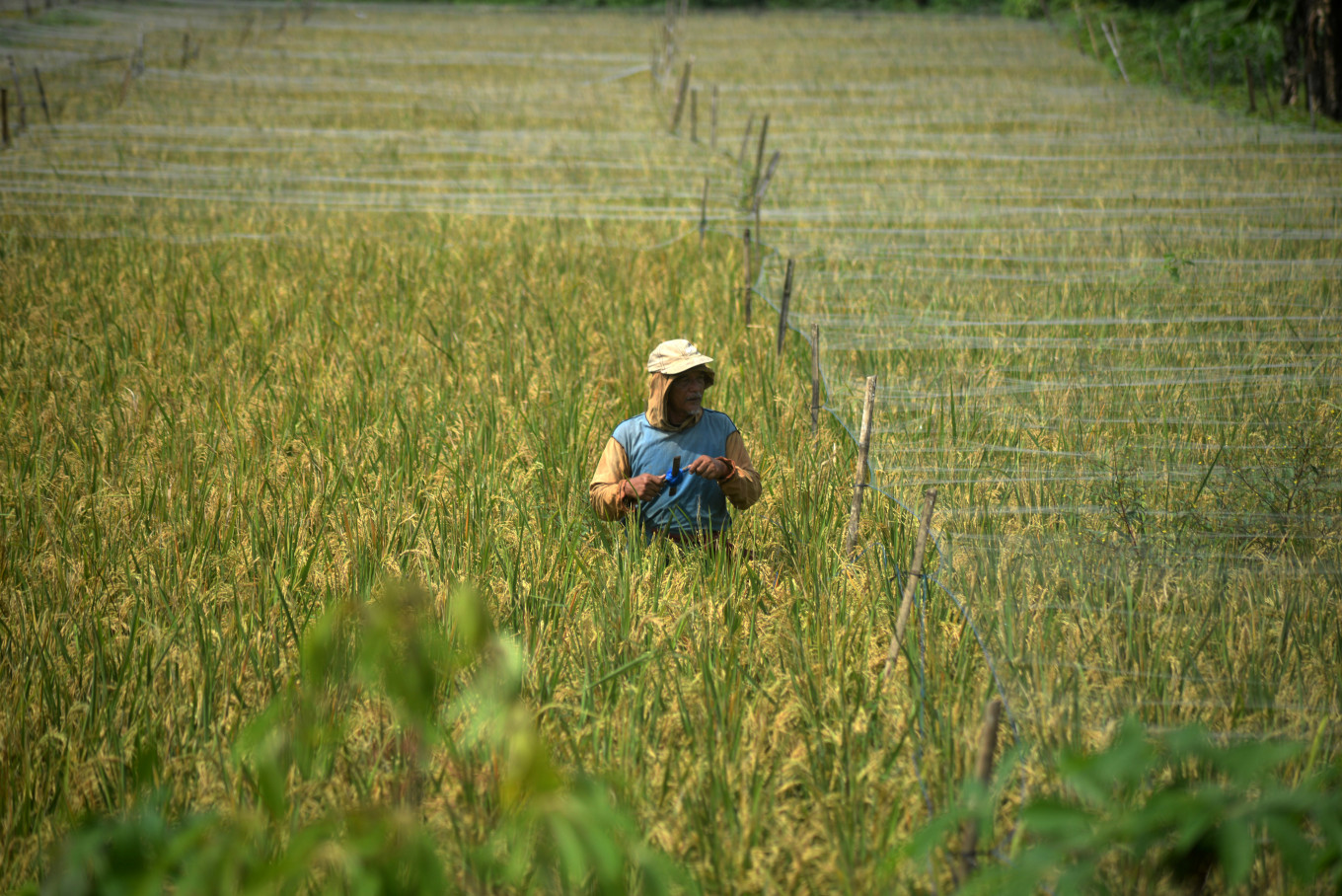 Clever trick: A farmer rolls up rope while installing netting over a rice field on March 25, 2026, in Banyudono, Boyolali, Central Java. According to the farmer, installing the netting costs Rp 720,000 (US$42.68), to protect the rice crop from bird pests. (Antara/Aloysius Jarot Nugroho)
F
orecasts for the strongest El Niño in a decade promise hotter, drier weather across Asia in the second half of 2026, hitting crops and food supplies while farmers grapple with fertiliser shortages and costly fuel caused by the Iran war.
Japan's weather bureau sees a 70 percent chance of El Niño emerging in the northern hemisphere summer, while China's climate officials fear it could persist until year-end and India expects below-average monsoon rains for the first time in three years.
"We are already seeing heat and dryness in parts of Australia and India," said Chris Hyde, a meteorologist at weather intelligence firm Meteomatics based in Switzerland.
"The last time we saw similar signals was during the severe 2015 to 2016 El Niño," he said, adding that the two countries, along with Southeast Asia were the among the regions most susceptible to an El Niño and likely to show the earliest signs.
El Niño is a periodic warming of sea surface temperatures in the central and eastern Pacific Ocean. One of the strongest such patterns occurred in 2015 and 2016, triggering widespread drought in Asia, cutting grain and oilseed output.
Typically linked to heavier rains in North and South America, the phenomenon could also disrupt the United States autumn harvest, meteorologists and analysts said.

Adding to the weather woes this year are disruption in supplies of fertiliser, as the Iran war chokes traffic through the Strait of Hormuz, a route for about 30 percent of world trade in urea.
Early dryness
Farmers in parts of Australia's states of New South Wales and Queensland have already been forced to scale back planting of wheat and canola, following months of low rainfall that have led to shortages of moisture, fertilizer and fuel.
"Our season has completely collapsed," said Pat Ryan, who grows crops and keeps cattle near Merriwa in New South Wales. "We haven't had any decent rain for three of four months now."
Forecasts show more dryness over the next few months in Australia, the world's fourth largest exporter of wheat and the No. 2 supplier of canola.
Dry weather in Southeast Asia also threatens production of palm oil and rice.
"The main impact on palm oil is felt six to 15 months later, due to the crop cycle," said M.R. Chandran, an industry official in Kuala Lumpur, the capital of Malaysia, which is one of the world's largest producers, along with neighboring Indonesia.
"A mild episode may cause only limited disruption, but a stronger and longer El Niño event could lead to 5 percent to 12 percent production declines."
In India, monsoon rains from June to September that are below normal levels could curb yields of summer crops such as rice, cotton and soybeans, while also reducing soil moisture for winter crops like wheat and rapeseed.
"The whole season is going to be below normal," Hyde added. "There is a potential for severe drought in India, particularly towards August and September."
This year's monsoon is likely to bring rain that is just 70 percent to 90 percent of the average, Hyde said, slightly less than New Delhi's forecast of 92 percent of the long-term average.
Abnormal weather could also be in store for China, the world's biggest importer of farm products and one of its biggest producers, although it tends to experience less intense impacts of an El Niño.
"A stronger El Niño does increase flooding risk in southern China, so this could hurt rice and vegetable production in those regions," said Darin Friedrichs, co-founder of Sitonia Consulting.
Risks in Europe and US
An El Niño could also dump more rain on Europe and the US, especially during the US corn and soybean harvest.
While heavier rains in the Americas can offset some of the agricultural losses in Asia, excessive rainfall and floods can disrupt harvests and degrade the quality of grains and oilseeds.
"In Europe, if we have a lot of rain this summer, it could be favourable for corn, and vice versa," said Benoit Fayaud, a senior grain analyst with commodity data group Expana based in France. "Then, for European wheat, when El Niño is expected to arrive, harvests should have already begun in Europe."
Also worrying farmers is the spectre of fertiliser made scarce as output and supplies of petrochemicals take a knock from the Middle East conflict.
"If fertilizer costs remain high, low rainfall will encourage farmers not to use it," said Vitor Pistoia at Rabobank in Australia. "Why spread expensive fertiliser on a crop that is going to be poor anyway? That could be a vicious cycle that compounds yield loss."