TheJakartaPost
Please Update your browser
Your browser is out of date, and may not be compatible with our website. A list of the most popular web browsers can be found below.
Just click on the icons to get to the download page.


Popular Reads
Top Results
No results found. Please check your search term and try again
Can't find what you're looking for?
View all search results
Popular Reads
Top Results
No results found. Please check your search term and try again
Can't find what you're looking for?
View all search resultsSeeing global change without the Western lens
Simultaneous disruptions offer a once-in-a-generation opportunity for the deep transformation of global institutions and ideas.
Change text size
Gift Premium Articles
to Anyone
Share the best of The Jakarta Post with friends, family, or colleagues. As a subscriber, you can gift 3 to 5 articles each month that anyone can read—no subscription needed!
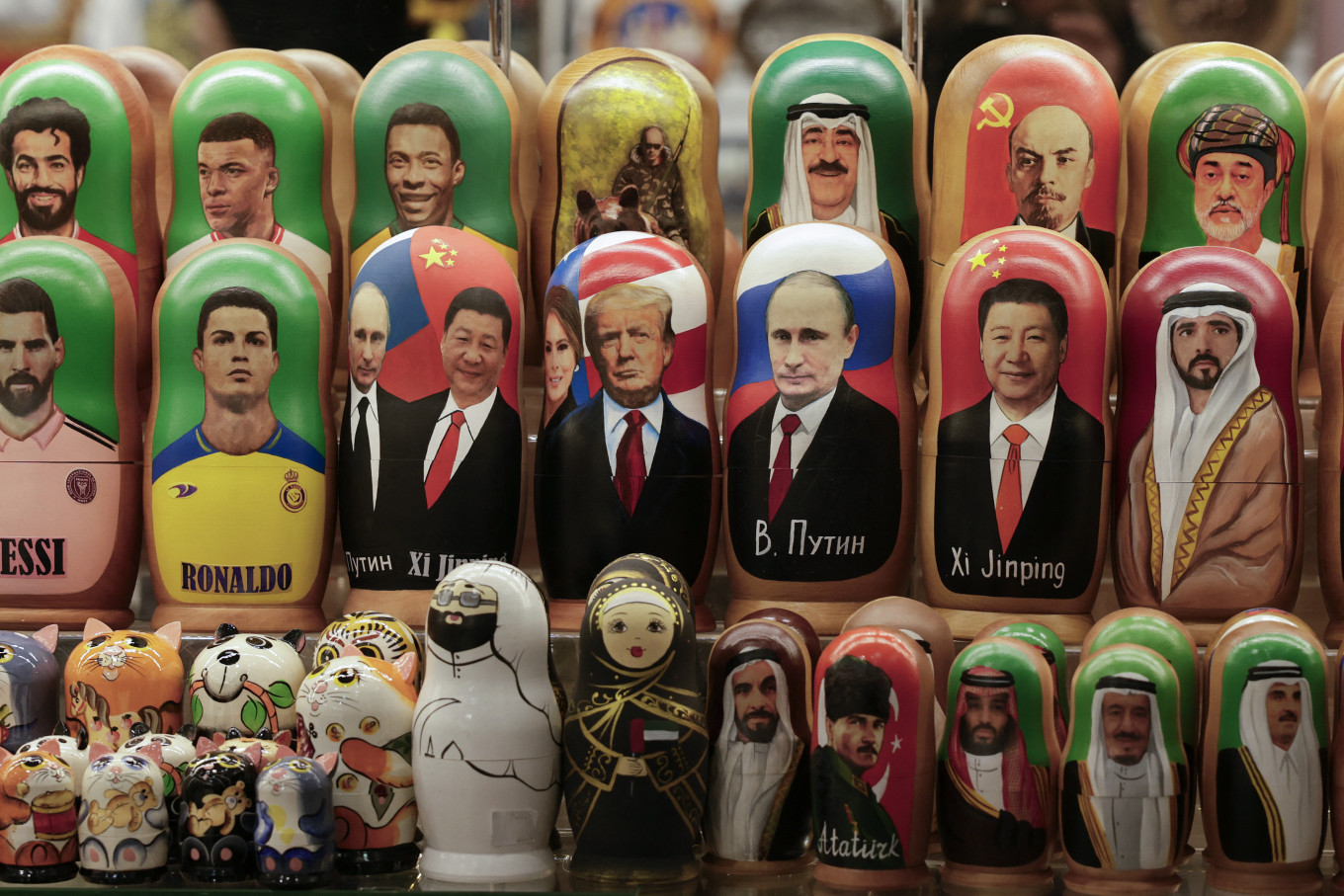 Traditional Russian wooden nesting dolls, Matryoshka dolls, depicting world leaders and celebrities are displayed for sale on Feb. 13 at a gift shop on tourist-oriented Arbat street in downtown Moscow. (AFP/Tatyana Makeyeva)
C
onflicts, trade wars, inequality and democratic decay fill today’s headlines. Each crisis appears to be feeding the next, and it can feel as though the world is coming apart. Western leaders and thinkers have embraced a single word to capture this entanglement of threats: “polycrisis.”
Adam Tooze, a historian at Columbia University in the United States who helped popularize the term, summarized its appeal in 2023: “Here is your fear, here is something that fundamentally distresses you. This is what it might be called.” But when fear becomes the central theme, the result can only be angst and paralysis, as Mark Leonard observed after the 2024 World Economic Forum in Davos.
Crises, however, are not necessarily followed by collapse. In fact, disruption has often paved the way for renewal, but only for those who were willing to let go of the old order.
With that in mind, I see the same moment through a different lens, as polytunity, a term I coined in a November 2024 Project Syndicate commentary and then later elaborated at the United Nations Development Program. The idea is simple: Simultaneous disruptions offer a once-in-a-generation opportunity for the deep transformation of global institutions and ideas. When everything seems to crumble at once, we are forced to go beyond patchwork solutions and redesign systems from the ground up.
For starters, we should recognize that the polycrisis is a Western-centric narrative masquerading as global. Two European theorists coined the word in 1993, while another European expert popularized it recently. A Western-based summit of elites gave the term a prominent platform, prompting its viral amplification by Western media, think tanks and academics.
Despite constant lamentations about a “ghastly future,” the conversation on polycrisis rarely, if ever, acknowledges the agency of the non-Western world, nowadays euphemistically called the “Global South”, or the solutions it has offered. Even as some theorists call for “Renewed Humanism,” they fail to confront the reality of a structurally unequal order and growing frustrations with it. Western dominance of international finance and institutions persists, while non-Western ideas and voices remain marginalized in supposedly global canons.

The establishment favors the language of polycrisis because it obscures the root causes of global breakdowns, making them appear like natural disasters. In reality, today’s overlapping crises can be traced back to the industrial-colonial paradigm that has prevailed since the Industrial Revolution, a worldview that defined progress as control: mechanical control over nature, and Western control over the rest of the world.